Explore ideas, evidence and developments across the textile value chain.
23,367 articles · latest first · 22,345–22,368
The Mohair Summit discussed several pilot projects to encourage employment in the Eastern Cape and establish more black mohair farmers as a means of keeping South Africa's mohair industry viable.
Nan Liu Enterprise was listed on the Taiwan Stock Exchange in May this year and has expanded its capacity to respond to growing demand in the hygiene and medical markets.
 News7 Nov 2013
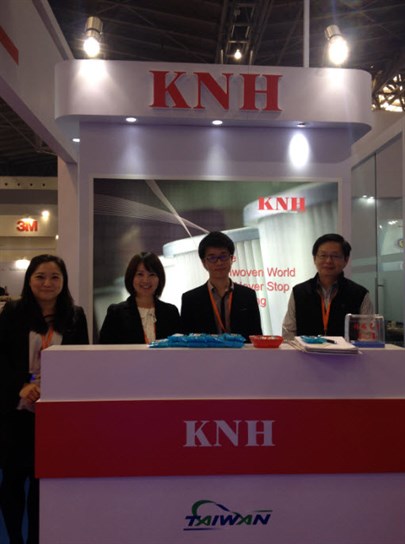
Kang Na Hsuing Enterprise (KNH) is a Taiwan-based nonwoven producer with four factories in Taiwan, one in Shanghai and one in Chengdu, China, which was established last year. The company produces nonwovens using a range of technologies, “basically everything except spunbond,” said assistant vice president Kevin Chen, for hygiene, personal care, industrial filtration, wastewater treatment and medical applications.
Mogul Nonwovens is starting production a of new core/sheath type bicomponent PET/COPET spunbond line, targeting mainly industrial applications.
 News7 Nov 2013
“Bolstering long-term competitiveness of the fashion and high-end industries is important for the overall economic recovery in Europe and this is why this sector has been very high on the agenda,” according to European Commission vice-president Antonio Tajani, commissioner for Industry and Entrepreneurship.
 News7 Nov 2013
According to the US Department of Commerce, US textiles and apparel imports were marginally higher in August compared with a month earlier. However, for a second consecutive month, imports were significant higher than the August total during the past couple of years. That strong pace of shipments during the summer months has boosted the cumulative total for the first eight months of the year, which now stands at 37.534 billion square metre equivalents (SME), 3.79% above the corresponding level in 2012.
 Insight7 Nov 2013
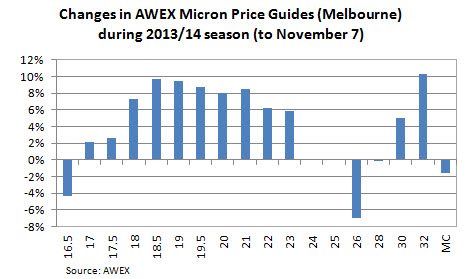
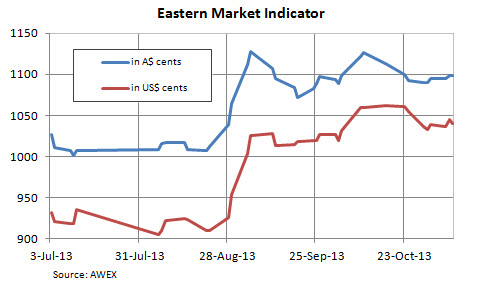
Chinese buyers have not been covering as actively as earlier in the season during the past couple of weeks. However, take-up has been sufficient to underpin auction values at close to unchanged. The scope for significant rises seems limited, as does the potential for a substantial decline. The Australian Wool Exchange’s (AWEX) Eastern Market Indicator (EMI) by 7% between July and the end of October. However, the bulk of that increase was achieved in late August, since when it has fluctuated somewhat uncertainly either side of 1,100 Australian cents per kilo, clean.
 News7 Nov 2013
Although export business is far from vibrant at present, and buying interest from China has typically only been stimulated by the most competitive offers during the past week, sufficient trading has taken place to keep both offers into China and replacement costs at auction about unchanged. Quotations for Type 55 into China were circulating today at around US$11.60/11.70 per kilo, clean, CIF (90 days Letter of Credit), compared with a replacement cost equivalent of roughly US$11.70/11.75 per kilo. Business was arranged earlier in the week at around US$11.60/11.65 per kilo, but some traders reported enquiry at much lower levels. Chinese merchants are reported to have been quoting out of domestic stocks at well below the levels mentioned above.
Prices at this week’s sale rebounded from losses made at the previous two auctions, as demand from China improved. A weaker rand and strong buying interest for the better qualities on offer were also supportive factors. The increase in prices was all the more impressive when one takes into account that the sales catalogue was larger than of late, at 12,928 bales. The clearance rate was 98%. The Cape Wools Merino Indicator rose by 3.6%, to R114.43 per kilo, clean. The rand, at R10.17 against the US dollar, was 3.4% weaker than the average rate a week earlier.
 Insight7 Nov 2013
The troubled Bangladesh garment industry remains unsettled, with local press reports indicating that the Bangladesh Knitwear Manufacturers and Exporters Association (BKMEA) and Bangladesh Garment Manufacturers and Exporters Association (BGMEA) are threatening a factory shutdown in two weeks if the government fails to revise down its recent minimum wage recommendation of Tk 5,300 ($67)/month.
 News7 Nov 2013
Another small offering attracted a modest buying interest, but one which was sufficient to help prices rule close to unchanged. The primary reason for the strength of prices during the past couple of months appears to have been the lower supply available to the market. The cumulative volume of wool offered during the four-month period under review was 145,718 bales, down from 181,236 bales by the same stage in 2012/13.
 News7 Nov 2013
The International Trade Committee of the European Parliament has decided to support the EU Commission proposal for a Unique Delegated Act including 10 country applications for GSP+. The countries are: Pakistan, Georgia, Paraguay, Peru, Mongolia, Ecuador, Cape Verde, Costa Rica, Bolivia and Armenia.
 News6 Nov 2013
Toray Industries has signed an agreement to purchase a 56.2% stake of Woongjin Chemical Company. In a deal valued at KRW430 billion ($405 million), Toray revealed on the Tokyo Stock Exchange that its Seoul-based unit Toray Advanced Materials Korea Inc will purchase the stake of the synthetic fibre and water-treatment filter maker.
 News6 Nov 2013
A Federal Patent Court of Germany has invalidated substantial parts of a patent held by Durst Phototechnik Digital Technology GmbH related to white ink printing that Durst had previously asserted in an infringement action against EFI.
 News6 Nov 2013
Import offers of many types of man-made fibre and filament yarn into Turkey have tended to ease back from the slightly higher levels quoted last week. Prices had been raised to reflect the higher container rates quoted for November shipments by the major shipping lines. However, due to sluggish demand at the higher box rates, those increases have not stuck and asking prices for fibre and filament yarn have been discounted accordingly. Moreover, demand from mills has remained sluggish throughout the past couple of weeks.
 News6 Nov 2013
Stockport UK-based schoolwear supplier Rowlinson Knitwear has implemented a new foreign exchange strategy to help protect the firm from currency volatility risk. Working with HSBC’s Manchester Commercial Centre, Rowlinson has ensured approximately 90% of its US dollar requirement is hedged on a 12 month rolling basis, whilst at least three quarters of its currency need is hedged on a two-year outlook.
Reports from Indonesia indicate that offers of polyester staple fibre (PSF) have continued to be revised downward during the past month. Prices quoted by domestic manufacturers for 1.4 denier, 38mm, have been reduced from around US$1.55/1.58 per kilo, to closer to US$1.53/1.55 per kilo this week. Import quotations have declined from US$1.48/1.50 per kilo, to roughly US$1.42/1.43 per kilo.