Explore ideas, evidence and developments across the textile value chain.
23,367 articles · latest first · 22,057–22,080
A workshop focused on ‘Sustainability in the value chain of nonwovens and technical textiles’ has delivered on its commitment of support the Latin American nonwovens sector.
 News29 Nov 2013
By using a continuous fibre-reinforced structural inlay based on Fortron polyphenylene sulfide (PPS) from Celanese Corporation, a pilot project run by the Faserinstitut Bremen e.V. (FIBRE) has developed a cost-effective and efficient process to manufacture lightweight aerospace components.
 News29 Nov 2013
Chinese textile producer Texhong is awaiting the final authorisation from Uruguay’s National Environmental Management agency (DINAMA) to begin constructing a $250 million factory, for the production of polyester fibres and viscose to be used as feedstocks for the manufacturing of clothing.
Invista, the owner of the Lycra fibre, and Lenzing, which produces man-made cellulosics like rayon, modal and lyocell, have joined forces to develop cellulosic denim fabrics with improved shape retention. The two companies are now offering a solution utilising Invista’s patented Lycra DualFX fabric technology combined with Lenzing’s Tencel fibre.
Reports emerging from various sectors of China’s textile industry in recent weeks have increasingly referred to a lack of cash flow as being a major concern for manufacturers and traders alike.
 News28 Nov 2013
After the successful installation of many of its ColorWash XL washing machines to accompany its digital textile printers, Hollanders has now incorporated a series of upgrade refinements designed to increase sustainability and throughput and reduce noise levels.
 Insight28 Nov 2013
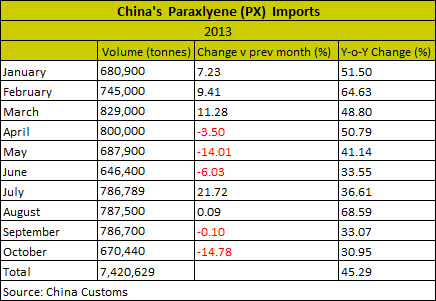
During the past decade, China has relied heavily on imported paraxlyene (PX) to feed aggressive expansion in local purified terephthalic acid (PTA) output. PX producers in Japan and South Korea, the two major suppliers to China, have benefited hugely from that growth.
 Profile28 Nov 2013
Growing demand for high-quality textiles in China has led one yarn manufacturer, Zhejiang Huafu Melange Yarn Co., Ltd (Zhejiang Huafu), to diversify its product base and focus on delivering the most efficient and sustainable production processes.
 News28 Nov 2013
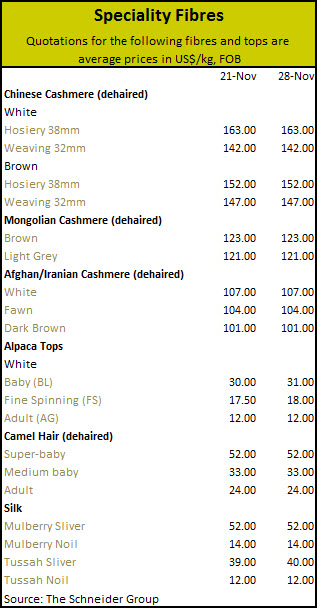
Good quality Kibiso (the raw silk used to produce mulberry tops and yarns) has remained in very limited supply during the past week, according to The Schneider Group. Similarly, the availability of Tussah silk, also known as "wild silk", has also been restricted. Prices for this last mentioned product have strengthened, reflecting the supply situation.
 News28 Nov 2013
Yarn prices in Pakistan have again been revised lower during the past week. The recent downturn in prices - between 6 to 12% since the beginning of September, with the biggest falls in the coarser counts - has created some difficulties for spinners. An increasing number have reported ongoing re-negotiations with buyers on existing contracts, delays in payments and a slow pace of deliveries. Moreover, the pace of fresh business has remained sluggish in recent days, with slower demand from China still the main factor undermining the market. However, strong competition from India has again been mentioned, both in terms of price and quality. Unsold stocks of yarn are thought to be building.
 News28 Nov 2013
The SGL Group has signed a cooperation agreement to develop and market high-performance carbon fibre yarns with Gruschwitz Textilwerke AG, a leading supplier of high-performance yarns, which concentrates on marketing speciality yarns, twisted industrial yarns and sewing threads in the automotive, healthcare, and other industries.
Auction prices have now moved to the top of their recent trading range. While export demand has been steady, it has principally been currency factors that have driven prices higher of late. We do not foresee any significant quickening in demand from China, but the size of the offerings for the final two weeks before the winter recess are forecast to be 47,726 and 48,493 bales, still below year-earlier levels. With supply and demand perhaps remaining about in balance, the main influence on prices could continue to be currency, which could depreciate further if the central bank does intervene. A steady to slightly firmer market may therefore be foreseeable in the short term.
 News28 Nov 2013
A group of European companies are attempting to develop, as part of an EU-funded project, innovative biocomposite building materials which help to reduce the current emissions challenges faced by the construction industry.
 News28 Nov 2013
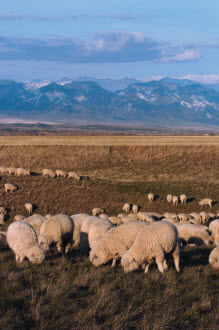
One of the key factors for exporters this week was again fluctuations in the Australian dollar versus its US counterpart. Recent comments by Reserve Bank of Australia officials have raised the possibility that the central bank could intervene in foreign exchange markets to drive the value of the Australian dollar down. With the exchange moving close to 91.00 Australian cents = US$1.00, exporters were this week able to maintain their offering rates for Type 55 (21 micron) at around US$11.60/11.70 per kilo, clean, CIF (90 days Letter of credit), despite a rise in replacement costs. Chinese buying was again steady, with some enquiry also forthcoming from Italy and India.