Explore ideas, evidence and developments across the textile value chain.
23,367 articles · latest first · 21,385–21,408
 News3 Feb 2014
Grasim Industries Limited, an Aditya Birla Group company, has revealed that its revenue during the quarter ended December 31, 2013, grew by 5% to Rs. 7120 crore ($1.13 billion), up from the Rs. 6779 crore ($1.08 billion) in the corresponding period of 2012.
 News3 Feb 2014
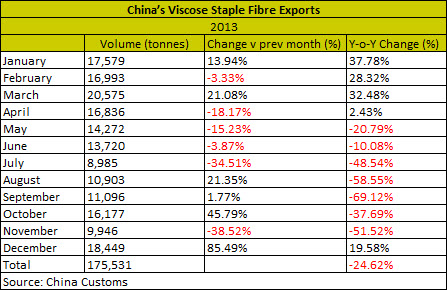
According to China Customs, viscose staple fibre (VSF) exports rebounded strongly in December from a low the previous month. However, cumulative exports during the whole of 2013, at 175,531 tonnes, were down by no less than 24.62% from a year earlier. This compares with growth in VSF exports during 2012 and 2011 of 43.18% and 63.45%, respectively.

Indorama Ventures Public (IVL) and Toyobo have signed a sale and purchase agreement with the intention to acquire the shares of PHP Fibers GmbH, Germany, and all subsidiaries controlled by the company.
 News3 Feb 2014
Century Enka Ltd, an Indian manufacturer of synthetic filament yarn, fibres and fabrics, has informed the Bombay Stock Exchange that its Continuous Polymerisation Unit - Polyester (CPU-Polyester) at its Bharuch Site, which was stopped on November 12, 2013, for preventive maintenance, will remain closed for an extended period.
 News31 Jan 2014
Eastman Chemical Company saw its sales revenue for the fourth quarter of 2013 increase by 4% to $2.3 billion, compared to $2.2 billion in the same period the year before, buoyed by a growth in the firm’s fibre, advanced materials and additives & functional products, segments.
 Insight31 Jan 2014
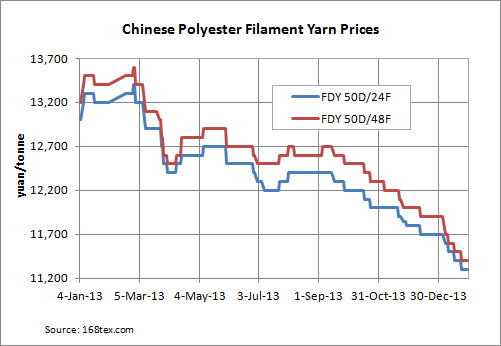
China’s polyester filament yarn market displayed a weak appearance during much of 2013. During the course of last year, quotations for FDY 50D/24F and FDY 50D/48F, two high volume types of filament in Shengze, eastern China, a major polyester textile production and trading hub, decreased by 10% and 6%, respectively.
 Insight31 Jan 2014
Improving the supply chain of textiles and encouraging practices which produce less environmental impacts, such as the recycling of effluent water, are areas where the industry can make substantial inroads, a new report has suggested.
 Insight31 Jan 2014
This week provided confirmation of the strong buying support underlying the New York futures market just a couple of cents below its current levels. The large volume of ‘on call’ purchases by mills for which prices still need to be 'fixed' against New York futures continues to provide buying support. A mill ‘fixation’ order involves the buying back of a ‘short’ position in New York, which decides how much a mill will pay for a bale of cotton. Being ‘short’ New York futures ahead of a huge inverse between the old and new crop months is becoming an increasingly uncomfortable position to be in. Any ‘short’ holder carrying that position beyond July could incur substantial losses. As a consequence, the timeframe left for mills to ‘fix’ is narrowing.
News31 Jan 2014New York cotton futures collapsed at the beginning of this week, dropping by close to the daily limit of 3 cents per lb in the front months. The sell off involved mainly speculators liquidating ‘long’ position on technical signals and may be viewed in the wider context of a switch among the investment community to a more risk averse stance, amid concern over the impact on emerging economies of the US Federal Reserve’s tapering of its bond buying programme. Financial markets in general have been hit by capital flight out of emerging markets.