Explore ideas, evidence and developments across the textile value chain.
23,367 articles · latest first · 20,737–20,760
 News10 Apr 2014
Manufacturers of nonwovens, dyes and pigments, as well as companies active in the preparation and spinning of textile fibres, may see their electricity bills drop through new national-government subsidy rules announced yesterday by the European Commission.
Herrmann Ultraschall and C4S have developed a new ultrasonic process that allows optimised particle fixation in an embedded layer for super absorbent structures which eliminates the need for fluff, glue and curly fibres. The process also means the patterned SAP feeding system is no longer required.
Manufacturing employment in North Carolina, USA, has hardly changed over the past year, reports the 2014 North Carolina Manufacturers Register, a database and directory. According to data collected in 2013, North Carolina added 824 jobs over the past year – far fewer than the 7,000 jobs the state added in 2012.
 News10 Apr 2014
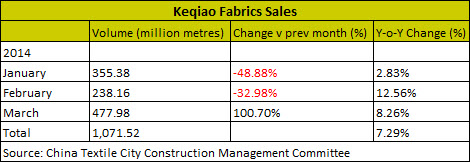
Fabric trading volumes during March in China’s Keqiao Textile City (a huge production and trading hub in Zhejiang province) amounted to 477.98 million metres, more than double the total in February (when sales were affected by the long Spring Festival break).
It doesn’t seem that long since ITMA Asia + CITME 2012 was taking place but here we are again, two years on, with ITMA Asia + CITME 2014 only two months away. The knit industry in China has changed somewhat in that time. Labour costs have risen significantly making labour-intensive post production processes less economical in China. These are tending to be off-shored to cheaper destinations such as Vietnam, Cambodia and Bangladesh.
Sustainability is becoming increasingly important in textile activities including spinning. Retech, which develops and produces components and installations for processing of synthetic filaments mainly in the mechanical and thermal treatment field, says it uses only materials which can be recycled and are based on environmentally responsible solutions.
Albaad, a producer of nonwovens and nonwoven products, has independently developed a confidential piece of technology for flushable fabrics. The company said that its technology has advantages over existing technologies, both product-wise and operational-wise.
 News9 Apr 2014
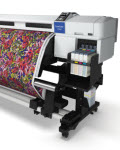
Global print and imaging giant Epson has launched a new 64-inch digital dye sublimation transfer printer. Epson said that the SureColor SC-F7100 is intended to build on the success of the SC-F7000, with the company responding to customer demand for a textile printer engineered for short to medium print runs.
 News9 Apr 2014
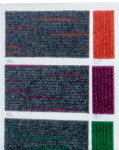
Heckmondwike FB, manufacturer of fibre-bonded carpets and tiles, recently introduced six new colourways which the company said will enhance the appeal of the popular Array range for more commercial projects. The colours include Copper, Marble, Peacock, Violet, Emerald and Fuchsia.
 News9 Apr 2014
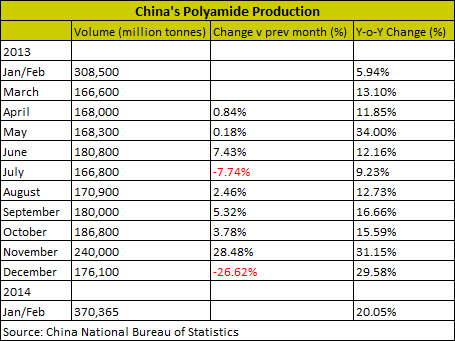
According to the China National Bureau of Statistics, polyamide production during the first two months of 2014 reached 370,365 tonnes, 20.05% higher than the same period of 2013, continuing the strong year-on-year growth witnessed during the preceding six months.
 News9 Apr 2014
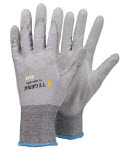
Ejendals, a company specialising in developing, manufacture and marketing of products that protect hands and feet, is now launching its latest glove, model 909, designed to be lightweight, offer a cool feel and provide level 3 cut resistance according to EN388.
The last three years have been a rollercoaster ride for the Indian textile industry, despite its size, product flexibility, raw material resources and government support under the concessional Technology Upgradation Fund (TUF) scheme. This was mainly due to the recession in demand from the major importing block, namely the US and the European Union, and the simultaneous decline in demand from domestic retail due to the slowing economy.
 News8 Apr 2014
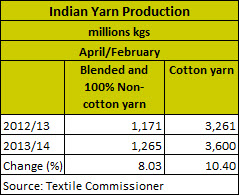
Yarn output between April 2013 and February 2014 (the first ten years of the fiscal year) continued to grow at an impressive pace compared with the corresponding 2012/13 level. Cotton yarn production rose by 10.4% to 3,600,000 tonnes, while blended and non-cotton yarn output increased by 8.0% to 1,265,000 tonnes.
 News8 Apr 2014
US textiles and apparel imports during February amounted to 4.36 billion square metre equivalents (SME), 14% lower than the previous month (a larger seasonal dip than that witnessed in recent years) and 4% lower than the year-earlier figure.