Explore ideas, evidence and developments across the textile value chain.
23,366 articles · latest first · 20,017–20,040
There are many reasons why knitting businesses across the world are deciding to reshore production. Responding to fast fashion retailer demands for fast turnaround, more favourable energy prices and a desire for more ethical production are among them.
The US Environmental Protection Agency has released a final risk assessment identifying health risks from trichloroethylene (TCE) exposures. These are hazardous to consumers using spray aerosol degreasers and spray fixatives, as well as those using degreasers in small commercial shops and as a stain removing agent in dry cleaning.
World Bank Group member, International Finance Corporation (IFC), is lending $28m to Sri Lankan apparel manufacturer, MAS Capital Private Ltd and its subsidiaries. The long-term loan will help MAS expand its portfolio and boost exports, as well as create jobs, predominantly for women.
HanesBrands, marketer of everyday basic apparel, intends to acquire DBApparel (DBA) of France from Sun Capital Partners, Inc. Consultations are underway with European and French works councils representing DBA employees to ensure customary closing conditions are met.
The Indonesian textiles industry is facing a crisis of competence that will worsen if vocational training continues to be neglected by the government and manufacturers, an industry training leader has warned. Johann Höpflinger, director of the International Garment Training Centre (IGTC), based in Citeurup, West Java, called on industry leaders to provide extra funding to address the skills shortage.
Jakob Müller exhibited two new machines for air jet label weaving and jacquard pattern weaving at ITMA ASIA + CITME last week. The MÜJET MBJL6 has a working width of 1200mm and constant production speed of 950rpm, resulting in a 20% increase in output. An optimised weft insertion system is particularly stable and gentle. Compressed air in the left and right relay nozzle sections is individually adjustable and another new feature is retention air that can be separately switched on and off in order to reduce air consumption.
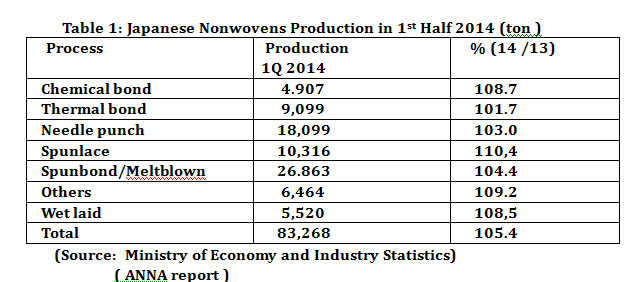
Suominen has reported that demand for nonwovens products supplied by its Nakkila plant in Finland remains than anticipated during the second half of the year, due to delays in commercialisation of new customer projects.
Baptist Health is the first health system to widely adopt specialised staff garments featuring Vestex textile technology, designed to repel fluids and minimise the transmission of organisms. From July 10, more than 30,000 pieces of staff uniforms, lab coats and scrub jackets will be distributed to its employees.
The UK Environment Agency (EA) has issued a new guidance document (LFE7) regarding construction quality assurance (CQA) of nonwoven protector geotextiles used in landfill engineering. The EA is encouraging the use of its cylinder test methodology, a performance test, to be used during the design rather than the CQA process.