Explore ideas, evidence and developments across the textile value chain.
23,365 articles · latest first · 17,665–17,688
 Insight28 Apr 2015
It’s been a chaotic six months for the SDC, beginning with an Extraordinary General Meeting in November 2014, where a vote of ‘no confidence’ in the Board of Trustees was passed, and more recently with the announcement that chemical giant DyStar is to phase out its use of the Colour Index. However, rather than treating these occurrences as setbacks for the Society, SDC is making changes which will ensure its development over the next year.
 Insight28 Apr 2015
Hearing the words ‘garment factory’ and ‘working conditions’ immediately takes the mind to East Asia, where the problem of cheap labour is widespread. Poor safety, low wages and long hours are some of the most common problems in certain factories, where many of the world’s biggest clothing brands source their labour.
 Insight28 Apr 2015
A specialist silk organisation is working to keep alive the traditional process of Cambodian ikat silk dyeing. It involves yarns being tied into segments and dyed separately – using all natural dyes – before hand-weaving these into patterned fabric. The process, said Seila Polham, the founder of Khmer Artisanry, is ‘complicated and time-consuming’ – but it is what sets this traditional segment of textiles in Cambodia apart from machine-produced chemical dyed silk widely available in the market.
 Insight27 Apr 2015
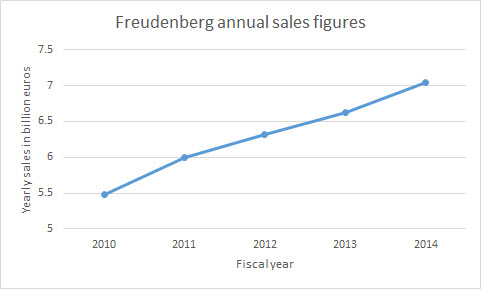
The Freudenberg Group has battled through what it called tough economic conditions, subdued markets and the unpredictable effects of bouncing exchange rates to grow in strength and surpass its own successes year after year. Since 2010, the company has seen a growth in sales from what was already a record-breaking achievement of €5.48bn that year to €5.992bn in the 2011 fiscal year, to €6.322bn in 2012 and to €6.6225bn in 2013. The company attributed a lot of its success over the years to commitment to growth markets and expansion in those areas, as well as an innovative portfolio of products.
 Insight27 Apr 2015
The growth of soft signage and its potential profitability is increasingly seeing businesses expand into the area with the introduction of their own digital textile printing equipment, or through the purchase of printers by well known brands.
 Insight27 Apr 2015
Following announcements from Bordeaux and Sensient back in March, J-Teck3 is the latest ink provider to publicise the launch of a new range of dye-sublimation inks at FESPA 2015, held in Cologne from 18-22 May, 2015, with its J-Lux series.
 Insight27 Apr 2015
The Philippines’ once formidable knitwear sector has been shrinking in size in the past two decades, but the Pacific archipelago’s inclusion in the European Union’s (EU) Generalised System of Preferences Plus (GSP+) preferential tariff scheme from January 1 is filling remaining manufacturers with some hope for another heyday.
 Insight27 Apr 2015
The global technical textiles market is set to grow at a consumer annual growth rate (CAGR) of 3.71% from now until 2019, according to a report by TechNavio. The main driver of this growth is high demand for technical nonwoven applications. While the growth of geotextiles was identified as a new market trend.
BioAmber Inc. has been chosen by Bayer MaterialScience as the supplier of bio-succinic acid used to produce a new range of bio-based polyurethanes for textile applications, IMPRANIL eco. The series of bio-based waterborne polyurethane dispersions with renewable content that reaches as high as 65%.
The fourth sale of the 2015 summer season was held in Port Elizabeth on April 21, with 159,397 kilos of mohair on offer. Although the auction took place under difficult trading conditions due to the fire at one of the top making facilities, the market held up well to shed only 1.6% off the average market indicator, closing on R188.28 per kilo.
 Insight24 Apr 2015
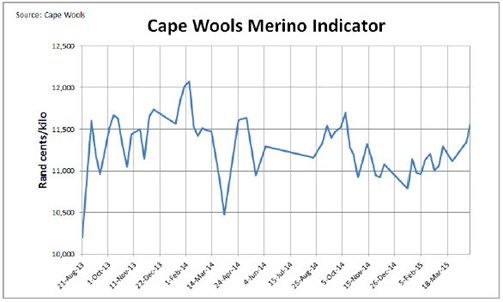
The wool market was dearer at the sale on April 22 and the Cape Wools Merino Indicator gained 1.9% to close at R115.55 per kilo clean. This is 3.5% up compared to the opening sale of this season and 6.3% up compared to the corresponding sale of the previous season.
 Insight24 Apr 2015
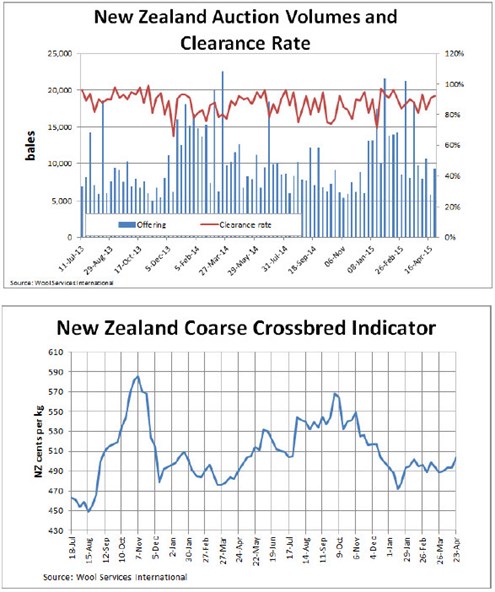
Lower than expected wool volumes at the sale on Thursday, April 23, put pressure on the South Island auction, generally lifting the market 2%. Of the 9,265 bales on offer, 92% sold. The weighted indicator for the main trading currencies leading up to the sale was 0.21% stronger compared to the last sale on April 16. Shipment pressure and a wider wool type selection this week added to the market strength.
 Insight24 Apr 2015
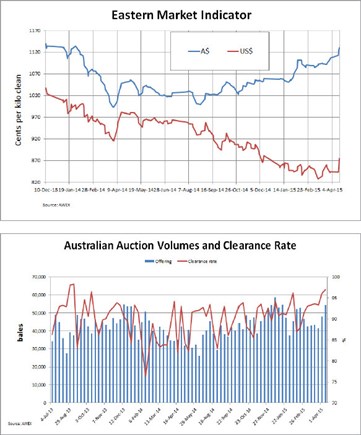
The Australian market skyrocketed to another season high at this week’s auctions. The Australian Wool Exchange (AWEX) Eastern Market Indicator (EMI) jumped by 23 cents to close at 1,153 cents per kilo clean on Thursday, April 23. In US dollars, the EMI also climbed by 18 US cents to close at 893 cents per kilo.