

WTiN reviews a patent published in 2019 where applicant Under Armour looks to develop a system or apparatus for picking up single sheets of material for further processing or manufacture in an apparel or textile production facility.
To view the patent in detail, you can use our new patent analysis tool WTiN Patents.
Automation has become vital in manufacturing, but textile & apparel manufacturing is somewhat behind the curve when it comes to automated and robotic technologies. With the industry’s small margins and labour-intensive work, it is important for the textile & apparel industry to invest in research and development (R&D) and fund new technologies for automation.
The Covid-19 pandemic has become a catalyst for digitalisation in manufacturing facilities: there is ongoing need for less workers within facilities and the capability for sites to run largely without workers due to social distancing conditions that limit the spread of the coronavirus, or any future similar threat. While the Under Armour patent [1] was filed long before the outbreak of the coronavirus, its importance has only become more relevant over time.
The patent is based on “picking a single sheet of fabric material from a surface or from a stack of fabric sheets, followed by transporting and placing the single picked sheet of fabric at a designated location in a production process” – this could be, for example, a process for forming apparel such as sewing or cutting, or for forming other textile materials. [1]
The patent notes that this task is “very difficult to automate due to the flexibility of the fabric and the ever-changing design of the pattern. This is further challenging when the sheet is very thin or has a very low basis weight, such as a single ply sheet of fabric” [1].
Robotically manoeuvring thin fabrics has long been a barrier to automation in the industry, and a number of OEMs have tried to solve this problem with their own technologies, whether through suction technology or grippers, for example.
However, the US patent states that while certain automated picking apparatuses are known for picking up a single sheet of fabric material, “conventionally, there is no known automated system that has demonstrated suitable flexibility and reliability necessary to eliminate the manual labour currently relied upon to pick a single ply sheet of fabric material from a stack of fabric sheets” [1].
Purpose
To develop an apparatus or system for picking up materials (eg fabric materials) and, in particular, an apparatus for picking up a sheet or panel of a fabric material from a substrate or from a stack of fabric sheets in a process for forming an article of apparel.
The purpose of the patent invention is also, in certain embodiments, a method of automatically picking a single material sheet from a support member such as “a stack of vertically aligned material sheets or directly from a support surface” [1].
Approach
Referring to Figure 4 as well as Figure 1 and 1A, the gripper technology depicted is moved into position over a stack of fabric sheets. The movement, according to the patent, includes movement in a number of linear and/or rotational dimensions that facilitate the alignments of the gripper over the fabric sheets. The controller on the system controls the movement of the gripper in any number of directions within the system “as necessary to appropriately align the gripper […] for performing a picking operation” [1].
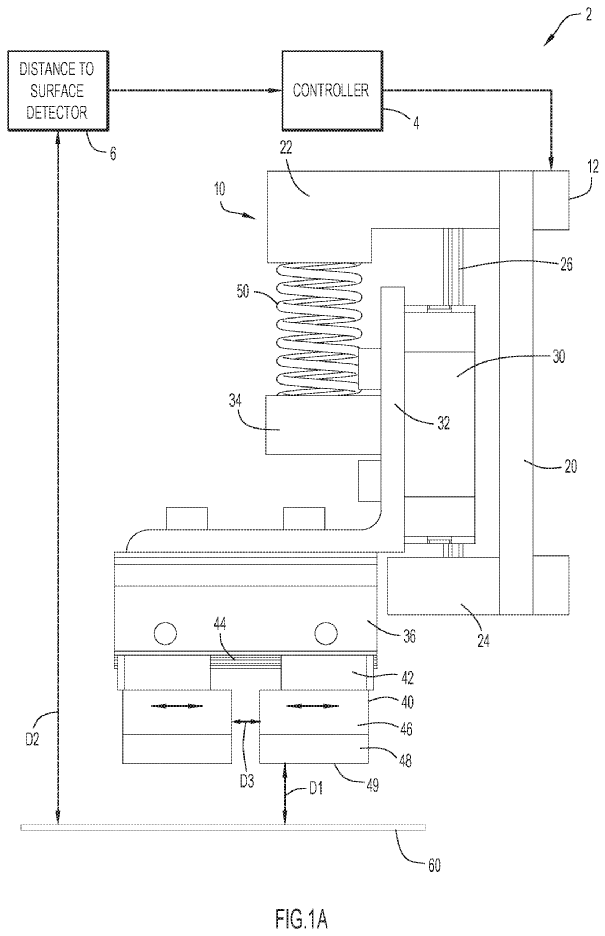
At 410 (Figure 4), a distance is determined between the gripping surface of a pincher and an upper facing surface of the fabric sheet to be picked up from the stack of the fabric sheets. This can be achieved, according to the patent, by measuring the distance between the detector and the fabric sheet surface. The controller uses this measurement to determine the distance (D1 – Figure 1A).
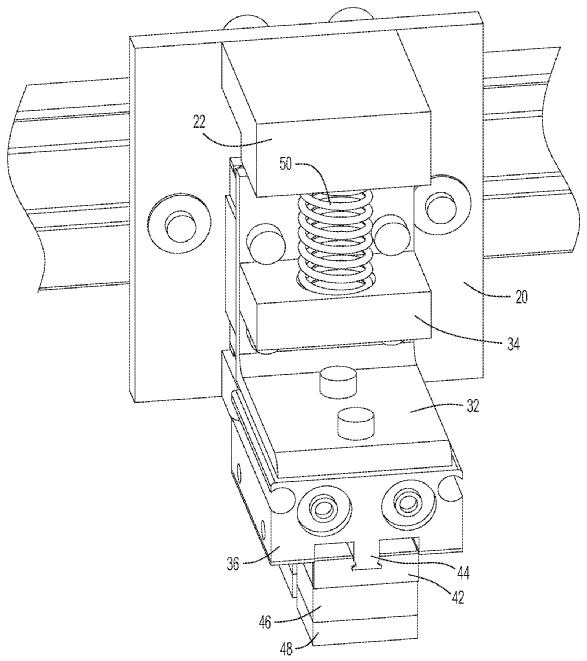
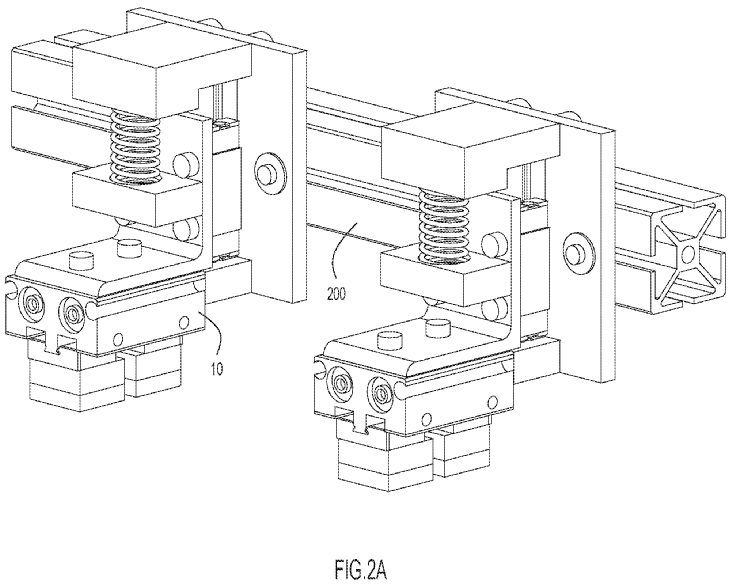
At 415 (Figure 4), the grippers (10 – Figure 2A) are moved towards the surface of the fabric sheet by an automated movement of a guide element controlled by the controller. The movement provides a predetermined amount of force and/or pressure to the fabric sheet, and a spring (50 Figure 1-1A) provides a damping effect that “modulates the downward force/pressure applied by the grippers to the fabric sheet […] to be picked so as to achieve a fine tuning or granular control on the amount of force/pressure applied” [1].
The patent continues that, when the gripping surface of the pinchers make contact with the surface of the fabric sheet, any continued downward movement of a gripper will apply a force that offsets the biasing force applied by the spring. The spring controls the resultant force and/or pressure applied by the pinchers to the fabric sheet surface. Thus, control of the downward travel distance of the gripper (based upon the determined distance D1 between the gripping surfaces of the pinchers and the surface of the fabric sheet to be picked) and the configuration of the spring effects the precise control of the amount of pressure applied to the fabric sheet by the pinchers.
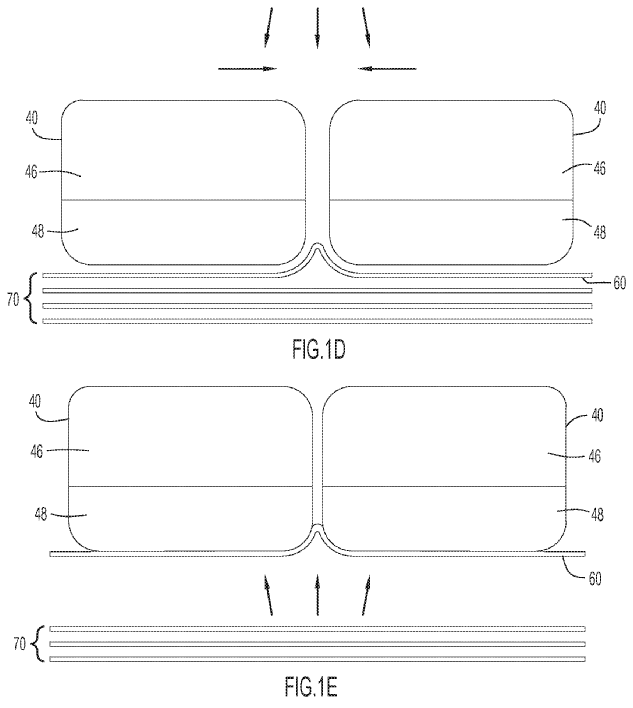
Once the grippers have been moved into position with the fabric sheet (415 – Figure 4), the next step in the systems method (420 – Figure 4) is that the pincher’s fingers are automatically moved towards each other by the controller. This is done by moving carriage members (36 – Figure 1A) along the rail (44 – Figure 1A). This causes a portion of an individual fabric sheet from the stack of sheets to become pinched or trapped between the engaging surfaces of the pinchers, as shown in Figure 1D.
The movement of the pinchers towards each other can be controlled so that the movement can take place at any given location of the grippers in relation to the fabric sheet, such as at the end of the downward travel movement of the grippers towards the fabric sheet; as the grippers as approaching the end of this movement or as the grippers move upwards away from the stack of fabric sheets.
At stage 425 (Figure 4), the grippers have the single fabric sheet trapped between the pinchers. The grippers are raised from the fabric sheet stack by the automatic movements of the grippers away from the stack, as depicted in Figure 1E, this is again controlled by the controller.
Next, the single fabric sheet is transported to a different location or station in the system for further processing (430 – Figure 4). For example, the sheet of fabric can be processed to form an article of apparel such as T-shirt, shorts or trousers, etc. Such processing can consist of combining the single fabric sheet with one or more other fabric sheets and/or other materials for sewing and stitching, for example. This can also include the printing of designs and logos on to the fabric sheet or consequent apparel item. The patent explains: “In an example embodiment of the invention, the grippers can be integrated in a system that can comprise a heat transfer machine for printing indicia on textiles, such as machine commercially available under the trade name TREKK HT300 (Trekk Equipment Group, Missouri, US). [1]
It goes on to say that the system, as described above, can be configured in a way that the grippers transport the piece of fabric in a vertical, horizontal and/or rotational direction to another station or location within the manufacturing facility for further processing.
It can also be programmed in a way that means that grippers vertically move the single fabric sheet from the stack and place it onto a platform that is moved into position below the grippers. “For example, a single fabric sheet […] can be vertically raised by the grippers, followed by movement of a movable platform automatically into position beneath the grippers and raised fabric sheet, and then placing the sheet by the grippers onto the movable platform” [1].
The final stage of the technology’s operation is the release of the single fabric sheet from the grippers. The pinchers are automatically moved away from each other – controlled by the controller – to release the ‘pinching hold’ of the fabric sheet [1]. The grippers are then moved away from the newly position single fabric sheet by the controller guide element of the technology.
Importantly, the patent notes that each of the grippers can be operated to move and pinch the fabric surface in sync or substantially simultaneously with each other during system operation (ie during process steps 415- 430 in Figure 4).
“Such simultaneous movement and operation of the grippers can be achieved regardless of whether the grippers are disposed on the same guide element or on two or more different guide elements” [1]. What’s more, in other embodiments (and depending upon the requirements for certain applications), the movements of some of the grippers can be staggered (ie not in sync) with other grippers. This can be achieved in systems where some grippers are disposed on two or more guide elements, the patent continues. This means that the guide elements are not moved in a synchronised way; rather, the movement of one guide element is slightly staggered in terms of time, in relation to the movement of another guide element.
Results
The patent inventors claim that the result of this technology is that a single material sheet is picked from a support member [1]. To do this, a gripping member is aligned above the support member, “where the gripping member includes a pair of spaced apart pinching members movably coupled with a main frame, and each pinching member includes an exposed gripping surface that is substantially planar and that faces an exposed surface of the material sheet. The gripping member is moved a first distance toward the exposed surface of the material sheet such that the gripping surfaces of the pinching members engage a portion of the material sheet. The pinching members for the gripping member are moved toward each other while the pinching members engage the portion of the material sheet so as to pinch the portion of the material sheet between the pinching members and vertically displace the material sheet from the support member” [1].
The technology moves the gripping member toward the exposed surface of the material sheet such that the gripping surfaces of the pinching members grip a portion of the material sheet. The pinching members then grip towards each other while gripping the material sheet, pinching the fabric between them.
Impact
The success of this patent could have the potential to determine automation in textile and apparel manufacturing facilities. WTiN Intelligence: Textile 4.0 analyst Sophie Darby notes that gripping technology should be able to achieve tasks performed by a human but with greater efficiency and productivity. In order to achieve this, grippers have been designed in several ways by using suction, air pressure, penetrative needles or by replicating the human hand. [2] However, there have long been issues with the thin, light and smooth nature of textiles, especially those like silk, that can easily slip between the pinching operation of the grippers. If this filed patent can address these issues, as well as cost issues around gripping technology [2], the impact of the system for Under Armour and its manufacturing facilities could be huge.
The patent notes that the technology would “enhance the manufacturing process by further automating this processing step and thus minimising human labour otherwise associated with such processing” [1].
With the textile and apparel manufacturing industry relying heavily on manual labourers, the number of employees a factory needs could reduce significantly. Whilst this could be a negative for these workers, it is hoped that automation will allow workers to engage in more skilled jobs, rather than mundane, repetitive jobs. Manufacturing countries such as China are also experiencing a reduction in unskilled workers, with millennials now shunning factory jobs as the country’s middle class rises [3]. Less unskilled work in nations such as China then, may not necessarily be a bad thing for the country’s employment rate. With the rising middle class, the countries wages are also increasing, so there exists a wish to keep costs down in an industry where margins are already tight.
From a health and safety perspective (especially in the current climate), having less workers in the manufacturing facility is also a good thing and, if successful, this system and method for picking up single fabric sheets could allow a reduction in workers in the factory at any given time. Automated technology can also run around the clock without tiring and as a result, can positively impact factory lead times.
“This automated process provided by the system alleviates issues associated with typical processing of single sheets of material (eg where conventional techniques require human interaction, where a human typically picks a single material sheet from a support surface or from a stack and manually moves the sheet to another location for further processing)” [1].
Comparatives
The gripping and transporting of individual textile goods has always been problematic. Adidas has used gripping technology by (formerly German, now Chinese) OEM KUKA in its Speedfactories, although its German and US-based facilities were closed down last year [4].
SoftWear Automation, a robotic sewing company based in Atlanta, US, is pioneering the creation of autonomous sewn good worklines for home goods, footwear and apparel [5]. However, rather than using gripping technologies, the ‘sewbots’ use inbuilt balls to roll the textile along the workstation. As a result, the technology is not able to physically pick up the textile and move it to another workstation – this has to be done manually.
At the moment, soft robotics are currently the only option for replicating a ‘human-like grip, with impactive technologies’ in the textile and apparel industry. While automated ingressive, astrictive and contigutive gripping technologies are increasingly available for use in the sector – such as vacuum and needle grippers – they have significant limitations. [6]
At Hannover Messe 2019, Chinese robotics business Suzhou Rochu Robotics, founded by entrepreneur Frank Zhang, presented the results of its year-long project to create a portfolio of soft robotic grippers for the apparel sector. The company has developed a range of grippers, as well as a control unit and supporting structure, specifically for transportation of cut garment pieces. Six soft robotic gripper types are currently available as part of the Rochu portfolio, with each one having been designed to deal with a different weight/type of fabric or size of garment piece. [6]
Zhang explains that the pressure each gripper exerts can be predefined for different fabric types so that the machine can automatically adapt during production to take into account a fabric’s thickness or texture. And the pinching movement is not the only aspect that can be adapted – the system is programmed to understand whether to peel the fabric from its original position or to lift it vertically, depending on the size and shape of the cut piece. “The process is easier with flat material,” Zhang adds, and explains that towel material has been the most challenging to work with. [6]
Formhand Automation, Festo and OnRobot are other OEMs that have created gripping technology for the textile and apparel manufacturing industry. For example, Formhand grippers consist of a granulate filled cushion which can adapt to different shapes. This cushion is evacuated by an airflow for gripping. The combination of gripper cushion and airflow offers many advantages for the handling of limp and porous objects as textile plies, leather cut-outs or thin layers of print paper. [7]
On the one hand, the gripper cushion provides a continuous gripping area which supports limp objects while transporting. This way the objects are kept in shape and crimpling and bending is avoided. On the other hand, the airflow through the cushion generates a gentle gripping force onto objects with any surface. By this airflow the objects are fully attached to the compacted gripper cushion. [7]
The modular design of Formhand grippers and the easy-to-scale-technology allow the construction of grippers in different sizes and shapes. This allows an extremely wide range of parts to be covered. Further benefits, the company states, include the gripping of porous, flexible and limp objects, the gripper cushion’s soft surface and gentle handling, and the high adaptability of the grippers [7].
Thus, the filed Under Armour technology will join a small but growing number of OEMs trying to solve the problem of automating fabric gripping and manoeuvre. Systems such as these are highly beneficial across textile and apparel manufacture, particularly in a world where being Industry 4.0-enabled is now a necessity, rather than choice.
References
[1] Dorman, J., Falzon, J., System and method for picking single sheet of material for further processing. US20190337745. 2019. [Online] Available at: https://patentscope.wipo.int/search/en/detail.jsf?docId=US276021382&_cid=P22-KCLTD9-53681-1 [Accessed 14 July 2020]
[2] Darby, S. “Collaborative robots: Part 1 – Cobot arms”, WTiN, 2019. [Online] Available at: https://www.wtin.com/article/2019/june/240619/collaborative-robots-part-1-cobot-arms/ [Accessed 14 July 2020]
[3] Dixon, R., “Chinese millennials are rejecting dull factory jobs – and transforming the economy”, Los Angeles Times, 2019. [Online] Available at: https://www.latimes.com/world/la-fg-china-millennials-jobs-20190512-story.html [Accessed 14 July 2020]
[4] Bain, M., “Adidas is shutting down the robotic factories that were supposed to be its future”, QUARTZ, 2019. [Online] Available at: https://qz.com/1746152/adidas-is-shutting-down-its-speedfactories-in-germany-and-the-us/ [Accessed 14 July 2020]
[5] Thomas, M., “Rise of the Sewbots: Rethinking the textile supply chain”, WTiN, 2017. [Online] Available at: https://www.wtin.com/article/2017/august/140817/rise-of-the-sewbots-rethinking-the-textile-supply-chain/ [Accessed 14 July 2020]
[6] Fall, T., “Revolutionary soft robotic gripper for moving garment cut-pieces”, WTiN, 2019. [Online] Available at: https://www.wtin.com/article/2019/april/010419/revolutionary-soft-robotic-gripper-for-moving-garment-cut-pieces/ [Accessed 14 July 2020]
[7] Rhodes, A., “Formhand discusses innovative gripper technology,” WTiN, 2019. [Online] Available at: https://www.wtin.com/article/2019/july/080719/formhand-discusses-innovative-gripper-technology/ [Accessed 14 July 2020]