Bangladesh’s unions have yet to be satisfied by an increase in the country’s minimum wage, which was published in a government gazette on 8 October, hiking minimum wages for entry-level knitwear workers by 51% to US$95 a month from December, up from the US$63 set in 2013.
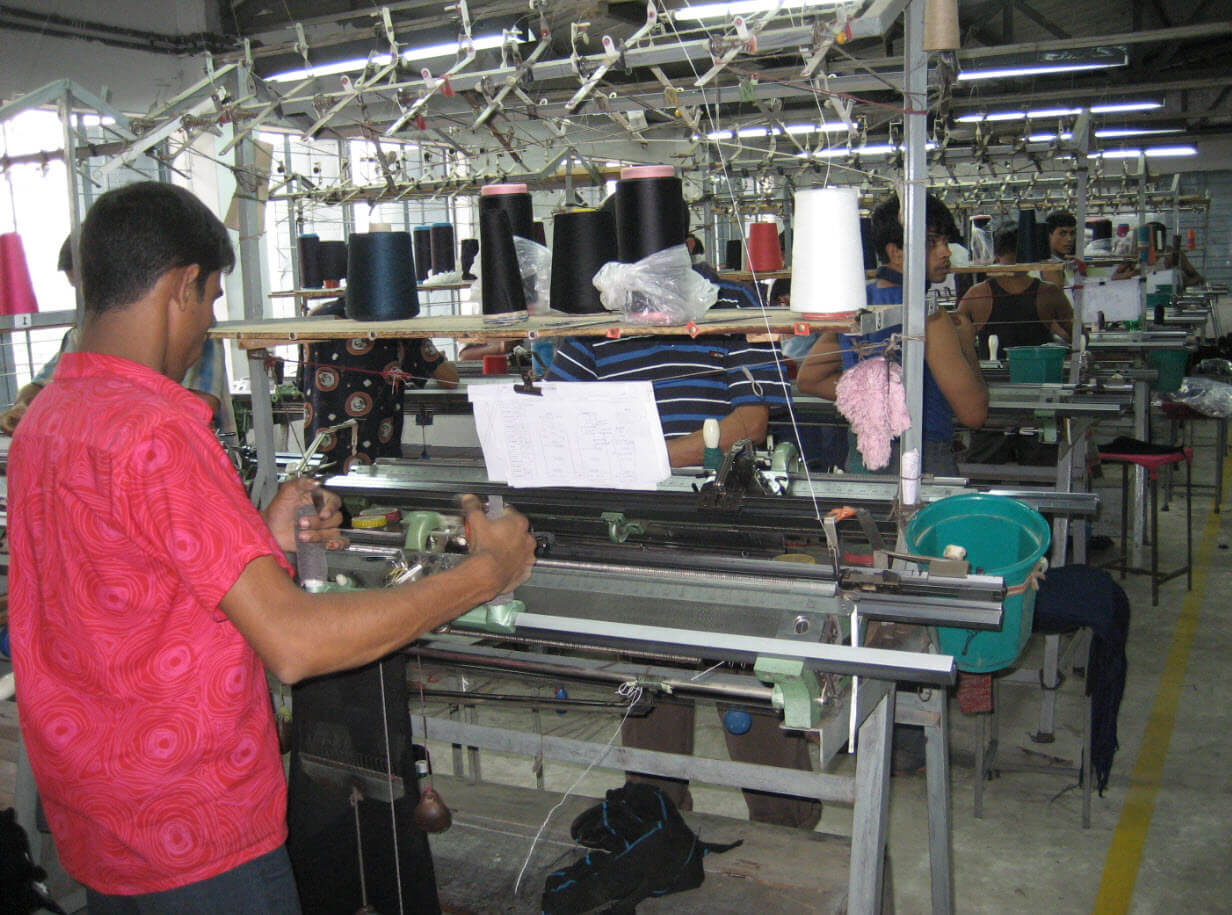
Businesses including knitwear factories in Bangladesh could face setbacks if negotiations are not made on fair wages
On 21 October, IndustriAll Bangladesh Council (IBC), an affiliate of the Geneva-based IndustriAll Global Union, submitted its objection letter to the wage board, which was formed in January, pushing for an upward revision of the wages to US$143 (Bangladesh Taka BDT12,020) a month. This amount mirrors what the workers’ representative on the government’s minimum wage board proposed in negotiations earlier this year.
“Workers will be happy if wages are fixed at BDT12,020,” says Salauddin Shapon, secretary-general of the IBC. “You won’t lose anything. Buyers are committed to raising cost of CM (cut and make).”
He says pay for Bangladeshi knitwear workers remains lower than that of major competing outsourcing countries.
Factory owners said that they will honour the government’s announcement but warned that their businesses will face setbacks in expansion unless buyers do not reciprocate with what they regard as fair prices.
“Internationally, prices are not increasing. We can’t say for sure whether buyers will come forward,” says Sulav Chowdhury, chief executive officer of the Bangladesh Knitwear Manufacturers and Exporters Association (BKMEA). “Negotiations on fair prices are going on.”
Negotiations on fair prices in the region are ongoing, according to BKMEA
Chowdhury, however, agrees that improving living standards of workers is important, if Bangladesh is going to realise its goal of becoming a middle-income country.
Interestingly, Amir Sheikh, a senior consultant with Gherzi Textil Organisation, India, argues that this recent change in minimum pay “would not have much effect on prevailing market wages.” Shifts in the exchange rate for the Bangladesh Taka with US dollars “will reduce the impact of this increase,” he notes. As a result, the Bangladesh knitwear sector will still be competitive with other major knitwear manufacturing countries, he claims.
Including benefits, labour costs in Bangladesh is estimated by Gherzi to be US$130 per month, whereas it is US$175 in India, US$275 in Vietnam, US$300 in Indonesia, and US$600 in China. Only East Africa’s growing hub of Ethiopia offers real cost competition at US$75, according to a study conducted by Gherzi.
Dr Khondaker Golam Moazzem, research director at the Centre for Policy Dialogue (CPD), a think-tank in Dhaka, underlined the need for reducing this gap in minimum wages between Bangladesh and its major competing countries to encourage the retention of quality workers.
“It’s irrelevant to ask whether the current wage is high or low. We can’t even pay our workers minimum wages, let alone competitive wages,” he says.
He argues attention should now be paid to wages that will ensure a decent living for workers. Citing a CPD study, Moazzem says 12% of the country’s workers still sleep on the floor.
“The industry has to realise that a living wage can only be sustainable in the long run,” Sheikh insists.
Meanwhile, concerns grow within unions over potential job losses as Bangladeshi knitters keep investing in labour-saving modern technology.
Bangladesh has already emerged as the third-largest investor in new circular knitting machines after China and India.
Between 2008-2017, the International Textile Manufacturers Federation (ITMF) said that Bangladesh procured 11,948 units of new circular knitting machines, compared with India’s 22,597 and China’s 188,482 units.
With the rising minimum wage, quality requirements and speed, Sheikh says Bangladesh would “need to accelerate investment in new equipment.”
IBC’s Shapon welcomes mechanisation in the knitting sector but insists that retrenched workers be retrained making them suitable for jobs in other sectors.
He feared that over the next four to five years, the size of manpower in Bangladesh’s apparel industry could plummet to 100,000 from roughly 500,000 now in the fallout from technology.
Chowdhury says the BKMEA is going to conduct a study on how mechanisation would impact the knitwear industry.
For now, knitwear exports are booming. Shipments of knitwear products grew 12.27% to US$4.20bn in the July-September period of the current financial year, compared to the same period in 2017.