Most people are now aware that the Earth is facing a plastic pollution crisis. Every year, it is estimated that between 1.15 and 2.41 million tons of plastic are entering the ocean from rivers across the world. Currents concentrate this plastic in five main areas across the ocean into ‘ocean garbage patches’. Once in these patches, the plastic will not go away by itself.
Models show that a full-scale cleanup system roll-out (a fleet of 60 systems) could clean 50% if the GPGP in five years
The biggest of the five plastic accumulation zones is known as the Great Pacific Garbage Patch (GPGP). This patch is located half way between Hawaii and California, US, and covers an estimated surface area of 1.6 sqkm – an area three times the size of France. Around 1.8 trillion pieces of plastic are in this patch, which equates to 80,000 tonnes and 250 pieces of plastic for every human on earth.
The majority of plastic in the patch are made of hard polyethylene, polypropylene or derelict fishing gear such as nets and rope. In terms of object count, 94% of the total is represented by microplastics and 46% of total mass is made from fishing nets.
Tackling this huge area of waste by vessels and nets alone would require billions of dollars and a lifetime’s worth of work, however now The Ocean Cleanup organisation has launched the world’s first cleanup system to begin removing plastic pollution from the GPGP.
System 001
Hundreds of scale-model tests, a series of prototypes, research expeditions and multiple iterations have led to The Ocean Cleanup having sufficient confidence in its technology to launch its first full-scale cleanup system – System 001.
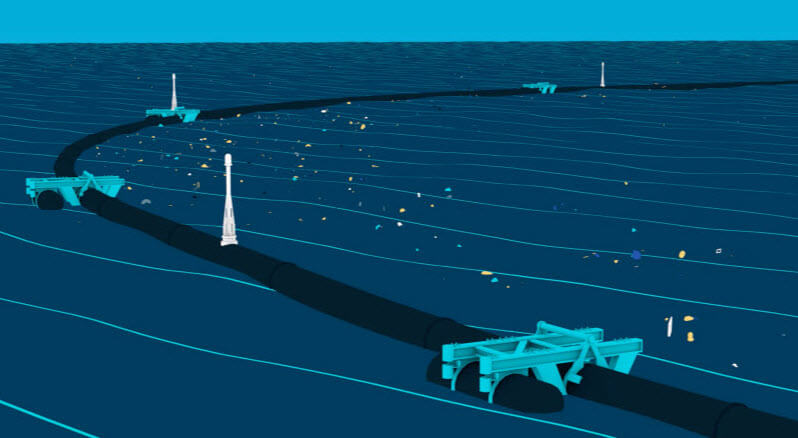
System 001 is a 600-metre long U-shaped floating barrier with a three-metre deep skirt attached below
System 001 is a 600-metre long U-shaped floating barrier with a three-metre deep skirt attached below.
The system is designed to be propelled by wind and waves, allowing it to passively catch and concentrate plastic debris in front of it. Due to its shape, the debris will be funnelled to the centre of the system. Moving slightly faster than the plastic, the system will act like a giant Pac-Man, skimming the surface of the ocean.
Speaking to WTiN, Vivian ten Have, communications consultant, CFF Communications with The Ocean Cleanup, explains that the screen is made out of a type of geotextile, a tightly woven textile that is strong but flexible. This is needed to withstand the different hydrodynamic scenarios the system will be subjected to.
“The floater is made out of High-Density Polyethylene (HDPE), a material that is commonly used for pipes on or in the sea bed,” she adds.
The system was launched on 8 September 2018 from San Francisco Bay, US. Firstly, the cleanup system headed to a location 240 nautical miles offshore for a two-week trial before continuing its journey toward the Great Pacific Garbage Patch, 1,200 nautical miles offshore, to start the cleanup. The system was officially deployed on 16 October.
System 001 was towed from the San Francisco Bay by the vessel Maersk Launcher, which has been made available to the project by AP Moller-Maersk and DeepGreen, its current charter holder.
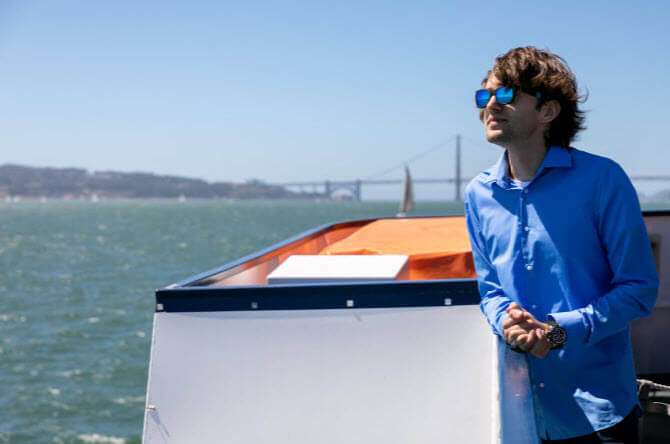
“The launch is an important milestone, but the real celebration will come once the first plastic returns to shore,” says Boyan Slat, founder and CEO of The Ocean Cleanup. “For 60 years, mankind has been putting plastic into the oceans; from that day onwards, we’re taking it back out again.”
The organisation has announced that System 001 has passed the trial and has reached the GPGP. The installation has been successfully completed and the first batch of plastic will be caught very soon.
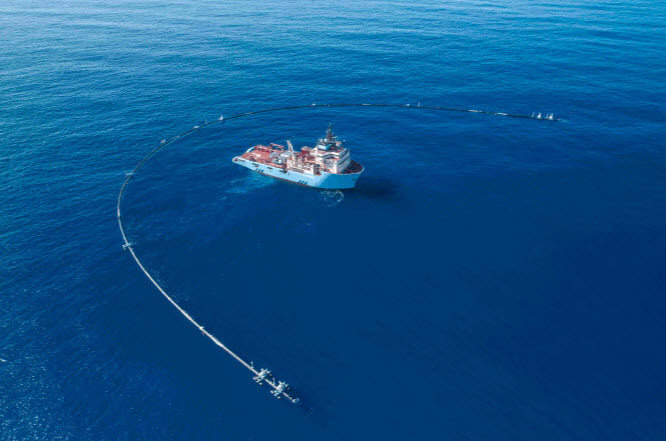 The installation has been successfully completed and the first batch of plastic will be caught very soon
Effectiveness
System 001 is designed to catch plastic up from several millimetres in size, which means that the team expects to catch about 90% of plastics in the Garbage Patch with the cleanup systems.
“A vessel acting somewhat like an ocean garbage truck will remove the collected plastic approximately every six weeks,” says ten Have.
“The Ocean Cleanup is planning to make use of a modified purse seine method designed to extract accumulated plastic without marine life by-catch. This extraction method is still in experimental stages and may be optimised based on testing during the first months of operation.”
The Ocean Cleanup anticipates that the first plastic will be collected and returned to land within six months after deployment. This will mark the first time that free floating plastic will have been successfully collected at sea.
After returning the plastic to land, The Ocean Cleanup plans to recycle the material into products such as rucksacks and use the proceeds to help fund the cleanup operations.
Models show that a full-scale cleanup system roll-out (a fleet of 60 systems) could clean 50% if the GPGP in five years, and after fleets of systems are deployed into every ocean gyre, combined with source reduction, The Ocean Cleanup predicts to be able to remove 90% of ocean plastic by 2040.
Safety at sea
Although System 001 is theoretically capable of capturing plastic, it has been designed to ensure sea life is safeguarded.
Firstly, the system moves slowly allowing creatures to swim away from it. Additionally, the screen is impenetrable, meaning that the current flows underneath, taking organisms with it. No sea life can be entangled as the screen is not a net, and people will always be present to check for marine life before the plastic is removed.
And when it comes to surviving storms, the key to survivability is flexibility. The team designed the system to be limber enough to be able to follow the waves, and because the system is free-floating, it can drift when subjected to high current speeds.
It is also important that the system does not collide with any other marine traffic. Therefore, the system is equipped with solar-powered and satellite-connected sensors, cameras and navigation lights to communicate the position of System 001 to passing marine traffic and enable extensive monitoring of the system and the environment.
After delivery of the system to the Great Pacific Garbage Patch, the Maersk Launcher will remain active as an observation platform for several weeks.
“I am incredibly grateful for the tremendous amount of support we have received over the past few years from people around the world, that has allowed us to develop, test, and launch a system with the potential to begin to mitigate this ecological disaster,” adds Slat.
“This makes me confident that, if we manage to make the technology work, the cleanup will happen.”