Researchers affiliated with the Ulsan National Institute of Science and Technology (UNIST), South Korea, have presented wearable technology that transforms skin into a loudspeaker.
Researchers affiliated with the Ulsan National Institute of Science and Technology (UNIST), South Korea,
have presented wearable technology that transforms skin into a loudspeaker
The breakthrough has been led by Professor Hyunhyub Ko in the School of Energy and Chemical Engineering at UNIST. Created in part to help the hearing and speech impaired, the new technology can be further explored for various potential applications, such as wearable IoT sensors and conformal healthcare devices.
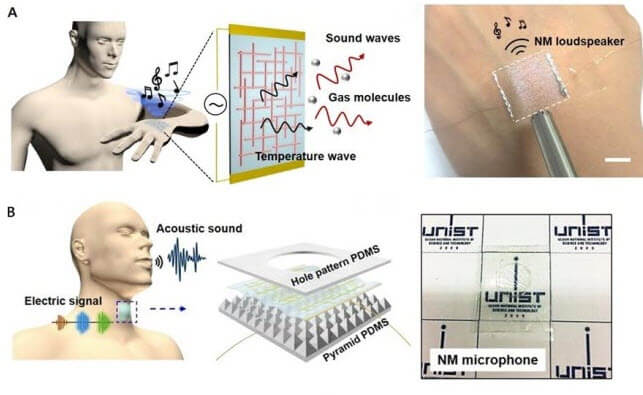
In the study, the research team developed ultrathin, transparent and conductive hybrid nanomembranes with nanoscale thicknesses, consisting of an orthogonal silver nanowire array embedded in a polymer matrix. They then demonstrated their nanomembrane by making it into a loudspeaker that can be attached to almost anything to produce sounds. The researchers also introduced a similar device, acting as a microphone, which can be connected to smartphones and computers to unlock voice-activated security systems.
Nanomembranes (NMs) are molecularly thin separation layers with nanoscale thickness. Polymer NMs have attracted considerable attention owing to their outstanding advantages, such as extreme flexibility, ultra-lightweight, and excellent adhesibility in that they can be attached directly to almost any surface. However, they tear easily and exhibit no electrical conductivity.

The skin-attachable nanomembrane loudspeakers work by emitting thermoacoustic sound
The research team has solved such issues by embedding a silver nanowire network within a polymer-based nanomembrane. This has enabled the demonstration of a skin-attachable and imperceptible loudspeaker and microphone.
“Our ultrathin, transparent and conductive hybrid NMs facilitate conformal contact with curvilinear and dynamic surfaces without any cracking or rupture,” says Saewon Kang in the doctoral programme of Energy and Chemical Engineering at UNIST, the first author of the study.
“These layers are capable of detecting sounds and vocal vibrations produced by the triboelectric voltage signals corresponding to sounds, which could be further explored for various potential applications, such as sound input/output devices,” he adds.
Using the hybrid NMs, the research team fabricated skin-attachable NM loudspeakers and microphones, which would be unobtrusive in appearance because of their excellent transparency and conformal contact capability. These wearable speakers and microphones are paper-thin, yet still capable of conducting sound signals.
“The biggest breakthrough of our research is the development of ultrathin, transparent and conductive hybrid nanomembranes with nanoscale thicknesses of less than 100 nanometres,” says Ko.
“These outstanding optical, electrical and mechanical properties of nanomembranes enable the demonstration of a skin-attachable and imperceptible loudspeaker and microphone.”
The skin-attachable nanomembrane loudspeakers work by emitting thermoacoustic sound by the temperature-induced oscillation of the surrounding air. The periodic Joule heating that occurs when an electric current passes through a conductor and produces heat leads to these temperature oscillations. It has attracted considerable attention for being a stretchable, transparent and skin-attachable loudspeaker.
Wearable microphones are sensors, attached to a speaker’s neck to even sense the vibration of the vocal folds. This sensor operates by converting the frictional force generated by the oscillation of the transparent conductive nanofibre into electric energy. For the operation of the microphone, the hybrid nanomembrane is inserted between elastic films with tiny patterns to precisely detect the sound and the vibration of the vocal cords based on a triboelectric voltage that results from the contact with the elastic films.
“For the commercial applications, the mechanical durability of nanomembranes and the performance of loudspeaker and microphone should be improved further,” says Ko.
This work has been supported by the Mid-career Researcher Supporting Program by the Ministry of Science and ICT. Their findings have been introduced in the August 2018 issue of Science Advances, a journal from the American Association for the Advancement of Science.