
WTiN examines a patent published in 2020 by Levi Strauss & Co which puts forward the use of machine learning (ML) and laser technologies to re-create wear patterns from existing garments for application on new garments.
Introduction
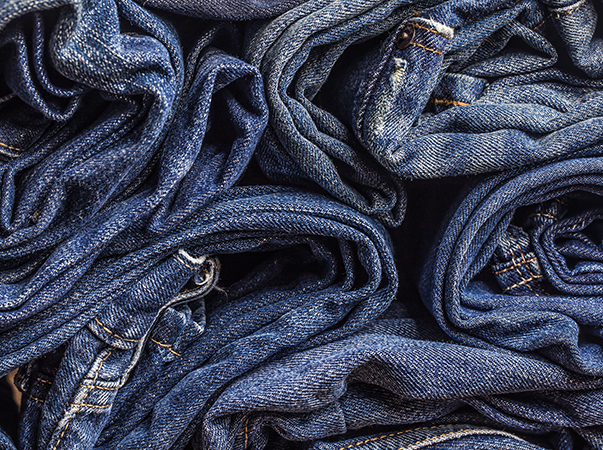
Though initially denim jeans were revered for their durability in work environments, denim garments are now statements of fashion, and increasingly consumers are concerned with the unique appearance of their jeans. In the past, over time, jeans became faded and distressed through normal wash and wear; soon, this became a desirable feature of the garment, and the apparel industry quickly recognised consumer demand for the worn denim look.
Wear patterns in denim include combs or honeycombs, whiskers, stacks and train tracks. Despite the success of these patterns, the processing of these features takes time, high processing costs, requires an intense consumption of resources (water, energy) and utilises arguably damaging bleaching or oxidising agents.
As such, over recent years, the need for improved processes brought innovation to the sector.
Lasers, supported by software, can now be used in finishing to produce a desired wear pattern or other design on a garment – one that is similar to or indistinguishable from a finish obtained using traditional processing techniques. (Figure 1 shows a block diagram of a system for creating, designing and producing apparel products with laser finishing; while Figure 2 shows a flow for a finishing technique that includes the use of a laser [1].) This trend has increased, particularly in denim – garments such as jeans, shirts, shorts, jackets, vests and skirts can now be made to look faded, distressed, washed or worn with laser technologies, catering to ongoing demand.
As such, in September 2020, legacy jeans company Levi Strauss & Co published a patent (initially filed in 2018) with the aim to simplify the creation of laser apparel designs [1].
Purpose
This patent suggests using machine learning (ML) to create or extract a laser input file from an existing garment’s wear pattern. With this laser input file, a laser can re-create the wear pattern from an existing garment onto a new garment.
Approach
A garment is assembled (sewn together) from woven denim fabric panels (Figure 3 – comprising indigo ring-dyed cotton yarn). For the purpose of this report, WTiN will refer to this unfinished garment as Item 1.
Next, an ML system – ML is a field of artificially intelligent (AI) computer science that gives computers the ability to automatically learn and improve without explicit programming – is used to recreate a laser input file from an existing garment’s finishing pattern. This second garment comprises different fabric characteristics from the initial indigo ring-dyed cotton yarn, for example, different colours, diameter characteristics, and yarn twists, etc. This garment will be referred to as Item 2.
The ML system comprises a generative adversarial network which is trained to extract and generate a laser input file which can produce a representative copy of the apparel design of Item 2 (Figures 13 and 14).
(The patent goes into further technical detail on how the ML recreates the pattern design of Item 2. According to the patent, wear patterns and other designs can be reproduced by capturing high resolution digital photographs (potentially in raw format) of existing garments with wear patterns. One approach is to convert these images into an inverted grayscale image, which the laser uses to burn the wear pattern into another garment, though the patent says this results in poor, unrealistic, flat reproduction of the original wear pattern. As such, the invention puts forward a solution whereby the model generates an accurate laser input file through data input and training the network.)
Using a laser, instructed by the laser input file, a finishing pattern is created on the outer surface of Item 1. (For clarification purposes, a laser is a device that emits light through a process of optical amplification based on the stimulated emission of electromagnetic radiation.) This laser will remove selected amounts of material from the surface of Item 1 at different pixel locations of the garment. For areas where a lighter shade is desired, a greater amount of Item 1’s surface is removed, while for areas where a darker shade is required, a lesser amount is removed. This is displayed visually in Figures 4-7.
The finishing pattern created can extend across portions of the garment where two or more fabric panels are joined together by the threads by exposing these portions to the laser.
Results
The invention is capable of replicating finishes of garments using ML and laser technology. The patent explains that, in application, apparel manufacturers could reproduce vintage or authentic wear pattern designs – such that were present on miner or worker jeans – on garments without ‘years’ of work to produce the required effect.
Additionally, the invention is not suited only to the denim sector. The patent explains that although the method may involve denim jeans, shirts, shorts, jackets, vests or skirts, the invention is ‘not limited [to] jeans or denim products’.
“The techniques and approaches described are applicable to other apparel and products,” the patent says, “including non-denim products and products made from knit materials.
“Some examples include T-shirts, sweaters, coats, sweatshirts, casualwear, athleticwear, outerwear, dresses, eveningwear, sleepwear, loungewear, underwear, socks, bags, backpacks, uniforms, umbrellas, swimwear, bedsheets, scarves, and many others.”
Commercial availability
Though there exists laser technologies to achieve desired patterns on denim and other material products, the availability of an invention that wields ML to replicate the pattern of another garment appears scarce. In this case, perhaps the invention will not only help simplify production processes of patterned garments, but could enhance the design process in some considerable way.
Impact
A main benefit of invention that relates to laser finishing is its ability to cut the use of dry abrasion, wet processing, oxidation and other techniques, which have been reported to be damaging to workers and the environment. By increasing innovation around laser finishing, perhaps industry will increasingly see the benefit of investing in laser machinery.
The other obvious benefit of the invention appears to be its intuitive nature. The complexity of laser processing may be inaccessible to traditional denim designers; thus, the use of an intelligent AI computer system to replicate designs based on high-resolution digital images could massively simplify the task, and again, encourage more users of the system.
This report is a summarised version of a larger, more extensive patent. View the patent here.
References
[1] Schultz, C., Schultz, J., Bell, B. and Mahanty, D., “Using neural networks in creating apparel designs”, WTiN Patents, 2020. [Online] Available: https://www.wtin.com/patents/detail?pno=EP3704608A1 [Accessed 9 March 2021]