An international team of scientists and researchers leading the search for affordable, durable and cost-effective smart textiles has pioneered a new technique to create fully electronic fibres that can be incorporated into the production of everyday clothing.
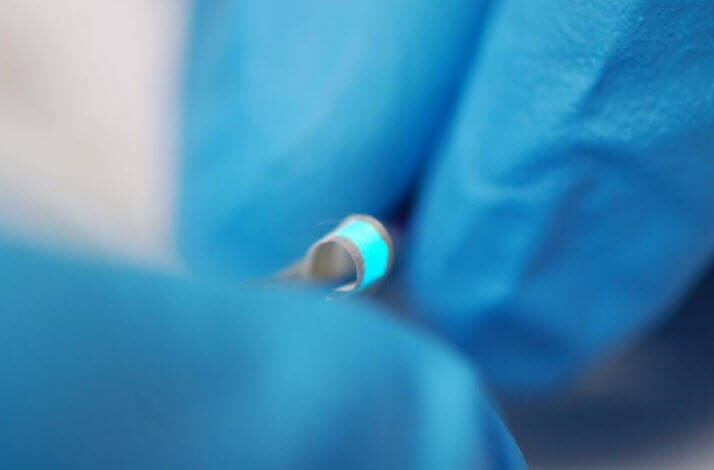
Graphene unlocks new potential for 'smart textiles'
Image credit: Prof Craciun Lab
The team, led by Professor Monica Craciun from the University of Exeter, has been using the so-called ‘wonder material’ graphene to develop electronic fibres for use in touch sensors and light-emitting devices.
At present, wearable electronics are achieved by ‘gluing’ devices to fabrics, which often means that the end product is too rigid and susceptible to malfunctioning. Now, the new research from the international team shows that electronic devices can be integrated into the fabric of the material.
This, the team states, will be done by coating electronic fibres with lightweight, durable components that will allow images to be shown directly on the fabric. The use of graphene to create the electronic fibres means that they can be ultra-thin, as graphene is just one atom thick.
The research team believes that the discovery has the potential to revolutionise the creation of wearable electronic devices for use in a range of commonly used applications. The team states that the technology could also be used in specialist applications such as health monitoring for heart rates and blood pressure, and also medical diagnostics.
The international collaborative research includes experts from the Centre of Graphene Science at the University of Exeter, the Universities of Aveiro and Lisbon in Portugal, and CenTexBel in Belgium, and was published in the scientific journal Flexible Electronics.
Describing the project, Professor Craciun, co-author of the research, says: “For truly wearable electronic devices to be achieved, it is vital that the components are able to be incorporated within the material, and not simply added to it.”
Dr Elias Torres Alonso, research scientist at Graphenea and former PhD student in Professor Craciun’s team at Exeter, adds: “This new research opens up the gateway for smart textiles to play a pivotal role in so many fields in the not-too-distant future. By weaving the graphene fibres into the fabric, we have created a new technique to allow the full integration of electronics into textiles. The only limits from now are really within our own imagination.”
Graphene is the much talked about material tipped to revolutionise a wide range of consumer and industrial products due to its variety of coveted properties. While graphene is extremely strong, it is crucially flexible and a good conductor of electricity, making it extremely useful as a component of wearable electronics.
The team’s research saw polypropylene fibres, which are typically used in a host of commercial applications in the textile industry, attached to the new, graphene-based electronic fibres to create light-emitting and touch sensor devices.
The new technique means that the fabrics can incorporate wearable displays without the need for electrodes, wires or additional materials.
Professor Saverio Russo, co-author and from the University of Exeter Physics department, adds: “The incorporation of electronic devices into fabrics is something that scientists have tried to produce for a number of years, and is a truly game-changing advancement for modern technology.”
The race is now on for scientists around the world to research how the material could be best used in applications such as wearable electronics. However, as graphene was only discovered in 2004, experts suggest that it could be decades before the material is used commonly in everyday products. Furthermore, its recent discovery also means that graphene is highly expensive.