Ahead of next year’s GeoAmericas 2020 conference, Andy Rhodes speaks to Chungsik Yoo, Ph.D, president of the International Geosynthetics Society
The global need to tackle carbon emissions and waste has provided a good opportunity for innovation in the textile industry – particularly geosynthetics which, compared to more traditional materials such as concrete and steel, offer an abundance of solutions for construction and futureproofed sustainable production.
As a result, the geosynthetics market is currently experiencing unprecedented demand. In fact, research firm Grand View Research projects that by the year 2025, the global geosynthetics market will be worth an estimated US$20.15bn.[1] Considering that this is up from a value of US$13.20bn in 2015 and that the market will rise at a compound annual growth rate (CAGR) of 6.2% over the forecast period, it is easy to see why the market is in good health.
Geosynthetics are synthetic polymeric materials typically used in rock or soil environments in construction and engineering projects. Geosynthetic materials boast benefits including being cost-effective, being easy to install, long service life and low maintenance costs. Studies have also shown that geosynthetics are highly durable, and so offer sustainability benefits, further boosting their demand.
Geosynthetic textiles, called geotextiles, in particular are benefiting from this increasing demand. According to Müller and Saathoff, geotextiles accounted for the largest volume (sqm) of geosynthetic material sold when compared other forms of geosynthetics such as geomembranes and geocomposites.[2] In 2010, 1,400 million sqm of geotextiles were sold at a total value of US$1,050m.

Global conference
Demand for geosynthetics as a whole almost doubled between 2007-2017 in the Central and South American region, which incidentally will play host to the upcoming GeoAmericas 2020 conference. This, the fourth Pan American conference on geosynthetics, is to be held in Rio de Janeiro, Brazil, on 26-29 April. The conference will focus on sustainability, averting natural disasters and new product launches.
More than 1,000 professionals and academics from over 30 countries are expected to attend the event at the Windsor Expo Convention Center. Relating to construction as a key driver of the global geosynthetics market, there will be a large focus on geosynthetic solutions for environmental, hydraulic, mining, highway and railway applications.
Speakers at the event are set to include:
- Richard Brachman (Queen’s University, Canada) – Inaugural Zornberg Lecture
- Kerry Rowe (Queen’s University, Canada) - Reinforced Embankments on Soft Soils
- Dov Leshchinsky (Delaware University, USA) - Limit State Design Framework for Geosynthetic Reinforced Walls and Slopes
- Denys Parra (Anddes Consultores, Peru) - Geosynthetics in Mining
- Jie Han (University of Kansas, USA) - Geosynthetics for Reinforced Paved and Unpaved Roads
- Barry Christopher (Independent Consultant, USA) - Lessons Learned: An Adventure in Four Decades of Geosynthetics Engineering
Commenting on the event, GeoAmericas 2020 Honorary President Ennio Marques Palmeira says: “GeoAmericas 2020 promises to be an excellent opportunity for geotechnical and geo-environmental engineers to be updated on recent developments in geosynthetic products and applications. Those interested in the geosynthetic discipline cannot miss it.”
International Geosynthetics Society
GeoAmericas 2020 is organised by the International Geosynthetics Society (IGS), which has been a global advocate for the geosynthetics industry since 1983.
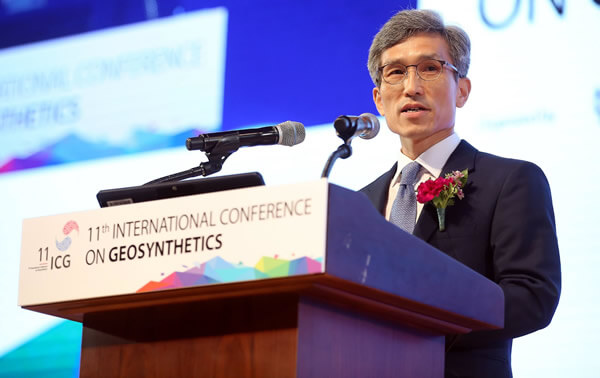
The IGS is currently overseen by Chungsik Yoo, Ph.D., who was elected as president of the society in 2018. Focusing on youth engagement, global education and sustainability, Yoo has given the IGS a new direction. “Our organisation was born out of a small event in 1977; last year we attracted more than 1,200 people and 109 exhibitors to the 11th International Conference on Geosynthetics in Seoul, South Korea. Next year’s GeoAmericas will be followed by our 7th EuroGeo Conference in Warsaw in September 2020, and GeoAsia and GeoAfrica in 2021.
“Our core purpose is to provide an understanding, and promote the appropriate use, of geosynthetic technology throughout the world,” adds Yoo. “Our vision is to see geosynthetics become widely recognised as fundamental to sustainable development, providing technological and engineering solutions to answer societal and environmental challenges.”
One of those challenges relates to sustainability. With plastic contamination issues becoming a key concern for the textile industry and the geosynthetics industry, it’s important for the IGS to inform and educate. “There is a lot of noise, much of it negative, about plastics waste globally at the moment,” Yoo explains. “The debate needs to become more fact-based and ‘grown-up’. Generally, manufacturers of plastics-based materials such as packaging or construction materials have been working hard on sustainability for years, by lowering their energy use and emissions, recycling scrap and incorporating post-consumer resin and alternative ‘natural’ materials where possible.
“In our own field, studies have shown that geosynthetics can reduce carbon footprints over the lifetime of a construction project,” he adds. “Geosynthetics have been proven ‘in the field’ for more than 50 years, but we continue to have to make the argument about their advantages above materials such as concrete and cement. It’s a challenge we relish.”
While sustainability poses a challenge for the industry, it is also a good opportunity for innovation. “Recent regulations in areas such as carbon emissions and waste are forcing industries to adopt proven newer technologies such as geosynthetics that offer a more responsible output than legacy materials,” says Yoo. “Emerging markets are also a big focus for our corporate members, due to the expected growth in engineering and construction projects. The ability to install geosynthetics swiftly and economically and with a much lower need for ongoing maintenance than legacy methods are powerful messages which we are taking worldwide.”
Future proof
The IGS is working to solve a problem that many sectors of the global textile industry also face at present. Attracting the next generation of young people to get involved in industries such as these is often difficult, however, nearly 15% of the IGS’s 3,800 members are students.
“I am proud of the demographics of our members,” says Yoo. “We are an old society with a youthful mindset. We have over 500 student members and an incredibly active young membership base. These men and women are the future of the IGS.
“We’re working hard to prepare young, high-potential people for leadership roles in the industry and we are facilitating the sharing of knowledge and ideas,” Yoo continues. “This includes adding youth-focused events to our forthcoming conferences. I’m also proud of our Educate the Educators series of events. We are addressing learning gaps, by briefing university professors about geosynthetics so they can pass this information onto their students. Through education, we can leave an exciting legacy for future generations.”
For more information on the IGS and GeoAmericas 2020, visit: https://www.geosyntheticssociety.org/