Texprocess, the leading trade fair for processing textile and flexible materials, is to focus on micro-factories and clothing production at this year’s event, which will take place in Frankfurt, Germany, on 14-17 May.
“Send your favourite design to the manufacturer today via an app and wear your individually designed, perfectly fitting trainers or shirt tomorrow,” says Michael Jänecke, director, Brand Management Technical Textiles and Textile Processing at Messe Frankfurt. “It’s a long time since this was just a pipe dream for the future.
“Behind it, however, lies a host of complex processes, involving production, processing and logistics. Micro-factories, based on networked and integrated procedures, represent the progressive way of making textile processing quicker, more flexible, and because it is more local, more sustainable, while at the same time producing personalised products.”
A total of four micro-factories will be at the upcoming Texprocess, and trade visitors will be able to get an idea of how integrated textile processing works and where micro-factories are already being used.
The four micro-factories are:
- Digital Textile Micro-Factory
- Smart Textiles Micro-Factory
- World of Digital Fashion
- Micro-Factory presented by Efka and Gemini
Digital Textile Micro-Factory
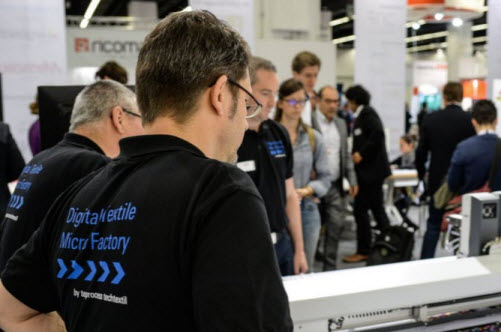
Following the last event, Texprocess, in collaboration with the German Institutes of Textile and Fibre Research in Denkendorf, Germany, (Institute für Textil- und Faserforschung Denkendorf – DITF) and partners from industry, will once again be presenting a Digital Textile Micro-Factory display – and thus, fully networked production chains – live in Hall 4.1.
What’s more, this year the Digital Textile Micro-Factory will showcase three production lines – one for apparel manufacture, one for 3D-knitted shoes and one for processing technical textiles, largely for the motor vehicle and furniture industries.
Utilising VR and AR
The fashion industry plays a central role in the Digital Textile Micro-Factory.
The customer’s digital doppelgänger is becoming more and more important in development departments in the apparel industry – as the starting point for individualised and perfectly fitting clothes and for links with finishing departments. In the context of the micro-factory’s production line, it is a key feature.
The production line demonstrates the various stages involved, including CAD/design, printing, cutting out, assembly, finishing and labelling.
New approaches also combine 3D simulations of clothing with direct data transfer in virtual reality (VR) and augmented reality (AR).
Instead of presenting the customer with physical examples of the clothing to be produced, the examples are visualised as virtual objects. And, during the production process, the customer has the opportunity for direct input into the design of the product in question.
This direct interaction between the 3D simulation of an item, the representation in VR/AR displayed on the customer’s own hardware, and the direct impact on the production process has never been shown before in this way, according to organisers.
Partners of the Fashion Line are: Assyst (CAD/design); Mitwill (materials); Caddon; ErgoSoft; Mimaki and Multiplot (printing); Zünd (cutting); Juki and Stoll (assembling); Veit (finishing); and Vuframe (AR/VR).
3D knitting
The Digital Textile Micro-Factory will also show a workflow that enables 3D-knitted uppers for shoes to be produced directly from the customer’s own particular foot measurements.
The process should only take 18 minutes from the 3D image to the finished prototype.
The 3D-knitting line of the micro-factory demonstrates the process from the 3D model to the creation of a geometrically accurate knitting pattern by the software, based on the 3D data set, and the development of a specification of the final knitting data, through to the manufacture of a 3D-knitted prototype.
The 3D-knitting line is partnered by Stoll.
Processing technical textiles
The focus of the third production line of the Digital Textile Micro-Factory is on the automated processing of technical textiles, personalised for the individual customer, right through to the finished product.
Trade visitors will see on-demand inkjet printing and networked machines with integrated sensors, which are linked through a bus system – a future-oriented topic for integrated manufacturing.
A robot arm with a special claw for use with textiles sorts the cut items as they emerge from the cutter in a free-moving open shuttle. The items to be sewn are then conveyed automatically to the sewing stations. Tracing and tracking procedures show the progress of each order through the individual stages of the manufacturing process using an auto ID.
Additionally, the display will also show how creative ideas from the Cloud can be incorporated in the manufacture of technical products.
Partners of the production line include: Mitwill (design); ErgoSoft (RIP); Caddon (colour management); HP (large-format inkjet printing); Zünd (cutting); Dürkopp Adler (networking, integration of an open shuttle, sewing); Veit (finishing); and Next Robotics (material handling).
Smart Textiles Micro-Factory
In the Smart Textiles Micro-Factory, located in the walkway between Halls 4.1 and 5.1, the Institute for Textile Technology (ITA) at the RWTH Aachen University, together with partners from industry and research, will be producing a ‘smart’ pillow which, with the help of integrated LEDs, provides new ways of interaction.
With this demonstration, the partners of the project will present an industrial-style manufacturing process for a smart textile from design to finished product. The prototype of the pillow was displayed in advance at Heimtextil 2019.
The following are all involved in the Smart Textiles Micro-Factory: the Institute for Textile Technology (ITA) of the RWTH Aachen University (project coordination), Gerber Technology GmbH (cutting), the Korea Institute for Industrial Technology KITECH (electronics), VETRON TYPICAL Europe GmbH (sewing), Wear it GmbH (product design and concept) and ZSK Stickmaschinen GmbH (embroidery).
World of Digital Fashion
Six companies have grouped together to create the World of Digital Fashion.
They work in areas of visualisation, CAD-cutting systems, automated body measurement, cutting out and process automation.
Together, they will be showcasing, in Hall 4.0, ways of integrating and combining their products in a variety of workflows within the value creation chain and will enable visitors to experience what the digital process chain is like in practice.
The focus will fall particularly on the customisation of apparel and fashion items.
Partners of the World of Digital Fashion are: Browzwear Solutions and Tronog (visualisation); Software Dr K Friedrich (CAD); Fision (automated body measurement); Bullmer (cutting); as well as Gertsch Consulting and Mode Vision (process automation).
Micro-factory presented by Efka and Gemini
Manufacturers of drive mechanisms for industrial sewing machines Efka, in collaboration with CAD supplier Gemini, will be showcasing the production of a knitted garment that can be individually designed.
The core element of its micro-factory, which closely reflects industrial practice, is the link to the sewing stage of production; something that is already available today as an economic, partially automated solution.
The display presents a solution that can be easily implemented and adopted by most companies, using already available resources.