New company, Smart Fabrik, has developed an umbrella that can significantly reduce temperature. Suruchi Wadhwa, head of marketing and communications, explains more to Jessica Owen.
Heatstroke is a serious health issue. The condition occurs when the body has been exposed to high temperatures and, in some cases, the body can exceed 40°C. If treated fast, the body can resume as normal fairly quickly, however heatstroke can also result in death.
With climate change increasing the frequency of extreme weather events such as heat waves across the globe, it is likely that heatstroke casualties will increase. Only over the summer this year (2018), 65 people died in Japan due to heatstroke from the heat wave and a further 22,000 people were treated in hospital, according to the BBC.
To help reduce the risk of heatstroke and other heat-related illnesses, a new start-up company called Smart Fabrik, which is a spin-off from the family-run technical textiles company Rado Industries Ltd, has developed an umbrella that significantly reflects the heat back into the atmosphere.
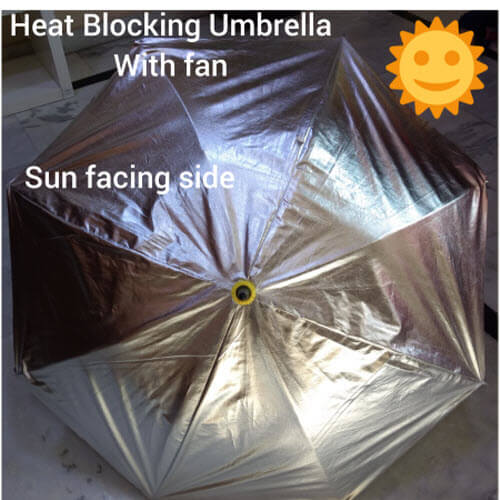
The inspiration for the umbrella came from when a family member suffered from heat stroke
Identifying an issue
The inspiration for Smart Fabrik’s umbrella came about three years ago, when Wadhwa’s brother was admitted to hospital due to heatstroke from the 45°C weather in India.
“While we were waiting outside the emergency ward, my family and I noticed that patients were coming into the hospital every 20 minutes or so with heatstroke related problems such as a bad stomach, feeling faint or vomiting,” says Wadhwa.
“That day we decided that we needed to find a solution to the heat.”
Wadhwa and her family noticed that there are jackets for all weather types such as rain and snow, but there is nothing available to protect the human body properly from the heat. And the solutions that are available are usually expensive and not accessible to most people.
“There are winter jackets, rain jackets and snow jackets but nothing to prevent heat getting to the body, or if it’s there, it’s not for the general public,” adds Wadhwa.

Smart Fabrik is a spin-off from the family-run technical textiles company Rado Industries Ltd
The development stage
Wadhwa and her team started to develop solutions to the problem, and they tried options from clay coatings to wood fibre coatings. “We even tried spray coatings that are used on automobile engines to keep them cool.”
However, none of the solutions the team came up with were good enough, and there was also the problem of developing a product that could be put effectively into production.
“My brother has worked in the textile industry for 17 years, so he knew it had to be both cost effective and production friendly too,” explains Wadhwa.
Then one day, Wadhwa was discussing the trials with her uncle who has worked in the textile industry as a trader and manufacturer for around 40 years and he shared with her a development he had been working on.
“He told me about how a metallic coating had recently been developed to produce Indian Army sleeping bags. We took some of this fabric from him and did some trials and it proved very good for resisting heat.”
Although the new-found fabric and coating showed positive results in terms of heat resistance, it was not quite practical yet. Wadhwa and her team went back to her uncle and a lighter weight fabric was developed.
After eight months of exploration, the team had finally developed a nanoparticle metallic fabric that is very light weight. The coating on the fabric is made from aluminium and this reflects back the heat naturally.
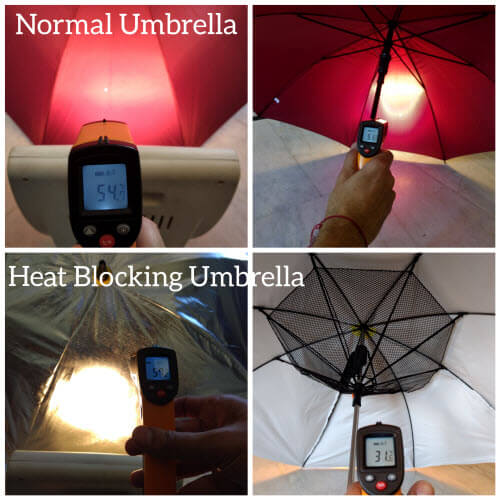
The final design is able to block out approximately 20°C
From fabric to finished product
Once the fabric and coating had been developed, it was then time to turn this into a product that a person could use or wear.
“We started with jackets made from the metallic fabric, but we realised it was not easy to develop this. For example, because the fabric touched the body, we needed to add in some ventilation,” explains Wadhwa.
“Then one day I went on a trip to Jaipur and I noticed that lots of people use umbrellas. I discussed this idea with the team, and we agreed to start developing an umbrella instead.
“Another reason we went with the umbrella was because the material gave the jacket an astronaut look, and we didn’t want to impact on the outfit.”
The final design is able to reflect back about 20°C. So, when the air temperature is 50°C outside, under the umbrella it feels more like 30°C.
There is also a small fan connected to the umbrella, which provides the user with a breeze too.
The next step for the company is to potentially start selling the umbrella: “We have not yet sold any umbrellas, but we have plans for this coming year if we can find a good platform and help from external sources,” explains Wadhwa.
“We will also try again with the jacket as a next step too.”