A major factor holding back the development of wearable biosensors for health monitoring is the lack of a lightweight, long-lasting power supply.
Now scientists at the University of Massachusetts Amherst, led by materials chemist Trisha Andrew, report that they have developed a method for making a charge-storing system that is easily integrated into clothing for “embroidering a charge-storing pattern onto any garment.”
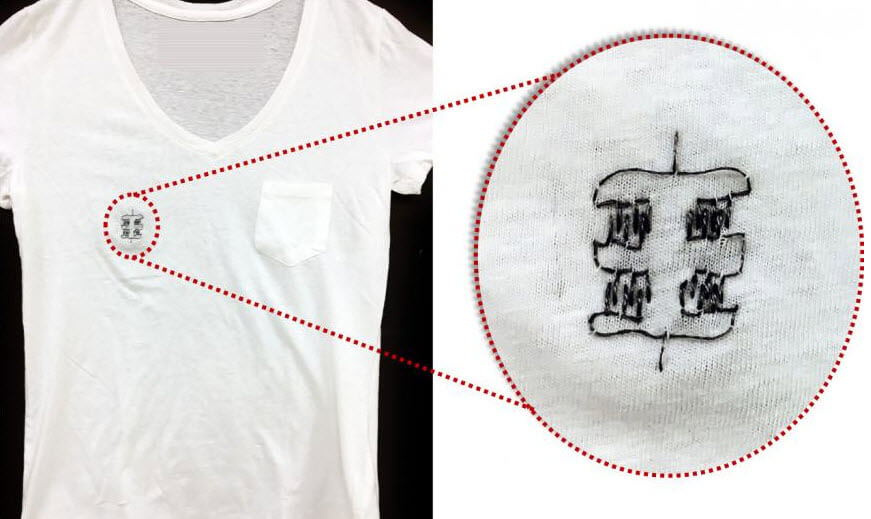
The researchers have developed a charge-storing device that can be embroidered onto a garment
“Batteries or other kinds of charge storage are still the limiting components for most portable, wearable, ingestible or flexible technologies,” says Andrew. “The devices tend to be some combination of too large, too heavy and not flexible.”
Their new method uses a micro-supercapacitor and combines vapour-coated conductive threads with a polymer film, plus a special sewing technique to create a flexible mesh of aligned electrodes on a textile backing. The resulting solid-state device has a high ability to store charge for its size, and other characteristics that allow it to power wearable biosensors.
“Each 2x2 mm² device is a micro-supercapacitor that is meant to power on-chip electronics,” says Andrew. “In our paper, we describe how many of these devices can be embroidered and connected together, like string lights, to linearly increase the storage capacity.
“A medium sized T-shirt with maybe a side panel fully embroidered with such devices would be able to charge a mobile phone.”
Andrew adds that while researchers have remarkably miniaturised many different electronic circuit components, until now the same could not be said for charge-storing devices.
“With this paper, we show that we can literally embroider a charge-storing pattern onto any garment using the vapour-coated threads that our lab makes. This opens the door for simply sewing circuits on self-powered smart garments.”
Additionally, the reactive vapour coating process creates coatings that are abrasion resistant, meaning that they are also machine washable.
Andrew and postdoctoral researcher and first author Lushuai Zhang, plus chemical engineering graduate student Wesley Viola, point out that supercapacitors are ideal candidates for wearable charge storage circuits because they have inherently higher power densities compared to batteries.
But, “incorporating electrochemically active materials with high electrical conductivities and rapid ion transport into textiles is challenging,” they add.
Andrew and colleagues show that their vapour coating process creates porous conducting polymer films on densely-twisted yarns, which can be easily swelled with electrolyte ions and maintain high charge storage capacity per unit length, as compared to prior work with dyed or extruded fibres.
Andrew, who directs the Wearable Electronics Lab at UMass Amherst, notes that textile scientists have tended not to use vapour deposition because of technical difficulties and high costs, but more recently, research has shown that the technology can be scaled up and remain cost-effective.
Before the technology can become commercially available, “the reactor that performs the reactive vapour coating process needs to be scaled up to manufacture the threads that store charge,” explains Andrew.
She and her team are currently working with others at the UMass Amherst Institute for Applied Life Sciences’ Personalised Health Monitoring Centre on incorporating the new embroidered charge-storage arrays with e-textile sensors and low-power microprocessors to build smart garments that can monitor a person’s gait and joint movements throughout a normal day.