With the textile industry beginning to evolve through the 4th Industrial Revolution, Santex Rimar Group is continuing its growth throughout its many divisions.
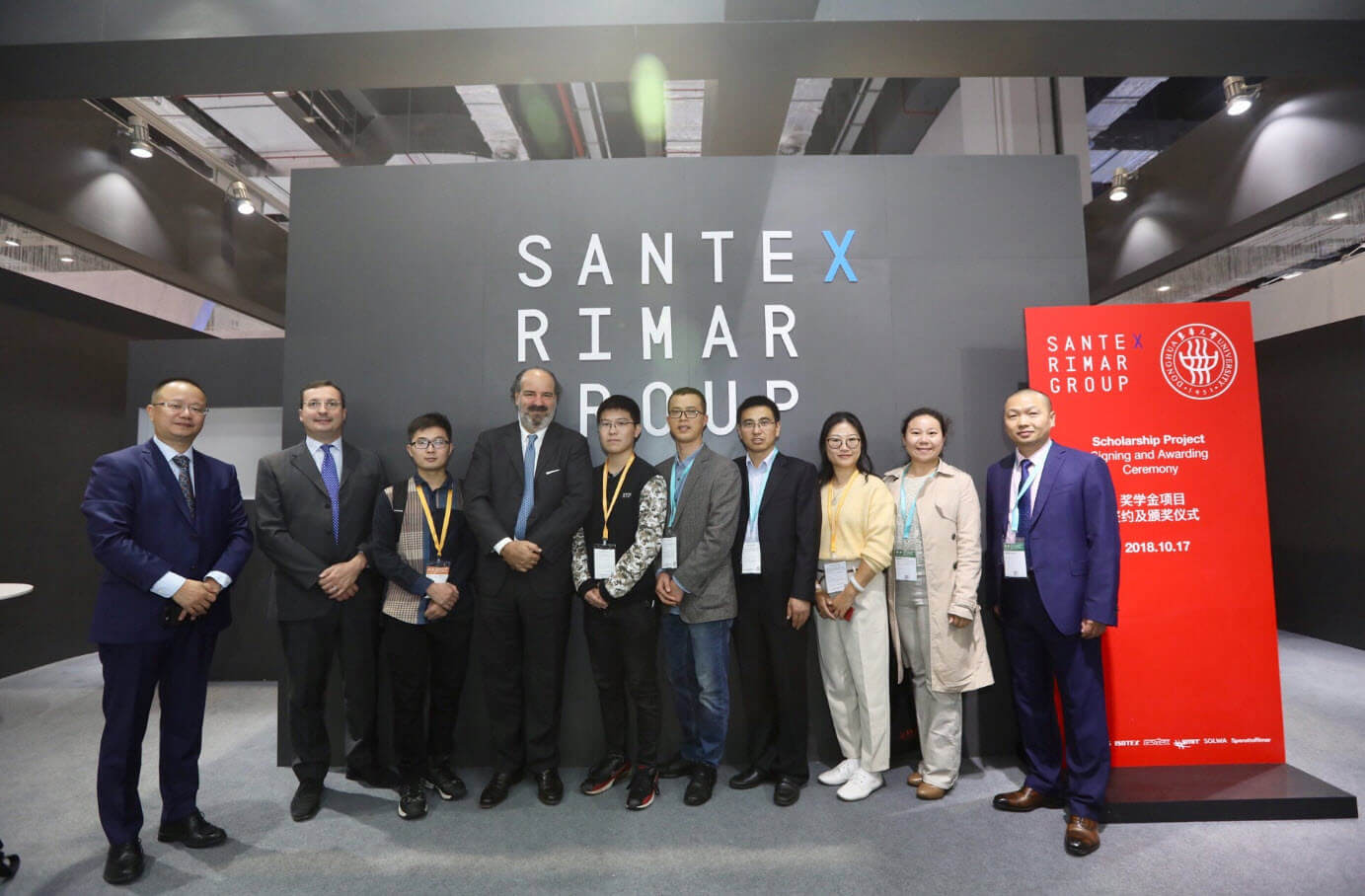
Santex Rimar Group awarded a scholarship to Donghua University students at ITMA Asia + CITME 2018
Santex Rimar Group’s CEO, Simone Rancan, explains that currently, and forecasting for 2019, the company sees growth everywhere, especially as it took over weaving machine manufacturer Smit two years ago. He says: “Our vision is of course to grow. We are already growing very fast at approximately 25% per year in terms of turnover as a group.”
As well as developing the brands it already has, the Group is also interested in making more acquisitions in the future as he forecasts that the textile industry will continue to consolidate. “What we see is big potential in textile machinery manufacturing to have further aggregations of players,” he says. “We want to be the right size to be able to take part in this consolidation that is going to happen in the future.”
Industry 4.0 is set to be responsible for the continued growth, both of Santex and of the textile industry more broadly. Rancan says: “I think that Industry 4.0 and sustainability are linked to the profit of the customer. Environmentally friendly means less waste and less waste for the customer means saving money.
“We are working in ways that means the customer will have less waste,” he continues. “For example, at the moment the customer checks the fabric at the end of the process. If they find some defects they need to scrap the fabric. But once you scrap a fabric which is dye and finished, you have wasted a lot of energy, time and materials. If you can avoid the defect before you add more value, this is something that is very interesting for the customer.”
And the stricter environmental regulations is only propelling the need for Industry 4.0 technologies. Rancan says: “The regulations are forcing companies to close or to change the technology.” Forcing companies to renovate their production lines.
Rancan adds: “Industry 4.0 and being environmentally friendly fit perfectly together, and it makes sense for customers.” Also, Rancan notes that automation is needed because, rather than taking people away from jobs, leading to a rise in unemployment, textile manufacturers actually struggle to find employees – particualrly over the last few years where younger generations have not wanted to work in the textile field.
As the Group covers so many different areas with its number of divisions, it has an advantage in Industry 4.0 in that it covers a broader area of the textile industry so is able to see problems from a broader point of view and aid in creating complete production workflows. Rancan says: “We see the textile process from different points. For example, if I only produce a weaving machine my priority is to make the machine faster and more reliable etc. But this may not be what is really needed in the process. The customer may want the machine faster, but maybe it does not help to have a weaving machine faster when there will be a bottleneck later on in the process. In the end, it’s not bringing you any results. So let’s see step-by-step, it is educational for us first and then we pass this to the customer.”
He adds: “A full production workflow with all different visions can help with streamlining workflows and changes in the process.”
ITMA Asia + CITME
Santex Rimar Group presented new surface finishing solutions under the Sperotto Rimar brand: SOFTA – high-speed brushing; and VELURA – high-speed raising. While Cavitec presented CAVIMELT P+P LINE, the new hotmelt coating and laminating line with a rotogravure system, and Smit presented the new GS980 F: the fastest free flight rapier machine for outstanding terry quality.
Additionally, the Group awarded scholarships to Donghua University students at a ceremony on its booth. The Group has signed a partnership project with Donghua University to keep exploring the growth of the new textile industry and build strong relationships with international students.
Every year, Santex Rimar Group says it will award two of Donghua University’s best students with a scholarship and training course at its headquarters based in Vicenza, Italy.
Wu Baogen, deputy director of Corporate Relations Office, Donghua University; Professor Xu, deputy Dean of Textile College, Donghua University; Liu Wenwei, party deputy secretary, Donghua University; and Yuan Haiyuan, director of the Admissions Office, Donghua University, all attended the signing and awarding ceremony at Santex Rimar Group’s booth on 17 October together with Ferdinando Businaro, Santex Rimar Group’s president: Simone Rancan, Group CEO; Jack Zhao, Santex Rimar Shanghai general manager; and Rock Luo, general manager of Smit Shanghai.
Wang Jue, senior student of Textile Engineering, and Zhang Kun, who majored in Textile Materials and Textile Design, are the awarded students of this first edition of the Donghua University – Santex Rimar Group scholarship project.
Markets
The Group’s main markets are fluctuating as the global economy continues to shift. For example, Turkey is a big market for the company but it is now suffering. India is always a big market for weaving, but now the company is looking to Central Asia, such as Uzbekistan and Tajikistan because of the amount of cotton in this region. “South-East Asia is also a big market, but Vietnam is now cooling because the Vietnamese heavily depend on Chinese investments,” says Rancan. “Bangladesh is very active and now we see the actions of China in Africa.”
Despite these popular markets, when it comes to weaving, in the last three/four years for example, Rancan states that “Italy alone always bought more weaving machines than the whole of South America.” Thus, there remains a strong textile market in Europe. However, Rancan continues that this is mainly limited to Italy, with a small amount of weaving now in Porutgal due to the ‘fast-fashion’ concept where “a share of your capacity you keep locally because you need to be able to react quickly [to the market] so you need the stock nearby or you need to be close in terms of shipment days. If you are in Portugal instead of India you save one month/six weeks. So for example, a company may not produce all its goods in Portugal but but will reshore a notable percentage in order to react better to the makret.”
For Rancan, the Spanish market is similar to that of Portugal. The UK textile indsutry he notes, is mostly finishing and the Group has started to have requests for finishing machinery in the US. “We think weaving may remain in South America, Mexico and Honduras, then from there they will go to the US,” he adds.