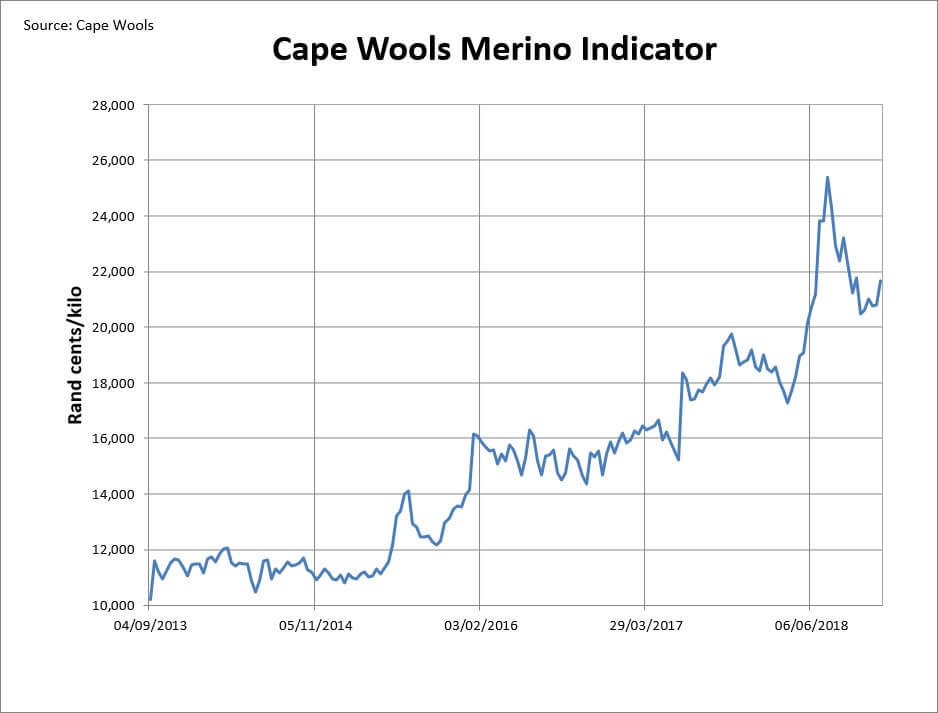
The opening sale of 2019 saw the South African wool market move up strongly on the back of substantial increases in Australia. The Cape Wools Merino Indicator increased by 863 points (4.2%) to close at a value of R216.48 (clean). The Cape Wools All Wool Indicator gained 3.9%.
There was extremely good competition for Merino wools, especially well grown wools with good length. The lower style wools and lambs’ wools were sellers favour and it is apparent that there will be a shortage of good wools from both Australia and South Africa due to the continuing droughts in both countries as well as the change in shearing patterns, leading to
more short wools being offered on the market.
The broader end of 19.5 micron and coarser wools increased more than the finer end due to the larger offerings of finer wools in Australia and with the clip in both countries having more hunger fine wools due to the drought.
This week saw the rand at R13.95 to the US dollar and R15.98 to the euro. The rand was 1.2% weaker against the US dollar and 2.2% weaker against the euro compared with the average rate at the previous sale.
The offering comprised 10,850 bales of which 95.8% was sold. Major traders were G Modiano SA (3,467 bales), Standard Wool SA (3,446), Lempriere SA (1,693) and Tianyu SA (1,306).
The average clean prices for the selection within the different micron categories for good top-making (MF5), long fleeces were as follows: 18 microns decreased 2.3% to close at R240.33/kg; 18.5 microns moved 1.8% up to close at R239.10/kg; 19 microns gained 3.6% to close at R230.98/kg; 19.5 microns strengthened by 3.2% to close at R230.07/kg; 20 microns was 3.2% stronger to close at R227.58/kg; 20.5 microns won 3.3% to close at R226.11/kg; 21 microns recovered 3.3% to close at R224.53/kg; 21.5 microns improved by 4.4% to close at R217.05/kg; 22 microns rose 4.3% to close at 213.83/kg and 22.5 microns climbed by 5%
to close at R214.83/kg.
Source: Cape Wools