Researchers at Northwestern University and San Diego State University (SDSU) have better unravelled the complex process of how black widow spiders transform proteins into steel-strength fibres. This knowledge promises to aid scientists in creating equally strong synthetic materials.
Black widow spiders and their relatives, native to temperate climates in North America, Europe, Asia, Australia, Africa and South America, produce an array of silks with exceptional material properties.
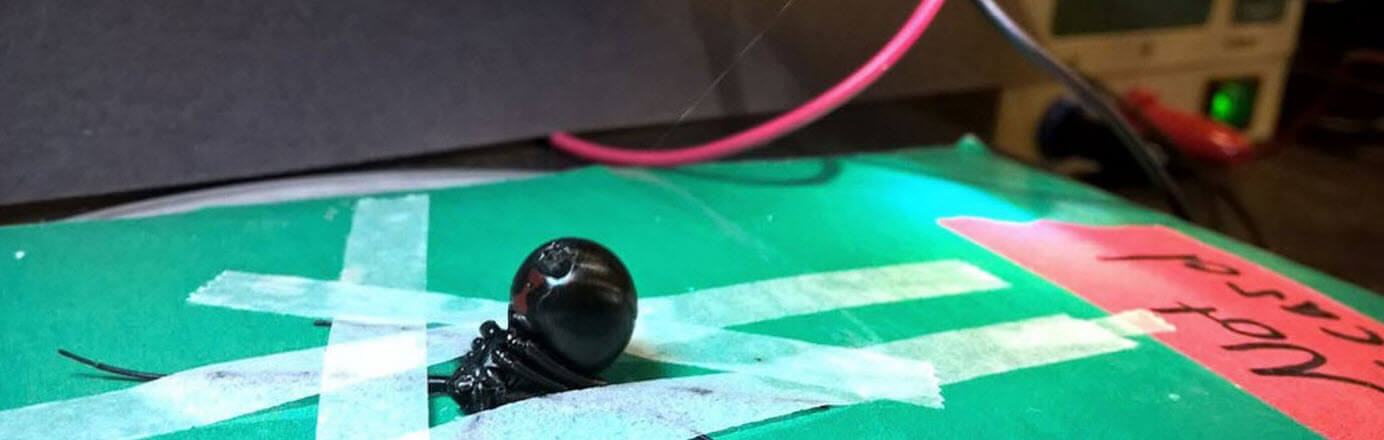
Black widow spiders produce an array of silks with exceptional material properties
The unknown
Scientists have long known the primary sequence of amino acids that make up some spider silk proteins and understood the structure of the fibres and webs.
Previous research theorised that spider silk proteins await the spinning process as nano-size amphiphilic spherical micelles (clusters of water soluble and non-soluble molecules) before being funnelled through the spider’s spinning apparatus to form silk fibres. However, when scientists attempted to replicate this process, they were unable to create synthetic materials with the strengths and properties of native spider silk fibres.
“The knowledge gap was literally in the middle,” says professor Nathan Gianneschi, department of chemistry, Northwestern University.
“What we didn’t understand completely is what goes on at the nanoscale in the silk glands or the spinning duct – the storage, transformation and transportation process involved in proteins becoming fibres.”
If a better and cost-effective version of synthetic spider silk could be developed, it could be used as a super-strong material
Complementary research techniques
Funded in part by the US Department of Defence through the Air Force Office of Scientific Research, the findings have been published in the journal Proceedings of the National Academy of Sciences (PNAS).
In the study, the two labs used different but complementary techniques to examine the nanoscale structure of micelles – a structure of molecules in liquid, involved in the very first stage of formation of the black widow’s dragline silk.
At SDSU’s Chemical Sciences Laboratory, the team used nuclear magnetic resonance (NMR) spectroscopy, the same technology involved in a hospital MRI to image soft tissue, which observes magnetic fields around atomic nuclei.
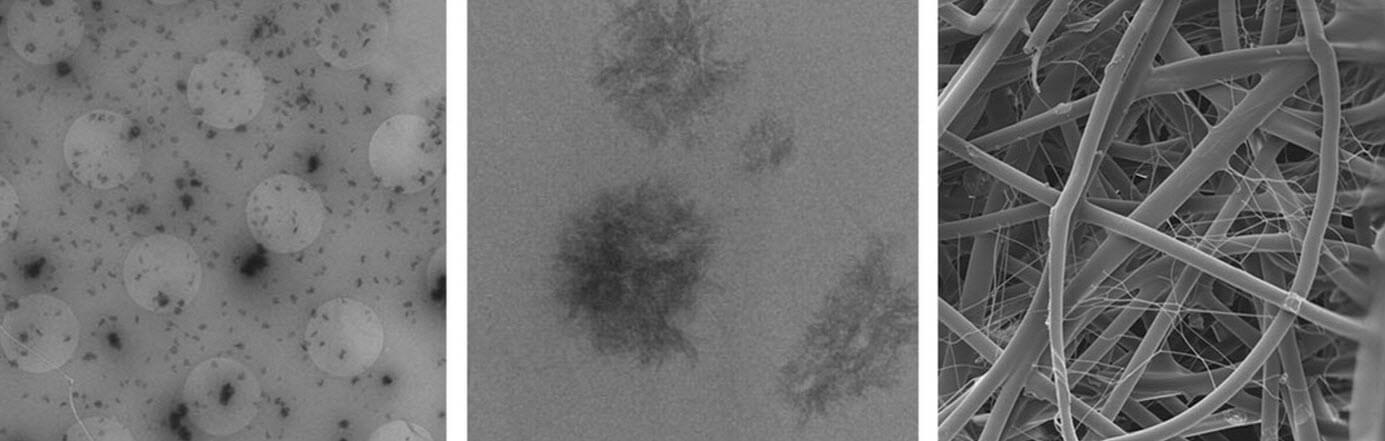
At Northwestern, Gianneschi employed high-resolution cryogenic transmission electron microscopy, a state-of-the-art, Nobel-winning technique to flash-freeze a solution and examine the nanoscale structures of protein molecules.
A convincing story
The researchers were looking to confirm whether the micelles form into spherical structures. “This hypothesis had been out there for a while,” says Gregory Holland, co-corresponding author of the study and a professor at SDSU. “Nobody had strong evidence that they actually existed.”
With two premier methods for determining biomolecular structure, the collaboration provided direct evidence the structure of the micelles is more complex than the spherical structures that had been hypothesised.
“It was the combination of these two advanced methods that allowed us to put together a truly convincing story,” says Holland, whose work with Gianneschi began when the latter was a researcher at the University of California, San Diego, US.
This ‘modified micelles theory’ concludes that spider silk proteins do not start out as simple spherical micelles, as previously thought, but instead as complex, compound micelles. This unique structure is potentially required to create the black widow spider’s impressive fibres.
“We now know that black widow spider silks are spun from hierarchical nano-assemblies (200-500 nanometres in diameter) of proteins stored in the spider’s abdomen, rather than from a random solution of individual proteins or from simple spherical particles,” adds Holland.
Limitless applications
If a better and cost-effective version of synthetic spider silk could be developed, it could be used as a super-strong material in military and industrial products, and as a biodegradable replacement for plastic. It would also hold promise for biomedical purposes, as is already the case for silkworm silk, Holland says.
“One cannot overstate the potential impact on materials and engineering if we can synthetically replicate this natural process to produce artificial fibres at scale,” says Gianneschi.
Holland adds: "The practical applications for a material like this are essentially limitless.”