
A study led by researchers from the University of Barcelona, Spain, has quantified the presence of textile microfibres across southern European marine floors.
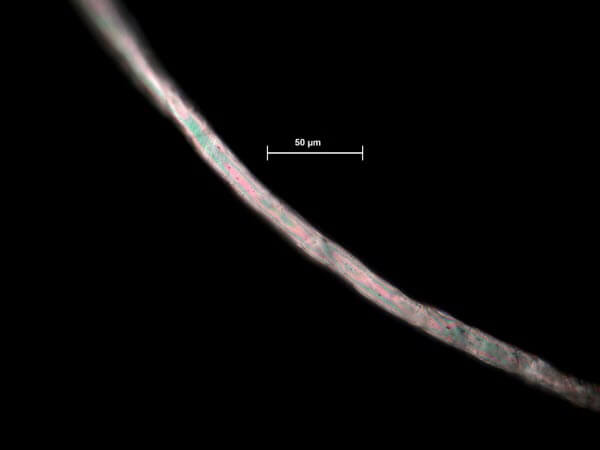
A polyester microfibre obtained in the Atlantic Ocean marine floors in a similar study. Image credit: Lucy Woodall, London Natural History Museum
The researchers analysed the amount of coloured fibres, which vary between 3 to 8 mm but are extremely fine, with less than a 0.1 mm diameter, and which come mainly from home and industrial washing machines.
The results show the dominance of cellulosic fibres over synthetic polymers and highlight that several oceanographic processes pile and transport microfibres to marine hollows.
These are some of the main conclusions of the article published in the scientific journal PLOS ONE by the researchers from the consolidated research group on Marine Geosciences of the Faculty of Earth Sciences of the University of Barcelona, in collaboration with the University of Plymouth, UK.
According to the researchers, the study reports the presence of this residue in marine floors and could help with the designing of effective management strategies to reduce the emission of microfibres with a potential negative effect on the marine ecosystems.
Residue in the deep
Microfibres are one of the most common microplastics in the marine environment, but such a deep study had not been carried out across such a large area until now, the researchers say.
The team analysed soil samples from 42 and 3,500 metres deep across 29 stations in southern European seas. The results show that higher densities of fibre are found in the Cantabrian Sea, followed by the Catalan seas and the Alboran Sea, respectively, while lower densities are in the western Mediterranean and the Black Sea.
The study also shows distance in deep seas is not a barrier to the accumulation of microfibres, since about 20% of these particles are accumulated in the open sea beyond 2,000 metres deep.
“Textile microfibres seem to concentrate at the bottom of submarine canyons, while the quantity in the slope is significantly lower,” says Anna Sánchez Vidal, from the Department of Earth and Ocean Dynamics at the University of Barcelona.
“This suggests microfibres, probably coming from the ground, are accumulated in the continental platform, from where they are swept and taken by several oceanographic processes to marine hollows through the natural conducts of marine canyons.”
Microfibres in deep water organisms
These findings also confirm previous studies that detected microfibres that were ingested by deep water organisms in a natural environment.
“Recent results show ingestions of microplastics by different organisms and in different ecosystems, but the specific impact on the organisms is unknown,” adds Sánchez Vidal.
“It can depend on a wide range of factors, such as features of the microfibres (size, abundance), or chemical substances these absorbed as well as the physiology and ecology (size, feeding, whether they excrete or accumulate) of marine organisms.”
The main type of microfibre they found in marine floors is natural cellulose (cotton, linen) and regenerated cellulose (rayon of viscose), coming from clothes and industrial textiles mainly.
Regarding synthetic fibres, polyester is the most common one, followed by acrylic, polyamide, polythene and polypropylene.
“Some of these synthetic microfibres are made of plastic, which does not degrade shortly, it can contain chemical additives, which can be easily incorporated to the trophic network,” explains Sánchez Vidal.
Measures to reduce emissions
For the researchers, the presence and persistence of microfibres in marine soils, and the negative impact these can have on marine organisms in the long run, makes it clear there is a need to design effective management strategies to reduce the emission.
“We need to advance research and innovation in the textile industry, in the design of effective filters for washing machines, in the treatment of waste waters, and the promotion of sustainable clothing,” concludes Sánchez Vidal.