Since its discovery, graphene has been used in many industries to make devices such as sensors, electronics, composites and biomedical products. However, there is an intrinsic limitation of graphene fibres arising from the folding and wrinkling of graphene layers during the fibre-spinning process.
But now, a research group under professor Sang Ouk Kim has applied polydopamine as an effective infiltrate binder to achieve high mechanical and electrical properties for graphene-based liquid crystalline fibres.
"Despite its technological potential, carbon fibre using graphene liquid crystals still has limits in terms of its structural limitations,” says Kim. “This technology will be applied to composite fibre fabrication and various wearable textile-based application devices."
Bio-inspired engineering
This bio-inspired defect engineering is clearly distinguishable from previous attempts with insulating binders and proposes great potential for versatile applications of flexible and wearable devices, as well as low-cost structural materials.
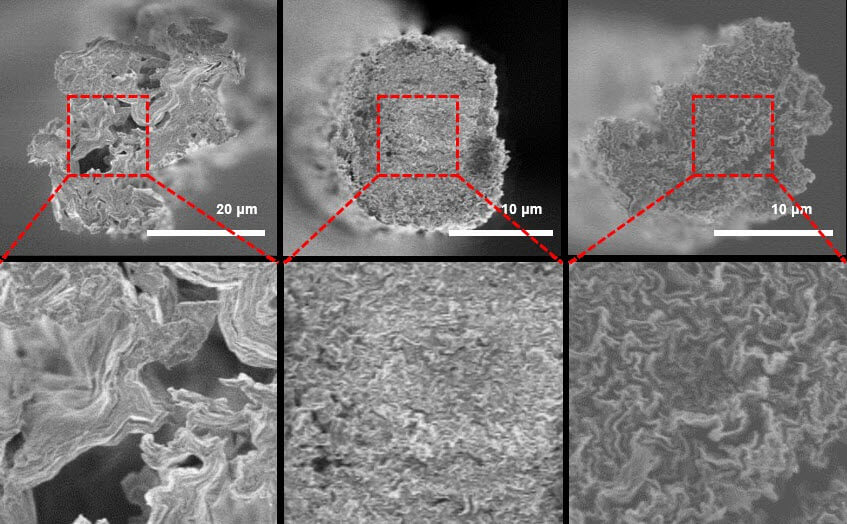
Cross-section SEM image of pure graphene fibre (left) and that of graphene fibre after two-stage defect control using polydopamine (middle and right)
Bio-inspired graphene-based fibre holds great promise for a wide range of applications, including flexible electronics, multifunctional textiles and wearable sensors.
In 2009, the research group discovered graphene oxide liquid crystals in aqueous media while introducing an effective purification process to remove ionic impurities. Graphene fibres, typically wet-spun from aqueous graphene oxide liquid crystal dispersion, are expected to demonstrate superior thermal and electrical conductivities as well as outstanding mechanical performance.
Nonetheless, owing to the inherent formation of defects and voids caused by bending and wrinkling the graphene oxide layer within graphene fibres, their mechanical strength and electrical/thermal conductivities are still far below the desired ideal values.
Accordingly, finding an efficient method for constructing the densely packed graphene fibres with strong interlayer interaction is a principal challenge.
Kim's team focused on the adhesion properties of dopamine, a polymer developed with the inspiration of the natural mussel, to solve the problem. This functional polymer, which is studied in various fields, can increase the adhesion between the graphene layers and prevent structural defects.
Success
The research group succeeded in fabricating high-strength graphene liquid crystalline fibres with controlled structural defects. They also fabricated fibres with improved electrical conductivity through the post-carbonisation process of polydopamine.
Based on the theory that dopamine with subsequent high temperature annealing has a similar structure with that of graphene, the team optimised dopamine polymerisation conditions and solved the inherent defect control problems of existing graphene fibres.
They also confirmed that the physical properties of dopamine are improved in terms of electrical conductivity due to the influence of nitrogen in dopamine molecules, without damaging the conductivity, which is the fundamental limit of conventional polymers.
This research was supported by the National Creative Research Initiative (CRI) Centre for Multi-Dimensional Directed Nanoscale Assembly and the Nanomaterial Technology Development Programme through the National Research Foundation of Korea funded by the Ministry of Science and ICT.