Sophisticated programming is seeing weaving machines becoming increasingly suited to the creation of complex structures and 3D components, writes Adrian Wilson.
For evidence of the way the textile industry is rapidly changing, look no further than the agenda of the UK Weaving Group’s 2018 seminar – entitled Textiles – Not As We Know It – to be held on 4 October.
Today’s weaving industry, let us not forget, has its origins in the Industrial Revolution which was sparked in the UK by the introduction of initial automation concepts from the 1780s, and the gradual grip of power looms starting from the beginning of the 19th Century, when there were still around 250,000 hand weavers working from cottages in the UK. Weaving has also been described as the first truly digital process, being binary by its nature.
The tremendous changes that followed are well documented in history books, but could a similar leap forward be about to take place? Many believe so, given the rapid advancement of Industry 4.0 and new automation.
As would be expected of such a long-established conference, speakers from all of today’s major European weaving machinery builders – Picanol, of Belgium, ITEMA of Italy, Germany’s Dornier and Groz-Beckert, Stäubli of Switzerland and Sweden’s Eltex – will be present at the UK Weaving Group’s 2018 event, which takes place in Bradford, West Yorkshire, UK.
Yet alongside them, are new and perhaps unfamiliar businesses to the delegates of such a conference, including the AMRC Factory 2050 and Flexciton, while Professor Prasad Potluri of the University of Manchester will address the advent of 3D weaving and robotics and consultant David Steen will talk about how the Internet of Things will impact on such a traditional field.
AMRC Factory 2050
The AMRC Factory 2050 is the UK’s first state of the art factory entirely dedicated to conducting collaborative research into reconfigurable, digitally-assisted assembly, component manufacturing and machining technologies, and is capable of rapidly switching production between different high-value components and one-off parts.
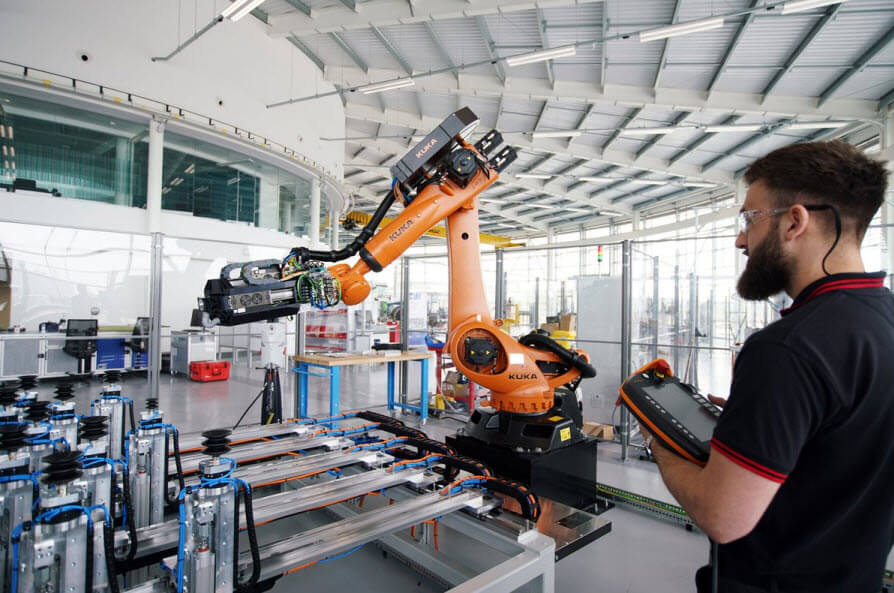
Traditional weaving and braiding technologies work alongside robots and automated guided vehicles at the AMRC Factory 2050 in Sheffield, UK
As such, it is the first building to be completed on the University of Sheffield’s new Advanced Manufacturing Campus and its landmark circular glass building and rectangular extension is home to the AMRC’s Integrated Manufacturing Group (IMG).
IMG’s work spans: robotics and automation; integrated large volume metrology; digitally-assisted assembly; and manufacturing informatics. Among other things, the group is developing ways of meeting demand for high variation and mass customisation, intelligent machines and processes that monitor and optimise their operations, techniques to shorten lead times and ramp production up and down rapidly, ways of handling and making sense of big data, human machine collaboration and techniques for digitally assisted assembly.
New equipment installed at Factory 2050 includes a Kuka Titan heavy-duty 6-axis robot, controlled by a Siemens 840DSL controller and Kuka omniMove automated guided vehicles (AGVs).
The Kuka Titan is being upgraded to carry out heavy duty machining of difficult to machine materials, offering a more flexible alternative to traditional machine tools. The AGVs, capable of carrying loads of up to 15 tons and believed to be the first installed at any UK research and development facility, are being developed to work more autonomously with the wider smart factory setup.
Initial projects include a programme to take aerospace manufacturing technology into the construction industry, explore future digital factory technologies for building commercial aeroplanes and investigate digitally assisted assembly technologies that could help to fill a looming skills gap in the aerospace sector.
Intelligence
Flexciton, meanwhile, is engaged in building intelligent planning and scheduling web applications that can interact with real time data from manufacturing operations and has already implemented a full system at one UK weaving operation running 70 looms.
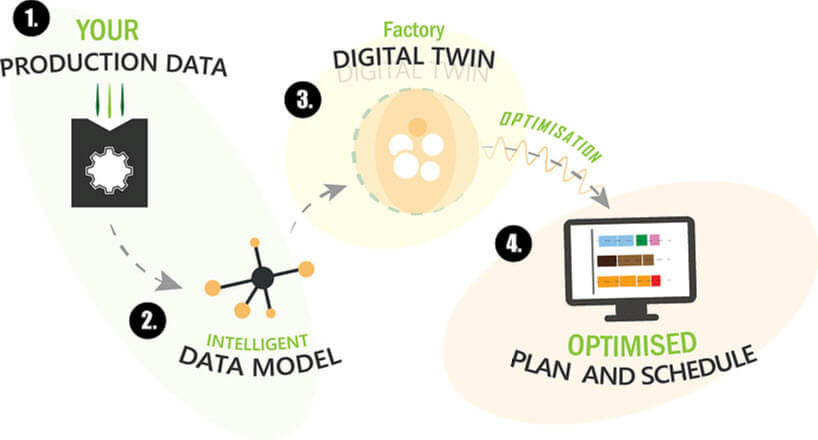
Flexciton’s software explores existing legacy systems to collect data and build a digital twin of a manufacturing plant, containing all constraints and parameters
“Planning and scheduling day-to-day production is incredibly difficult,” says the company’s head of business development, Luke Watkins. “Complicated production sequences, rush orders and unplanned events such as raw material delays and equipment breakdowns cause daily fire-fights with Excel or other clunky software. Companies have vast amounts of data recorded about their operations, but struggle to learn anything meaningful from it all. Our solution is simple, powerful software that can be implemented within any manufacturing facility.”
Its implementation, he adds, involves four basic steps. “We use your existing legacy systems to collect data, with no need to install new hardware, and then build a digital twin of the plant, containing all constraints and parameters. Our patented AI optimisation algorithms search the digital twin to find the best planning and scheduling solution for the set objectives and the optimised plan and schedule is calculated for a desired time horizon. All results are displayed using a simple-to-use web application.
“This has been proven to save manufacturers up to 20% in operational costs, with zero capital expense required. Implementation generally takes 3-6 months, but once set up, the results are immediate.”
Technical textiles
The established weaving machine manufacturers are well aware of the tremendous potential for positive change Industry 4.0 suggests, of course, and most notably in the production of technical textiles.
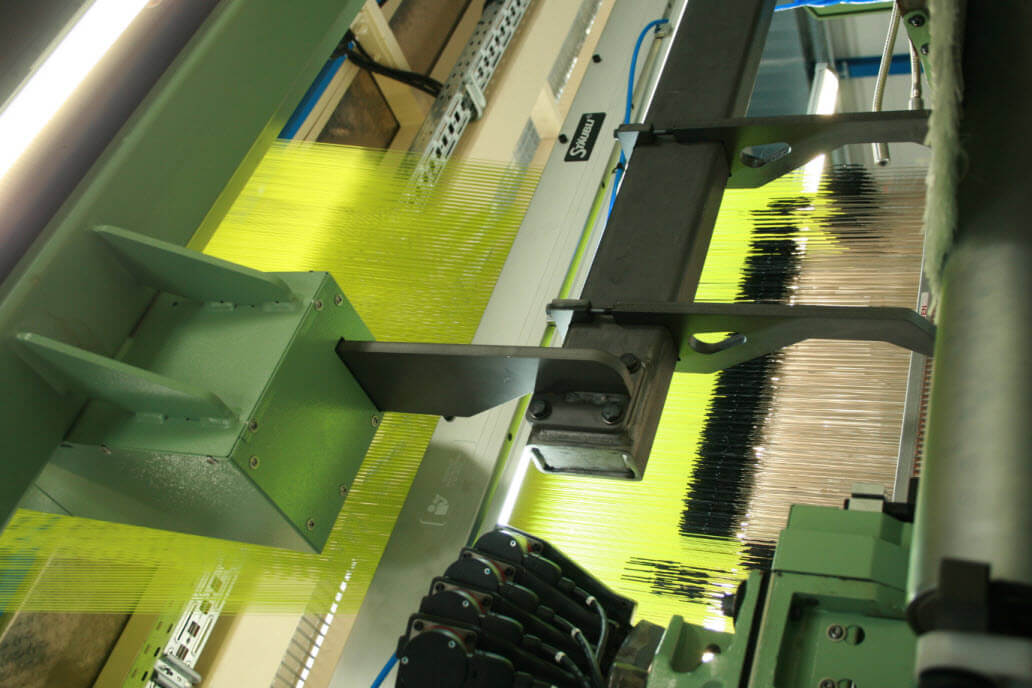
Stäubli, for example, was founded on advanced weaving technology back in 1892 and today is a specialist in the Jacquard harnesses which feed warp threads to weaving machines – as many as 40,000 of them per single unit – with total reproducibility.
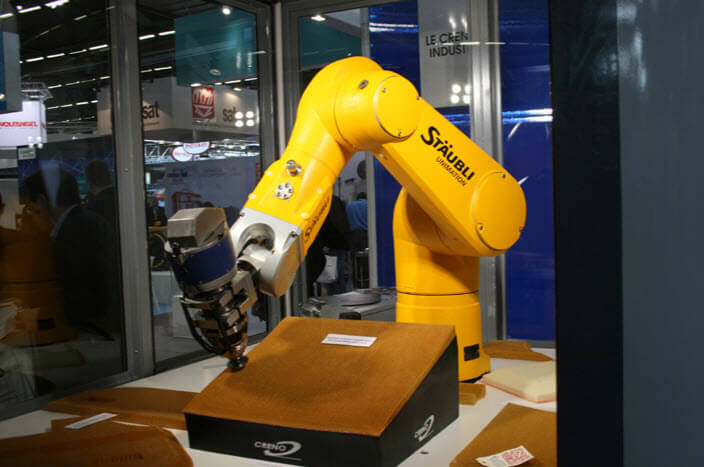
Switzerland’s Stäubli has three divisions – Textiles, Connectors and Robotics – for which it is actively exploring Industry 4.0 synergies
Given this long digital heritage, it’s perhaps no surprise that Stäubli should have developed over the decades into a specialist in mechatronic solutions, with annual sales of over CHF1bn and three divisions in 2017 – Textiles, Connectors and Robotics.
“We are now looking for more interaction between our divisions because it’s clear to me that Industry 4.0 will render many more opportunities to bring them and our global customers and our divisions together,” says Fritz Legler, Stäubli’s head of marketing, sales and customer support.
Stäubli’s Safir automatic drawing-in machines are designed to ensure perfect drawing in into the drop wires, healds and reed, depending on the model of the loom and jacquard, featuring optimised thread guiding elements without sharp edges or excessive abrasiveness and reducing yarn deflections to a minimum.
The key factors for achieving perfect results in the subsequent weaving process meanwhile, are a high degree of flexibility and reliability, optimally designed machine components and well-coordinated and gentle yarn handling mechanics when it comes to warp supply, shed formation, weft insertion and fabric take-off.
“Many complex woven fabrics consist of multiple materials, and the required weave structure – both in the warp and weft direction – must ultimately possess exacting properties such as high wear resistance, draping ability or specific absorption properties,” says Legler. “Woven spacer fabrics, on the other hand, must have an absolutely uniform distance between the layers, across the entire fabric area. Only when such requirements are met in the weaving process can the finished composite component deliver the expected benefits in actual service.”
Stäubli dobbies and Jacquard machines designed to handle such sophisticated demands include the LX/LXL and Unival Jacquard machines which have proven successful worldwide in producing technical textiles – from flat materials to the most complex 3D fabrics. In addition, with the TF weaving system, Stäubli is now supplying a high-performance weaving system for the flexible production of reinforcing fabrics and heavy industrial textiles.
“TF weaving systems are individually configurable and adapted exactly to the requirements of the articles to be woven, from warp supply to rapier, shed formation and pile weave, even the beat-up of the reed and fabric take-off,” says Legler. “Specific system components for each part of the weaving process provide tremendous flexibility and give mills the chance to take a leadership position in the technical textiles market.”
Expanded possibilities
Dornier’s 3D Jacquard weaving technology significantly expands the possibilities for the production of reinforced, multiple layer semi-finished structural woven parts.
The technology enables components to be designed, for example, to provide increased shear strength in one area and increased axial stiffness in another.
By controlling the fibre architecture in this way, it is possible to engineer components that meet specific performance goals while simultaneously satisfying component cost, qualification, certification, and eventual production needs.
Flexciton’s software explores existing legacy systems to collect data and build a digital twin of a manufacturing plant, containing all constraints and parameters
With contour weaving, either single or multi-layer 3D woven axisymmetric structures with contoured cross-sectional profiles can be manufactured so that the final woven preform shape – referred to as ‘near-net shape within the industry – is similar to that of the final component shape.
The reinforcement fibres can also be ‘steered’ to turn and follow the natural geometry of a part.
As a consequence, the technology can both reduce part production costs and improve product structural performance.
A 3D machine is now available for trials at the Dornier CS Technology Center in Dornier, Germany.
Human potential
For Belgium-headquartered Picanol, flexibility, teamwork and reacting in an intelligent way to new technological challenges are just as much the keys to success as automation and product development.
“We believe steadfastly in the further development of the manufacturing industry in Belgium and aim to commit ourselves fully to the future and sustainable growth, with our personnel as the driving force,” says Geert Ostyn, the company’s vice-president of weaving machines.
Last year, Picanol launched its Let’s Make it Together programme based on three simple priorities – developing world-class production technology, the further digitisation of processes and a firm focus on developing its people.
“We are testing various new technologies within the group to find out how they can help us in carrying out heavy work,” Ostyn explains. “We have recently acquired several exoskeletons, for example – wearable machines or powered suits that help people to lift and carry heavy loads, giving them superhuman strength. There are many types of exoskeleton, depending on the application for which they are intended, and different types are currently being tried out at various places in our production plant.
“In addition, we have various projects running to explore the possibilities of virtual reality for training. The users wear headsets with visual displays that simulate a particular environment, giving them the impression of being physically present in the virtual world.”
Picanol has an outstanding track record, in particular, in the production of high-tech rapier machines, having launched its first weaving machine with rapier insertion in 1975 and subsequently installed over 90,000 worldwide.
With industrial speeds of up to 750 rpm, the OptiMax-i is unquestionably the world’s fastest rapier weaving machine in industrial production.
Recently, it has been further developed for increased performance, with a more rigid construction, new applications, smart energy efficiency and improved ergonomics and user-friendliness.
Available in reed widths ranging from 190 to 540 centimetres, the OptiMax-I’s versatility results from its guided gripper and free flight systems, along with new developments such as its electronic filling tensioner, SmartEye filling detector and the SmartCut filling cutter.