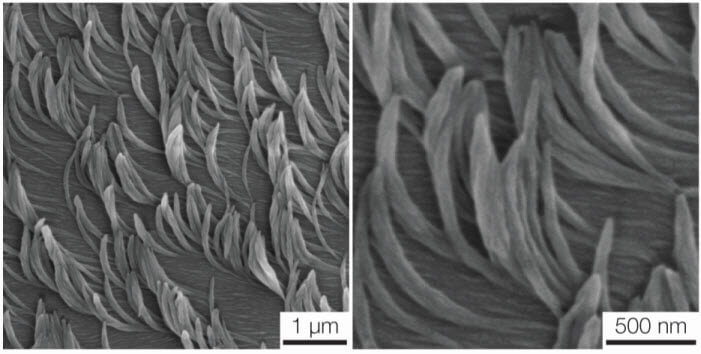
Inspired by the characteristics of polar bear fur, lotus leaves and gecko feet, engineering researchers have developed a new way to make arrays of nanofibres that could bring us coatings that are sticky, repellent, insulating or light emitting.
“This is so removed from anything I’ve ever seen that I thought it was impossible,” says Joerg Lahann, a professor of chemical engineering at the University of Michigan and senior author of the paper, which appears in the journal Science.
Polar bear hairs are structured to let light in while keeping heat from escaping. Water-repelling lotus leaves are coated with arrays of microscopic waxy tubules. And the nanoscale hairs on the bottoms of gravity-defying gecko feet get so close to other surfaces that atomic forces of attraction come into play.
Researchers looking to mimic these superpowers and more have needed a way to create the minuscule arrays that do the work. “Fundamentally, this is a completely different way of making nanofibre arrays,” says Lahann.
Accidental success
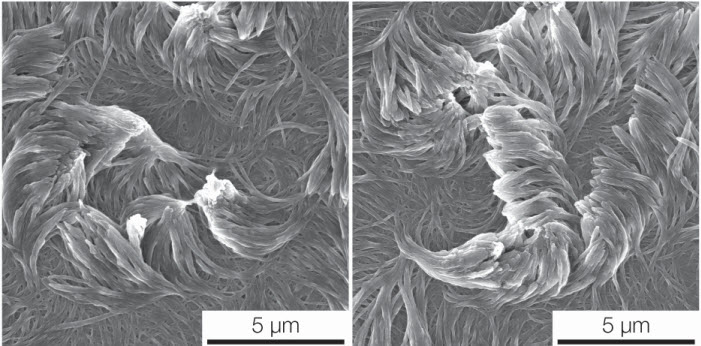
The researchers have shown that their nanofibres repelled water like lotus leaves. They grew straight and curved fibres and tested how they stuck together like Velcro – finding that clockwise and counter clockwise twisted fibres knitted together more tightly than two arrays of straight fibres.
They also experimented with optical properties, making a material that glows. The team believes it will be possible to make a structure that works like polar bear fur, with individual fibres structured to channel light.
But molecular carpets weren’t the original plan. Lahann’s group was working with that of Nicholas Abbott, at the time a professor of chemical engineering at UW-Madison, to put thin films of chain-like molecules, called polymers, on top of liquid crystals.
Liquid crystals are best known for their use in displays such as televisions and computer screens. They were trying to make sensors that could detect single molecules.
Lahann brought the expertise in producing thin films while Abbott led the design and production of the liquid crystals. In typical experiments, Lahann’s group evaporates single links in the chain and coaxes them to condense onto surfaces. But the thin polymer films sometimes didn’t materialise as expected.
“The discovery reinforces my view that the best advances in science and engineering occur when things don’t go as planned,” adds Abbott. “You just have to be alert and view failed experiments as opportunities.”
The technique
Instead of coating the top of the liquid crystal, the links slipped into the fluid and connected with each other on the glass slide. The liquid crystal then guided the shapes of the nanofibres growing up from the bottom, creating nanoscale carpets.
“A liquid crystal is a relatively disordered fluid, yet it can template the formation of nanofibres with remarkably well-defined lengths and diameters,” says Abbott.
And they didn’t only make straight strands. Depending on the liquid crystal, they could generate curved fibres, like microscopic bananas or staircases.
“We have a lot of control over the chemistry, the type of fibres, the architecture of the fibres and how we deposit them,” says Lahann. “This really adds a lot of complexity to the way we can engineer surfaces now - not just with thin two-dimensional films, but in three dimensions, too.”
The research was supported by the Army Research Office.