For more than three million people around the world, kidney failure is a life-altering diagnosis, if not a life-threatening one. While around 17% of people in the US with end-stage kidney disease are now getting transplants, the average time spent waiting is three to five years. Much of that time is consumed by planning for, receiving and recovering from treatment. These people spend several hours multiple times each week attached to a dialysis machine that cleans the toxins from their blood — easing the workload on their kidneys.
Dialysis can temporarily replace the function of the kidney while patients await a transplant. But it can also impose quite a few limitations on the quality of their life — effectively tethering patients to a dialysis machine and, likely, a medical facility. It’s such an imposing sentence that some people choose to delay or forego the procedure and take their chances while waiting for a kidney transplant.
But now, in a paper recently published in ACS Nano, researchers from Drexel, the University of California Los Angeles, Brighton University in England, Guangxi Medical University and Huazhong University of Science and Technology in China, and Symbiosis International University in India, report that MXene materials could be a candidate for removing urea from blood in wearable artificial kidney applications.
“This is an exciting development for biomedical technology,” says Yury Gogotsi, PhD, professor in Drexel’s College of Engineering in the Department of Materials Science and Engineering, who led the research.
“This material has shown a better ability to adsorb urea molecules from the blood plasma compared to other known sorbents. This means it could one day make the wearable kidney a reality, improving quality of life for many people.”
MXene
MXene materials are composed of nanometre-thin layers whose chemical composition and spacing can be tailored to make them incredibly selective filters.
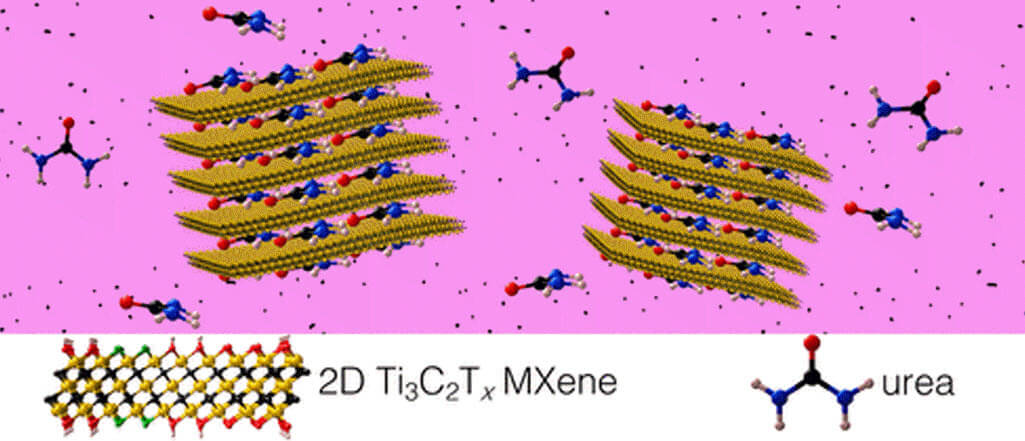
MXenes’ layered structure can be intercalated and deintercalated with water and urea
MXene materials have been put to use in trapping electromagnetic radiation, transmitting radio waves and enhancing the flow of electricity. In the paper, the group explains how they can also be designed to filter urea molecules:
“Similar to clays, MXenes’ layered structure can be intercalated and deintercalated with water and organic molecules, such as hydrazine, urea and cationic dyes.
“This suggests that the MXene structure could potentially be fine-tuned to absorb urea by optimising the chemical composition and interlaminar distance of the material.”
In addition to this physical menagerie, the chemical arrangement of the layers also creates a molecular attraction to the urea particles, according to the researchers.
Taken together, these properties of MXene, which can be optimised through additional research, could make them the ideal material to ease the kidney’s urea-filtration workload.
Urea removal
Looking at just three of the 30 types of MXene materials that are already available, the study shows that they can remove 99% of urea from an aqueous urea solution and 94% from dialysate — the water that absorbs urea in dialysis.
“The removal of urea has been a very challenging problem because the molecule is small and conventional sorbents, such as activated charcoal do not absorb it in sufficient quantities,” says Gogotsi.
“We have been studying the use of porous carbons for blood cleansing with our colleagues from Brighton University for more than a decade, but the one molecule we could not remove from the blood with carbon was urea.
“When we first synthesised MXene and began testing its properties, we found that urea could be intercalated into it — which was the important discovery that eventually led to this paper, recognising MXenes’ potential for use in wearable artificial kidneys.”
Current restrains
Portable dialysis devices, which have been in development for decades, still cannot accomplish the task of removing urea well enough.
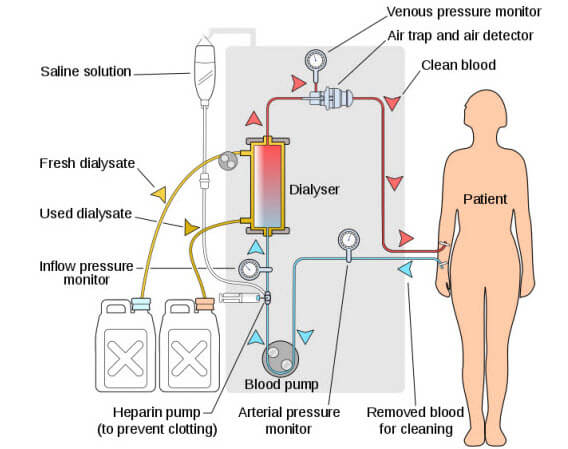
Portable dialysis devices, which have been in development for decades, still cannot accomplish the task of removing urea well enough
They also use an enzyme to break down the urea in the dialysate, into carbon dioxide and ammonia. The carbon dioxide must be carefully vented to prevent bubbles from getting into the circulatory system. And the ammonia must be absorbed by a special filter before it reaches toxic levels.
All of this adds weight to a device that resembles a large tool belt and is meant to be worn continuously throughout the day.
The authors, among them Victor Gura, managing director from Cedars Sinai Medical Center, Los Angeles, US, and the University of California’s David Geffen School of Medicine, who developed the first wearable artificial kidney technology, note that more frequent and longer dialysis has proven to be associated with better outcomes:
“In healthy humans, blood is continuously filtered by kidneys, that is, 168 hours a week, maintaining perfect homeostasis of electrolytes, acid-base equilibrium and fluid balance.
“As such, imitating the nonstop filtration may be a worthy goal to achieve better health and quality of life in end-stage renal disease patients, leading to the concept of the wearable artificial kidney.”
What’s next?
While there is still a long road of refinement and testing ahead of the technology, the possibility of modifying and integrating MXene materials could remove some of its most daunting obstacles.
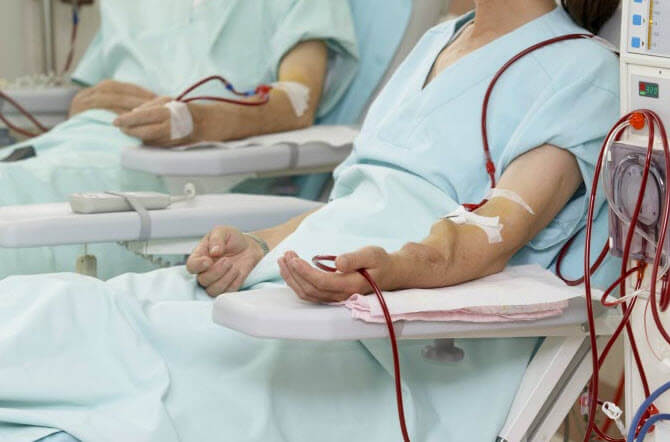
The next step for the researchers is to figure out which type of MXene is the best for filtering urea
The next step for the researchers is to figure out which type of MXene is the best for filtering urea and to continue tests that show it is safe to use in medical applications.
“This seemingly small discovery that some new materials can remove urea from the blood, could actually have quite a significant impact on the quality of lives for people with kidney failure,” says Sergey Mikhalovsky, PhD, a co-author from the University of Brighton’s School of Pharmacy and Biomolecular Sciences.
“Giving patients an alternative to in-clinic dialysis, and a chance to maintain a more normal routine while waiting for a kidney transplant, will ultimately save lives.”
The research was funded by the US Department of Energy and the British Council and the UK Global Innovation Initiative. To read the full paper, visit: https://pubs.acs.org/doi/10.1021/acsnano.8b06494