
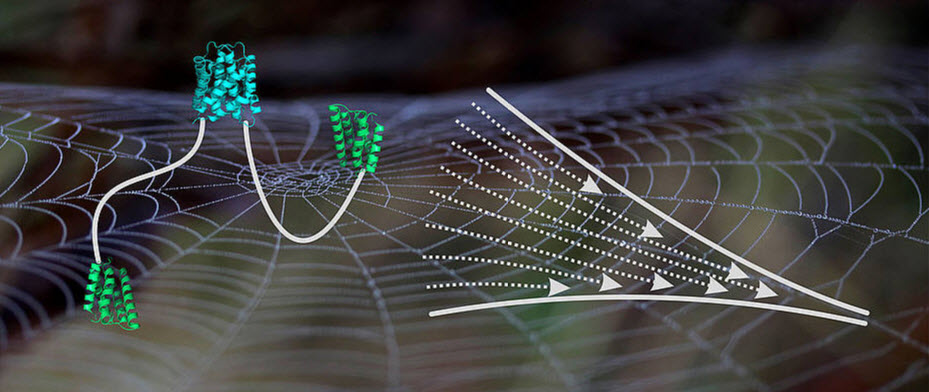
Spider silk belongs to the toughest fibres in nature and has astounding properties. They are lightweight, almost invisible, highly extensible and strong, and of course biodegradable.
In fact, spider silk belongs to the toughest fibres in nature. Based on its low weight it even supersedes high-tech threads such as Kevlar or Carbon. Its unique combination of strength and extensibility renders it particularly attractive for use in industry. Whether it be the aviation industry, textile industry, or medicine, the potential applications of this material are manifold.
For a long time now, scientists have continued to try reproducing the fibre in the laboratory, but with limited success. Today, it is possible to manufacture artificial spider silk of similar properties, but at the molecular-level, structural details responsible for material properties await to be disclosed.
Now, scientists from the Julius-Maximilians-Universität Würzburg (JMU) have discovered new molecular details of self-assembly of a spider silk fibre protein.
“The silk fibres consist of protein building blocks, so-called spidroins, which are assembled by spiders within their spinning gland,” explains Dr Hannes Neuweiler, lecturer at the Institute of Biotechnology and Biophysics at JMU, who is in charge of the project.
The terminal ends of these building blocks take special roles in this process. The two ends of a spidroin are terminated by an N- and a C-terminal domain. The domains at both ends connect the protein building blocks together.
In the present study, Neuweiler and his colleagues took a close look at the C-terminal domain. The C-terminal domain connects the two spidroins through formation of an intertwined structure that resembles a molecular clamp.
“We observed that the clamp self-assembles in two discrete steps,” says Neuweiler. “While the first step comprises association of two chain ends, the second step involves the folding of labile helices in the periphery of the domain.”
This two-step process of self-assembly was previously unknown and may contribute to the existing knowledge of spider silk.
The stretching of spider silk is thought to be similar to that of a helix unfolding. Previous work, however, traced extensibility back to the unfolding of helices in the central segment of spidroins.
“We propose that the C-terminal domain might also act as module that contributes to extensibility,” adds Neuweiler.
In the study, the researchers investigated protein building blocks of the nursery web spider (Euprosthenops australis). They used genetic engineering to exchange individual moieties of the building blocks and modified the protein chemically using fluorescent dyes. Finally, the interaction of light with soluble proteins disclosed that the domain assembles in two discrete steps.
Neuweiler describes the result as “a contribution to our molecular-level understanding of structure, assembly and mechanical properties of spider silk.”
It may aid material scientists to reproduce natural spider silk in the laboratory. Currently, modified and synthetic spidroins are being used for this purpose.
Neuweiler adds: “Should the C-terminal domain contribute to flexibility of the thread, material scientists may modulate mechanical properties of the fibre through modulation of the C-terminal domain.”
The results are published in the scientific journal Nature Communications.


