Maru Swimwear has partnered up with the SEA LIFE Trust in a bid to tackle ocean plastic pollution. David Allen, CEO at Maru, explains more to Jess Owen.
Plastic pollution is a global issue. Every piece of plastic that has ever been made still exists in some form, with eight million tonnes of plastic ending up in the ocean every year. If that wasn’t enough, much of the ocean plastic that breaks down into smaller, microplastics, ends up in our food chain.

Maru has a goal to have all swimsuits made from regenerated products by 2020
Now, Maru Swimwear, a British performance swimwear brand, has announced its partnership with the SEA LIFE Trust, a global charity dedicated to protecting the world’s oceans and the marine life that lives within them.
“We are all aware of the immense amount of work needed to protect our oceans from the intense pollution caused by plastic waste,” says David Allen, CEO of Maru.
The partnership will see Maru donate 100% of its profit from the sales of its new eco swimwear range, Black Pack, to the SEA LIFE Trust to help fund the many projects and campaigns they run globally to reduce ocean plastic.
The Black Pack range
“Maru has been making efforts to practice sustainability for the past several years, but this specific project began in April 2018,” says Allen. “With the cultural conversation shifting to climate change and the increased awareness of the problems surrounding plastic, we knew we could be doing more to help.”
The partnership will see Maru donate 100% of its profit from the sales of its new eco swimwear range, Black Pack, to the SEA LIFE Trust
Each swimsuit in the Black Pack range is manufactured using ECONYL. This is a regenerated nylon yarn made from pre and post-consumer waste, including ghost fishing nets, fabric scraps from mills and carpet fluff.
“This waste goes through a regeneration and purification process and the nylon is regenerated right back into its original purity,” says Allen. “The regenerated nylon polymer is turned into yarn, which is then woven into our swimwear fabric.”
Overall Maru’s ECOTECH fabric is 78% ECONYL regenerated nylon yarn and 22% Lycra Xtra Life, to give the costume its stretch.
“By manufacturing our Black Pack range from ECONYL, it ensures we adopt a closed loop approach by recovering waste plastic and regenerating it into something new.”
The Black Pack costumes have a stylish and subtle use of mesh panelling, which alongside vibrant colour accents, provide a Maru twist on the black costume.
“Our ECOTECH fabric also has many qualities, which makes the Black Pack range the perfect combination of chic, high quality and sustainable.”
The range is ‘ultrachlorine’ resistant, has UV protection, muscular compression and shape retention qualities. Additionally, the fabric is soft and offers breathability while the Lycra Xtra Life allows for long lasting stretch.
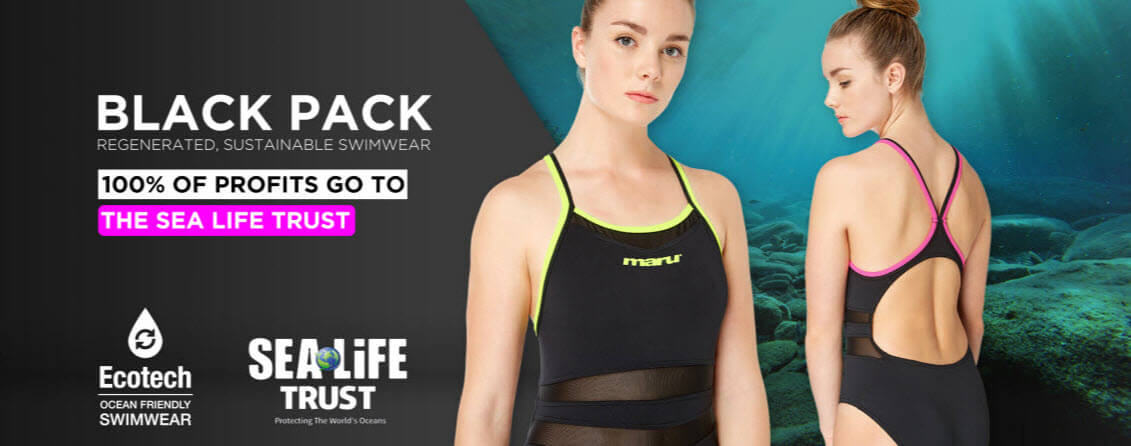
Maru’s ECOTECH fabric is 78% ECONYL regenerated nylon yarn and 22% Lycra Xtra Life
Challenges
As with almost all innovations, the journey has not been completely smooth. Maru has encountered several challenges while developing its Black Pack swimwear range.
“Being at the forefront of this movement means it has been hard to find fabrics and components which are readily available and don’t compromise Maru’s identity as a brand, which provides high quality swimwear,” adds Allen.
“We have also found it difficult to source sustainable components which are not extremely expensive, as we do not want to have to pass on additional costs onto consumers.”
To comply with hygiene regulations, the Maru factories have to package the costumes during shipping. Currently, the bags used are plastic and while these bags are 100% recyclable, the company is still searching for more sustainable alternatives.
“This is something we are focused on trying to achieve by the end of 2020.”
SEA LIFE partnership
“There are several amazing environmental organisations who are focusing on ocean health,” says Allen. “We actually presented three worthy charities to our staff and had a company-wide vote.
“Overwhelmingly, the SEA LIFE Trust was the favourite. Since working with the team at the SEA LIFE Trust and learning more about their programmes, we could not be more thrilled to be partnered with them.”
By donating 100% of the profits from the sales of the Black Pack to the SEA LIFE Trust, it allows them to fund projects right across the globe.
“We’re delighted that Maru Swimwear are so generously supporting the SEA LIFE Trust and our work to reduce plastic in our oceans through the launch of their new Black Pack collection,” adds Andy Bool, head of SEA LIFE Trust.
“It’s great to see practical solutions like this that are helping to protect marine wildlife from the threat of marine litter and we applaud Maru’s commitment to making a positive difference.”
Sustainability
Maru has a goal to have all swimsuits made from regenerated products by 2020. By the end of 2019, 18% of Maru’s Aqua Sport range will be made from regenerated or recycled fabric and 100% of the core range of basic costumes will also be made of sustainable fabric by the end of 2019, Allen explains.
“We are on track to have at least 50% of our spring/summer 2020 made of sustainable fabric, aiming to move to 100% for autumn/winter 2020. We are also making good progress on sourcing sustainable lining fabric and threads, which we hope to use for spring/summer 2020 range.”
The Black Pack project has also led Maru to investigate its current practices regarding printing, manufacturing, shipping and delivery.
Maru’s fabric is printed by Friedman’s, a UK-based company whose eco-friendly practices limit wastewater, reclaim heat and potential pollutants and reduce its overall carbon footprint.
“We only work with ethical factories, audited by third parties, as well as by our staff. We encourage our retailers to place forward orders, so we can properly forecast fabric needs. Laser cutting ensures that minimal fabric is wasted during manufacturing, for example.
“We ship by sea, not by air when available and we don’t ship items on hangers, which saves box space,” says Allen. “Our cardboard boxes are made from 100% recycled material and are recyclable. In order to offset their own carbon footprint, our box supplier plants a tree in the Forest of Hearts for every £50,000 of sales. This equates to around 250 trees planted per year. Our mailing bags are reusable and recyclable also.”
Black Pack launched on Monday 3 December 2018 and is now available for consumers to purchase from the Maru website.