At the penultimate sale of the 2018 calendar year, the Australian wool market experienced a small decline. In a complete contrast to the previous sale, this was mainly due to large losses experienced in the crossbred sector, while the Merino fleece types recorded overall gains.
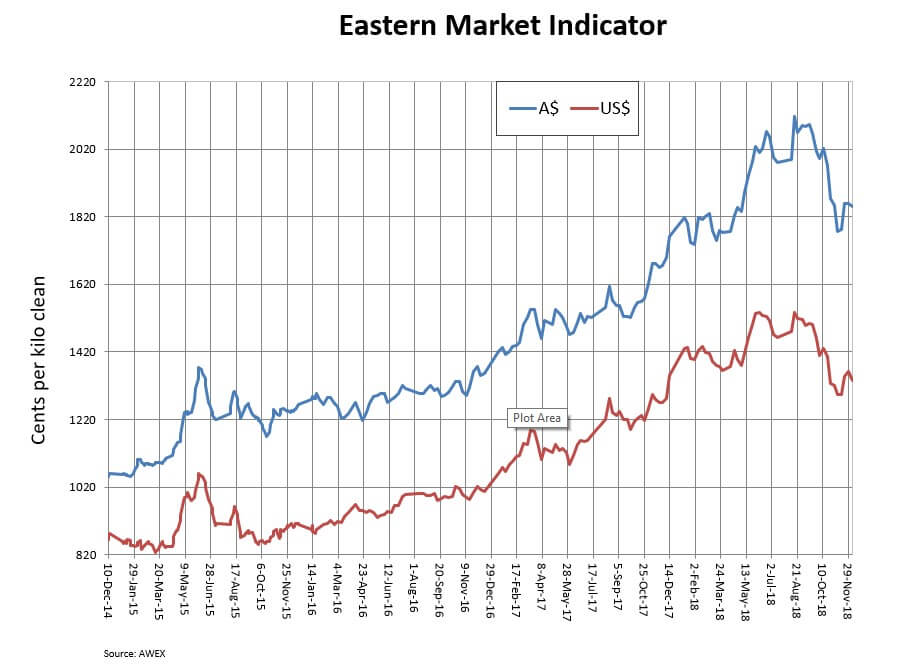
The Australian Wool Exchange (AWEX) Eastern Market Indicator (EMI) fell by 11 cents (0.6%) for the week to close on 1,849 cents per kilo clean on Thursday 6 December. In US dollar terms, the EMI lost 25 cents (1.8%) to finish on 1,336 US cents.
The Australian dollar against the US dollar finished 0.88 cents (1.2% lower) to close at 72.26 US cents on Thursday.
This week’s total national offering was 38,315 bales, compared with 34,513 bales last week. This means that the amount of wool offered so far this season is 162,043 bales less than at the same point in the previous season, a reduction of over 18%.
The overall clearance rate this week was 89.75%. Among the Merino types the clearance rate was 93.5%, while among the crossbreds it was 80.9%.
The New Zealand Merino Company offered 905 bales in Melbourne on Thursday, with a clearance rate of 83.8%.
Sales were held at all three selling centres on Wednesday 5 December and Thursday 6 December. On Wednesday, the EMI fell by 14 cents to 1,846 cents and in US dollar terms declined by 16 cents to 1,345 US cents. On Thursday the EMI rose by 3 cents to 1,849 cents and in US dollar terms decreased by a further 9 cents to 1,336 US cents.
Analysts observed that on Wednesday the market displayed a downward trend that was more apparent among the lesser Merino and crossbred types, before becoming positive among the Merinos on Thursday when prices were assisted by a 0.62 cent fall in the Aussie dollar against the US dollar.
The falls in the crossbred wools continued on Thursday, cancelling out the big gains made last week when these wools were in very strong demand.
AWEX reported that the Merino sector performed solidly across the two days, recording gains across most microns, with only a lack of interest in some inferior types and reduced buyer demand for wool with poor additional measurement results preventing the average AWEX Micron Price Guides (MPGs) posting larger increases than they did. Superfine wool enjoyed the largest gains, with 17 microns and finer generally 20 to 30 cents higher.
Among the MPGs, 16.5 microns rose by 32 cents (1.3%); 17 microns was up by 22 cents (0.9%); 17.5 microns climbed by 8 cents (0.3%); 18 microns increased by 9 cents (0.4%); 18.5 microns lifted by 19 cents (0.8%); 19 microns increased by 24 cents (1.1%); 19.5 microns gained 15 cents (0.7%); 20 microns increased by 4 cents (0.2%); 21 microns decreased by 5 cents (0.2%); and 22 microns fell by 1 cent.
After recording large gains at the previous sale, the crossbred market had a quick reversal.
Wools of 30 microns and finer lost between 70 and 130 cents. The sharp reduction in price was met with firm seller resistance, and by the end of the week nearly 20% of crossbred wool was passed in.
Among the average AWEX MPGs for the crossbred types, 25 microns declined by 66 cents (4.4%); 26 microns fell by 122 cents (9.1%); 28 microns fell by 85 cents (9.1%); and 30 microns decreased by 50 cents (6.7%).
After three weeks of sustained price rises, the oddment market lost ground this week. Locks, stains and crutchings generally fell by 10 to 20 cents, pushing the average AWEX Merino Cardings Price Guide down by 15 cents to close at 1,173 cents.
AWEX reported that the total value of the wool sold this week was AU$68.2m (AU$2,029 per bale), taking the season total to AU$1.466bn (AU$2,275 per bale). Buyers for China were dominant, with support from buyers for Europe and India.
Looking ahead, next week’s sale will be the last before the annual three-week Christmas recess. This is the final selling opportunity until January and quantities have increased.
Currently, there are 48,777 bales rostered for sale in Sydney, Melbourne and Fremantle, which would make it the largest sale since the first sale after the mid-year break, when 49,414 bales were offered. However, the offering is still forecast to be 4.2% lower than the corresponding week last year.