The Australian wool market has begun the year on a positive note, following on from the good finish to 2018.
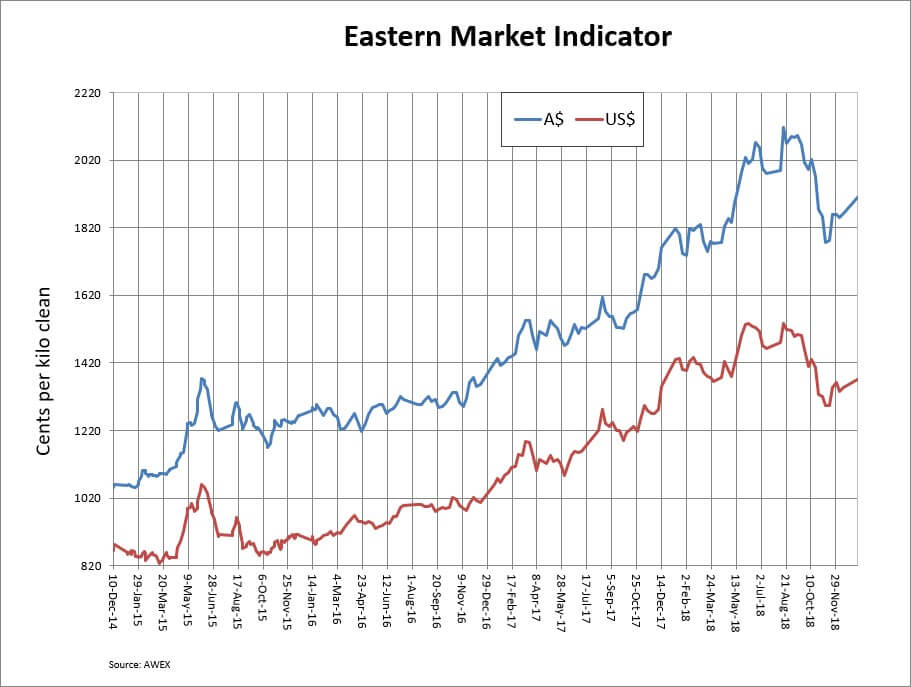
At the first week of sales after the annual three-week Christmas recess, the Australian Wool Exchange (AWEX) Eastern Market Indicator (EMI) rose by 48 cents (2.6%) for the week to close on 1,910 cents per kilo clean on Thursday 10 January. In US dollar terms, the EMI gained 25 cents (1.9%) to finish on 1,371 US cents.
The Australian dollar against the US dollar finished 0.41 cents (0.6%) lower compared with the last sale of 2018, closing at 71.85 US cents on Thursday.
Analysts noted that the positive movements at this week’s sale follow a strong history of price rises in the first sale of the calendar year. The EMI has risen eight times in the last ten years and 17 times over the past 20 years in the first January auction.
This week’s total national offering was 47,593 bales, making it the largest of the season since the first sale after the mid-year break. It compared with 46,003 bales at the last sale before Christmas. The clearance rate this week was 92.8%.
AWEX noted that the first sale of the calendar year is traditionally one of the largest, as there is still shearing occurring over the Christmas recess and wool is stockpiling in brokers’ stores.
In an unusual selling pattern, sales opened this week on Tuesday 8 January at Fremantle and
Melbourne. This was to avoid Melbourne selling in isolation after an extended recess. On Wednesday 9 January sales were held at all three selling centres, and on Thursday 10 January at Sydney and Melbourne.
On Tuesday the EMI rose by 17 cents to 1,879 cents and in US dollar terms fell by 7 cents to 1,339 US cents. On Wednesday the EMI lifted by 33 cents to 1,912 cents and in US dollar terms increased by 30 cents to 1,369 US cents. On Thursday the EMI declined by 2 cents to 1,910 cents and in US dollar terms rose by 2 cents to 1,371 US cents.
Sales got away to a positive start, with good increases in prices across all types and micron ranges on Tuesday and Wednesday, before settling on Thursday. The greatest gains were from 19 to 22 microns among the Merinos and across all comeback and crossbred micron ranges.
AWEX reported that as this was the first buying opportunity in nearly a month, there were many buyers who were noticeably keen to secure quantity. This created widespread demand, resulting in aggressive buyer activity and spirited bidding from the outset. Price increases were realised
from the opening lot and continued virtually unabated until the final hammer.
Premiums were again being paid for wool possessing favourable additional measurement results. In
contrast to this, a large selection of wools with very high mid-breaks (greater than 70) were continually discounted, as buyers struggled to average them into their purchases. By the
end of the series prices had generally increased by 25 to 70 cents.
Among the average AWEX MPGs for the Merino fleece types, 16.5 microns fell by 2 cents (0.1%); 17 microns was up by 25 cents (1%); 17.5 microns climbed by 39 cents (1.6%); 18 microns increased by 38 cents (1.6%); 18.5 microns lifted by 39 cents (1.7%); 19 microns increased by 46 cents (2%); 19.5 microns gained 66 cents (3%); 20 microns increased by 64 cents (2.9%); 21 microns increased by 69 cents (3.2%); 22 microns rose by 49 cents (2.3%); 23 microns gained 24 cents (1.1%); and 25 microns rose by 67 cents (4.8%).
Skirtings followed a similar path to the fleece types, with prices continually tracking upward and generally finishing the week 40 to 70 cents dearer.
The crossbred sector also had a strong start to the new calendar year, with wools of 26 microns all the way through to 32 microns experiencing general price increases of 30 to 60 cents. The better prepared lines recorded the largest gains.
Among the average AWEX MPGs for the crossbred types, 26 microns climbed by 55 cents (4.5%); 28 microns lifted by 33 cents (3.8%); 30 microns increased by 13 cents (1.8%); and 32 microns rose by 34 cents (7.4%).
Oddments also had a strong week. A 36 cents lift in the average AWEX Merino Cardings Price Guide recovered most of the 43 cents fall in the last sale.
AWEX reported that the total value of the wool sold this week was AU$86.5m (AU$1,954 per bale), taking the season total to AU$1.636bn (AU$2,227 per bale). Buyers for China were dominant, with support from buyers for India and Europe.
The national quantity is forecast to increase next week (Week 29) again as wool accumulated over the recess continues to come onto the market. Currently, there are 53,908 bales on offer. The forecast for Week 30 is 41,735 bales and Week 31 36,620 bales.
However, offerings for the next three sales are currently expected to be 3.1% less than in the corresponding weeks last season. The forecast progressive difference for the season as a whole up to Week 31 is 15.9% lower than the same period last season.