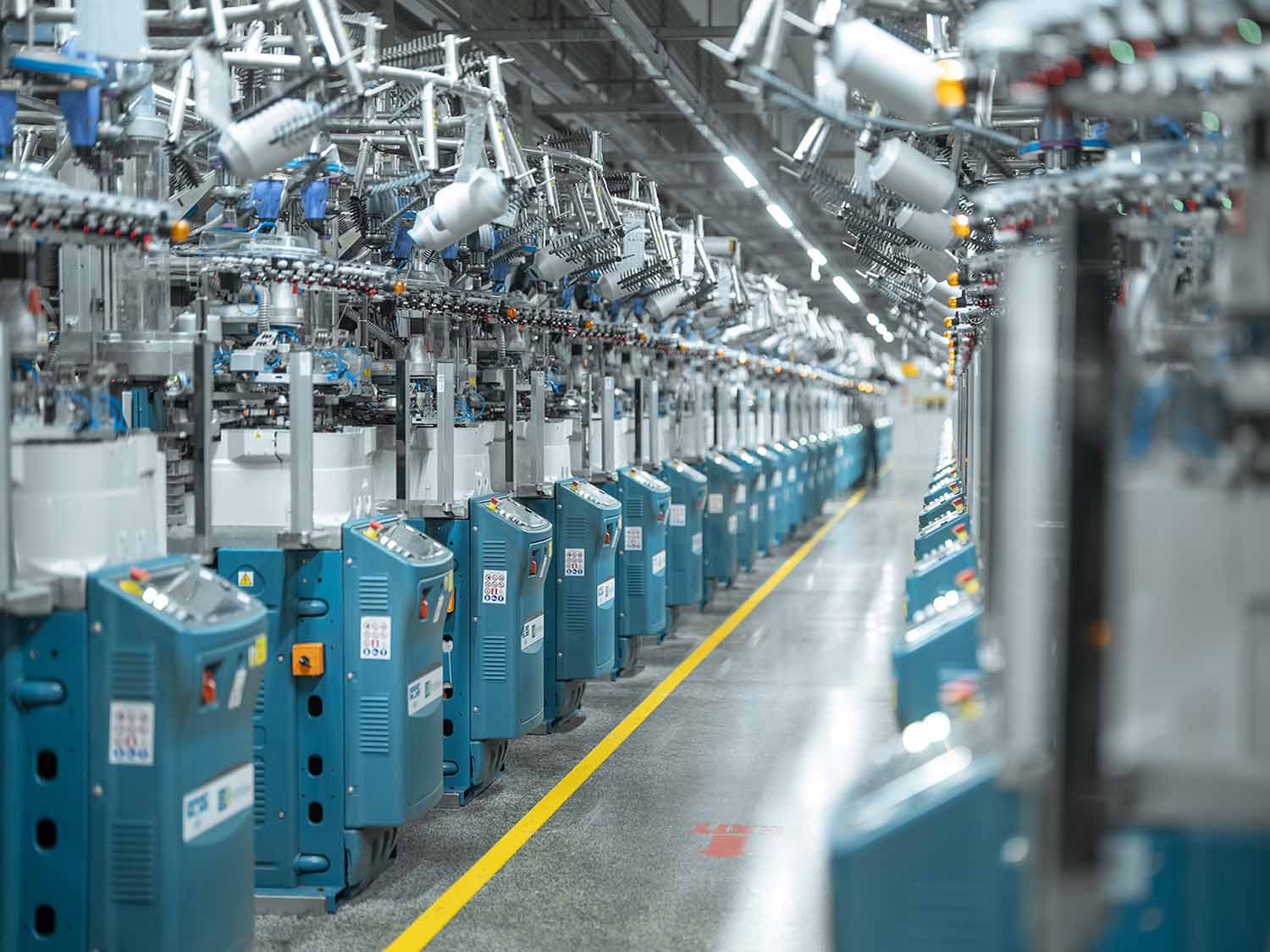
Today, the Covid-19 pandemic has made textile and apparel companies look even harder at the use of robotic machines to support – or even replace – labour, particularly since workforces have been continually limited due to Covid-19 restrictions.
Although many textile hubs remain rooted in traditional methods of manufacture, the adoption of robots appears inevitable. An increasingly restricted labour force, alongside challenging market environments, cheapening technologies and awareness of Industry 4.0 tools around the globe, means some expect we may one day witness the complete adoption of robotics throughout the supply chain.
The technology is not new to industrial application. Most notably, robots that carry goods have been arguably popularised by the rise of Amazon’s smart warehousing systems, while the proliferation of smart cobots (collaborative robots) to aid the manufacturing process of said products has gained considerable traction across industries.
However, although robots have long been utilised, the risks associated with adoption are scarcely outlined in any full capacity, particularly for the textile & apparel industry, where full adoption is somewhat new.
Aside the obvious implications to labour, the use of robotics poses huge challenges to manufacturers: cost, integration, security, monitoring, and implementation within existing human manufacturing networks and systems, to name a few.
This is no surprise – the technology is richly complex and thus requires skilled workers to integrate, operate and manage it.
There are industrial robots, which are larger and incredibly costly; there’s increasingly smarter autonomous machinery; there are product and tending process-based robots; there’s research into fabric gribbing tech; and there are cobot arms, which are even being leveraged as part of industry’s quality control systems, mounted with scanning and inspection technologies to, again, aid or replace current manual processes.
As technologies advance and industry has its eye on adoption, it is essential to assess best practices for robotic production, integration, overcoming problems, monitoring, and security issues relating to confidential data and sabotage.
For WTiN’s Textile 4.0 channel, we investigate the use of robotics in the new global context. The report will be available from 24 May 2021.