The importance of protectivewear is growing around the world, particularly in regions where evermore strict regulations are being introduced. Due to this, many fibre manufacturers are developing new products to cater for the growing market.
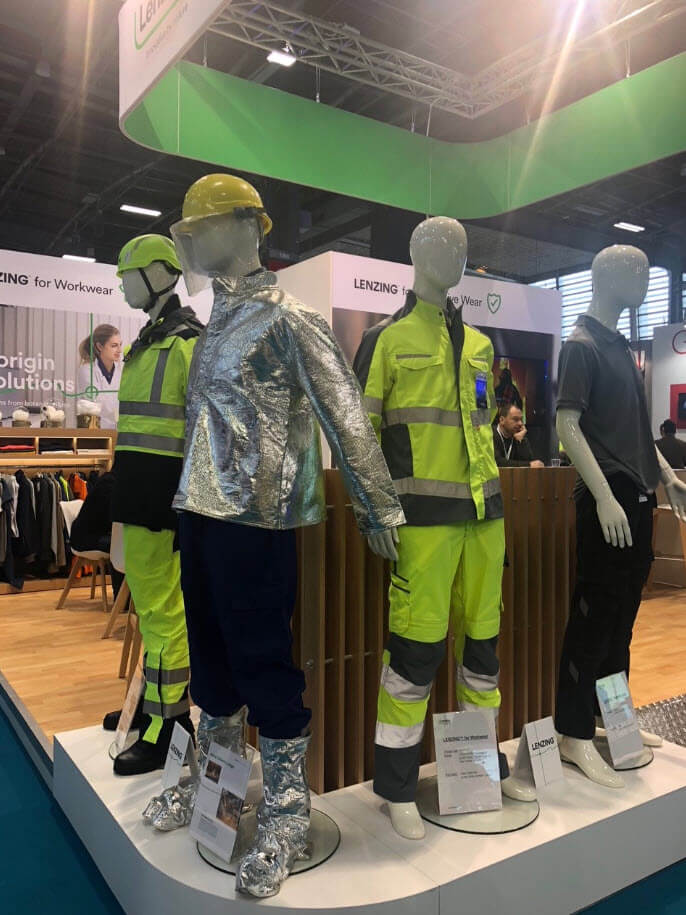
Lenzing’s Lyocell fibre is key to the company’s protectivewear products
Austria’s Lenzing AG is one of these companies, and although its core business is fashion and commodity apparel, its protectivewear and workwear segment is on the rise. Here, the company develops fibres that, for example, are flame resistant (FR technology) – an essential quality in modern-day protectivewear.
The company exhibited at the recent protectivewear and workwear event Expoprotection, held in Paris, on 6-8 November. At the event, Oliver Spöcker, director – Workwear & Protectivewear global commercial director – FR Fibres, spoke of his department’s focus on the segment.
“We are catering to three segments,” he says. “The first one is military and police, government-related business. This is, I would say, half of our business. The most traditional business is fire service, firefighting mainly for station-wear, but also for outer shells, and for what we call 'head-to-toe' concepts for firefighters. And the biggest gross potential I think in general is for industrial protectivewear, where we cater for three industries. One is metal splash, so wherever hot metals are produced or processed. The second is the oil and gas (petrochemical) industry, and the third and latest market is electric arc protection, so to protect workers in the utility and electricity industry against electric.”
Fibre focus
Lenzing has developed a range of fibres with benefits for the protectivewear and workwear markets, using its Lenzing Lyocell fibre as the base material, as Spöcker explains. “We have two different offerings for the FR market for the flame-resistant protectivewear we offer under Lenzing FR. This is, we call it, inherently flame-resistant cellulosic fibre based on the so-called modal technology. Modal is high-tenacity modulus viscose.”
He continues: “For the workwear market we offer Lenzing Lyocell fibres. In this industry, polycotton is the major product, but polycotton is somewhat old technology. The new technology is mainly recycled polyester, sustainable polyester and Lenzing Lyocell. Lenzing Lyocell is the most sustainable cellulosic fibre – it is a very modern and green technology. We are not polluting the environment.”
According to the company, lyocell has a unique capability when it comes to moisture management. It states that the fibril structure of the fibre can absorb large amounts of moisture to the outside, thus allowing it to evaporate so the body can cool down. This is particularly beneficial for firefighters in contact with high temperatures.
“What you cannot do with synthetic fibres like polyester, they don't absorb moisture, so the ability to absorb moisture is unique for Lenzing Lyocell and the high-tenacity, especially wet tenacity,” he says. “With viscose fibre, when it gets wet it gets weak, yet Lenzing Lyocell has a much higher tenacity in wet stretch.”
While Lenzing Lyocell is a key part of Lenzing’s work in FR fibres, it is also developing green alternatives. Spocker says: “With our REFIBRA™ technology we are offering a recycled lyocell fibre, so we are using the cotton waste of our customers and the cotton waste of the textile industry to make new fibres. This is a very new concept, it’s currently in the starting phase. We officially launched this product last year, and I think it will take some time for the industry to accept this concept.”
He continues: “Meanwhile, Lenzing ECOVERO™ is the greenest viscose fibre. It is viscose fibre produced under the highest ecological parameters, because rayon viscose was always supposed to be very polluting in the industry, which was true in the past, but now with modern technology it's not, and Lenzing is really on the front line to introduce such a sustainable solution. At the moment, we are starting but we are very successful in this area. We are producing it in Europe – in Austria in Lenzing, and we have been producing it for the last half a year in China in our Chinese factory.”
Sustainability is becoming more and more important across the entire textiles industry. However, bringing about this change isn’t easy, with one particularly difficult bridge to cross. “One challenge I think is price, especially in regard to commodity textiles and in price-sensitive markets,” he says. “Price is always an issue when you develop new concepts, when you work in the direction of sustainable products.”
However, the price is often workable if the consumer is willing to pay for the end product, as Spocker explains. I think it's push and pull. The consumer has to ask for it and has to be prepared to pay for it, this is probably still a problem. But it has to come from both sides. The companies have to offer green solutions, but also the consumers have to be prepared to pay for it. The consumer is powerful, and the young generation will ask for clean solutions, hopefully.”
Global outlook
With increasingly strict regulations being introduced through the region, Asia Pacific is growing in terms of the global market share of protectivewear and workwear fibres. Yet at present, Spocker states that Lenzing sells the majority of its protectivewear and workwear fibres to the west. “For Lenzing, Asia is the biggest market. Around 70% of our fibres we sell into Asia. But for the protective and workwear business it's the other way around. Around 70% we sell into Europe and the Americas, and only 30% into Asia, but Asia is really fast-growing.”
Despite the west’s current market dominance, China is introducing tougher laws and initiatives in order to better protect its workers. “The reason I think is now the Chinese government has brought in initiatives to protect their workers and protect their firefighters. When I personally started in this business 20 years ago in China and you introduced flame-resistant protectivewear, they asked why they needed it. Now, it's changing.
“The Chinese government now is really strict, and they say: ‘Either you improve your standards, or you are out.’ China is a growing market and in the last few years it has shown a 50% growth rate every year, year-on-year.”
Current challenges
While the industry is currently benefitting from a number of promising opportunities, it is also presented with a range of challenges, most of which are driven by consumer demand. Spocker explains: “The worker wants to have a garment at work that he is proud of. He might even say that he wants to wear it at home in his leisure time, so this is one development for sure that the consumer, the worker, the wearer, wants more and better looking designs for workwear and protectivewear.”
He adds: “The other trend is lightweight, this will not stop, it will continue. The garment has to be lightweight in order to be more comfortable, and also to increase the acceptance of the wearer. Protectivewear can only help the wearer if they want to put it on in the first place.
“This lightweight concept is a challenge because you have to have a certain degree of protection and certain weight to protect and insulate the wearer against heat and flames, for example,” Spocker adds.
However, this is not the only challenge he has observed. “Commodization I think is a challenge, and pricing is a challenge,” says Spocker. “I think at the moment business is really overheated, there are long lead times. The industry is not really ready to cater to the needs of the end user. I think we have to improve the whole value chain, from fibre manufacturing to yarn spinning to weaving and knitting to garment. I think that the business is still growing, and the industry has to come up with solutions, that is a challenge. It's a good problem to have.”