Japanese OEM Konica Minolta has long been selling digital textile printing machines. Traditionally it has focused on low and medium segment printers for the Chinese market and high-speed machines for the European and Turkish markets, having sold its flagship single-pass digital textile printing machine, the Nassenger SP-1, in Turkey and Europe.
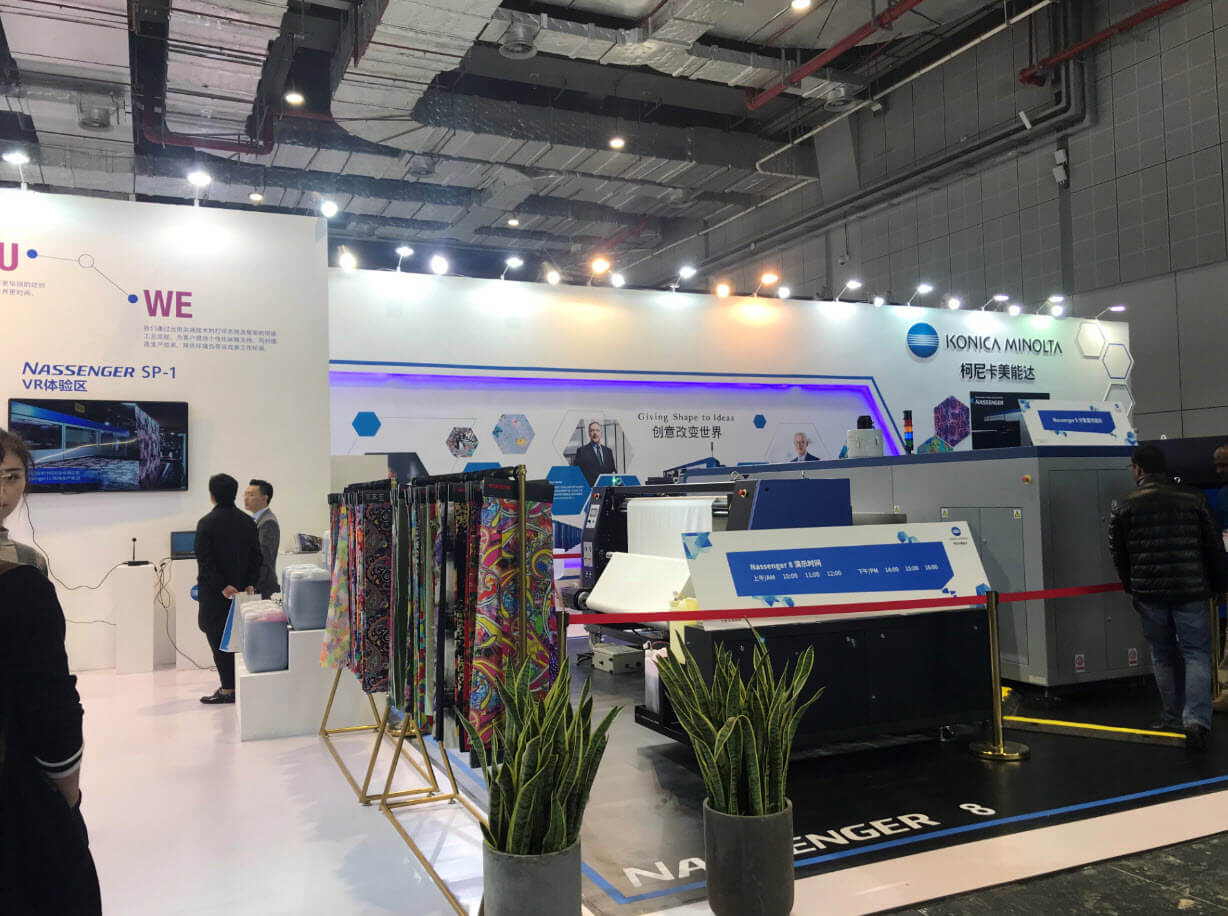
The Konica Minolta booth at ITMA Asia + CITME
Hiroki Inada, senior manager, Business Planning Group, Textile Business Promotion Division, Industrial Print Business Unit, Konica Minolta, says: “Chinese manufacturers are promoting medium-speed and low-end printers but we are focusing on the high-speed market.” At ITMA Asia + CITME 2018, however, the company was focusing on the high-speed segment in the Chinese digital textile printing industry. Inada adds: “We are selling inkjet textile printers with reactive, acid and disperse dyes, focusing on the high-speed segment. We have a single-pass printer [the Nassenger SP-1], which is super high-speed, printing 70m/min. We also have a high-speed scanning printer; the Nassenger 10.”
Konica Minolta’s shift towards the high-speed market comes as the Chinese apparel sector continues to grow as its consumer market increases. An example of this growth is the company’s first sale of its single-pass printer in the Chinese market, which is due to be installed in November. “Until now, we focused the single-pass business in Europe and Turkey but now we are spreading out the area [of focus for single-pass] to India and China,” says Inada.
Previously, with the focus being away from the Chinese market, Inada admits that the company hasn’t had enough technical staff in China to provide technical support. But, he says: “We focus on the big customers, sell the high-speed printer and then take care of the customer.” He adds that Konica Minolta has sometimes introduced some Chinese printers to some apparel manufacturers in Japan. “We try to create the business together with the customer. That way we create a win-win relationship,” adds Inada. “That is our business model.”
Despite this, Europe and Turkey still provide the most opportunities for the sale of single-pass machines, according to Inada. He adds: “In Asian countries there is not such a big demand for single-pass at the moment. That’s why we are trying to create the business model together with the customer. For example, with some apparel manufacturers we have made a protocol to make the production of the apparel products shorter.” And printing is one of the processes of apparel production. Inada, therefore, recognises that Konica Minolta needs to co-operate with other apparel production processes such as cutting, sewing and finishing to streamline its customers’ production workflow.
Creating a more efficient workflow is all part of the broader Industry 4.0 initiative. However, Inada says that, as of yet, this hasn’t really taken off in China. He thinks that the market will change faster towards Industry 4.0 if big players such as Alibaba evolve into the 4th Industrial Revolution. And Konica Minolta will also help this revolution with its new business models and products. Inada says: “Until now we just produced the printer, the ink and the consumables to sell to the market, but now we try to introduce the service side. For example, we are developing some new technologies such as predictive maintenance and remote diagnostics in order to reduce the downtime.”
Panasonic print head acquisition
Konica Minolta has also recently acquired Panasonic’s inkjet print head business. The company said in the summer that its goal is to strengthen its own inkjet head business, including its R&D and production. Inada says: “Konica Minolta print heads and Panasonic print heads have different strengths. Now that Konica Minolta can utilise Panasonic’s production line, maybe we will make some new products by using their technology and production platform.