It’s all in the data. Knitting machinery manufacturers are deploying the latest IoT advances to forge closer links with both suppliers and customers. This will result in greater efficiency, transparency and traceability for all involved, writes Adrian Wilson.
Flat knitting machinery manufacturer Stoll, headquartered in Reutlingen, Germany, has this year introduced its new Knitelligence networking concept ‘for tomorrow’s textile production.’
 Knitelligence combines all of Stoll’s software solutions along the entire value creation chain of flat-knitting production
Knitelligence combines all the company’s software solutions covering the entire value creation chain of flat-knitting production and allows customers to not only design their processes to be considerably more efficient, but also react far more flexibly to the requirements of the market.
Diversity in the manufacturing process and short-lived fashion trends are increasingly putting pressure on knitting mills – instead of two collections per year, as in the past, it is now not unusual to have ten or more. As a consequence, the intervals at which machine parks need to be reprogrammed and reconfigured are becoming ever shorter.
Networking
In order to make this as easy as possible, Stoll introduced its Production Planning System (PPS) at ITMA 2015 in Milan, as one of the first systems to completely network the production control of a knitting plant. The PPS collects production, machine and process data at a central control station, from where it is possible to individually monitor, control and configure each machine with a separate knitting job order. The system also provides information with details on which order is currently being knitted and when it is expected to be completed.
“Our goal was to provide knitting mills with a tool that completely visualises the digital chain, from the knitting job order through to completion of the product, in order to increase capacities, productivity and therefore profitability,” says Stoll CEO Andreas Schellhammer. The pilot phase demonstrated that the PPS could boost productivity by around 10%, since networking of the machines not only allows knitting mills to process orders faster and more frequently, but also to profitably manufacture small batch sizes, as a result of simplification of the machine operation.
Tailored solutions
Less than two years down the line, Stoll has expanded this software into the Knitelligence system, which links up tailored solutions for every step in the manufacturing chain, with the high degree of automation allowing new business models to be created.
As a web-based solution with a user-friendly interface, the PPS system can be operated from any browser, including mobile devices such as tablets or smartphones. It provides a quick and transparent overview of all processes, and thanks to the high integration of knitting machines and terminal devices, all weak points can be easily identified and analysed. Maintenance also becomes much easier and the central configurable access control prevents misuse at the machines.
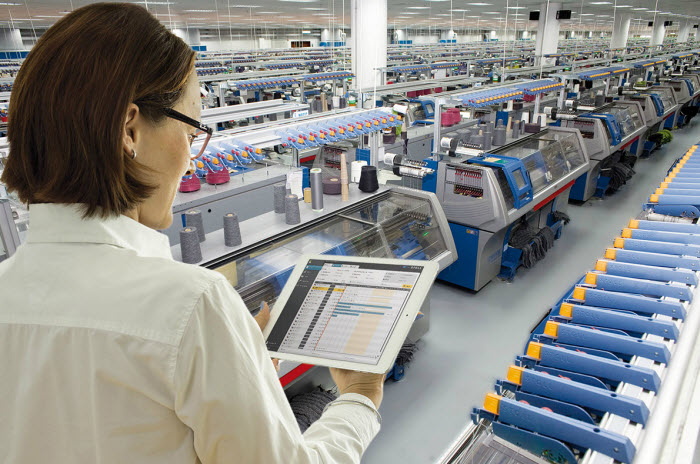 The Stoll PPS system collects production, machine and process data at a central control station, from where it is possible to individually monitor, control and configure each machine with a separate knitting job order
Knitelligence also incorporates the following modules:
• M1plus pattern software, for the creation of all patterns from cut and sew, fully fashion to Stoll-knit and wear, in intarsia, multi gauges, plating, devoré knit, plush etc. Stoll has an exclusive cooperation with Italian software developer ENEAS for the use of its modular graphics system for flat knitting. M1plus allows numerous automated functions already stored in the Stoll Explorer Database to be used directly.
• GKS, for the creation and grading of shapes. As a complement to the M1plus, GKS integrates fully dimensioned and functioning shape templates for all typical pattern variants. Using these as a basis, a first prototype can be created quickly and afterwards changed as much as required. This – and the fact that all shape parts of the entire garment are displayed and adjusted at the same time – guarantees that the linking edges of all shape parts in all sizes fit perfectly together from the start. Much of the information necessary for pattern generation – such as the type of start, narrowing specifications and more – is already integrated into the shape and can be defined or changed for all sizes at once. Inserting colour or stripes is done directly in the shape. The important job of realising style sets can be carried out swiftly and the subsequent grading is just as easy.
• EKC (enhanced knit control). This software is developed for the ease of use of Stoll knitting machines and can be seamlessly integrated into the PPS system. With the order-orientated and task-related graphical interface, anyone can produce complicated knitted products after just a short training period the company says, with assistance from newly-developed troubleshooting features designed to deal with any production event that occurs.
• APM (auto production mode). After a production order has been sent and loaded automatically to a machine equipped with this module through the PPS system, production begins without manual intervention. After completion, the next ticket is loaded and started automatically. Optionally, a routing slip with actual production information and feedback from the operator can be printed automatically. The content can be individually tailored and the completed ticket is picked up from the PPS so that the ERP (enterprise resource planning) programme can track completion. Production can also be monitored via database requests.
• SIN, for protecting knitting programmes with Stoll’s Sintral Crypto tool. Knitting programmes have a significant economic value, since they contain specific company know-how about applications, collections and fashion trends. SIN ensures a 1:1 copy of a fabric cannot be reproduced by unauthorised parties, and also that the programme code cannot be read.
On demand
With Auto Create, meanwhile, Stoll is paving the way for true IoT technology and production on demand. This is a powerful framework that automates pattern creation for mass customisation. Using automated colour arrangements, it allows simple bitmaps to be provided along with a formalised ‘receipt’ that can control their processing in the M1plus system without human interaction.
The automation of all processes and network production stages allows customers to benefit from more consistent workflows, shorter and more transparent production cycles and an increase in quality, productivity, and overall plant efficiency.
“Our aim is to always develop further for the benefit our customers and Knitelligence is an important step in this regard,” says Andreas Schellhammer. “We continue to set standards in the age of digitisation, and with Knitelligence will create substantial added value for our customers – highly efficient flat-knitting production through the optimisation and networking of all the individual production steps.”
KnitPLM
Meanwhile, in the development of it new product lifecycle management (PLM) system – Shima KnitPLM – Japan’s Shima Seiki has drawn on the know-how of a range of specialist software developers.
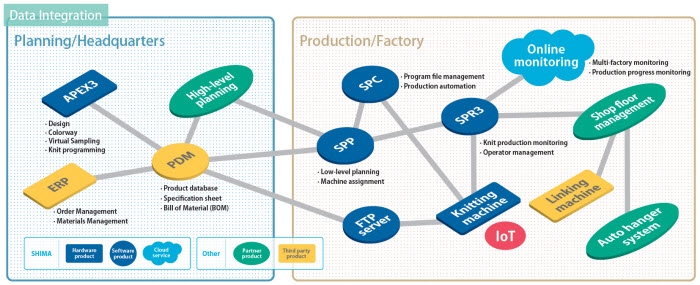 In the development of it new product lifecycle management (PLM) system, Japan’s Shima Seiki has drawn on the know-how of a range of specialist software developers
They include Fast React Systems, based in Derby, UK, which has developed and commercialised three key products:
• Vision, an extended PLM (e-PLM) solution for retail and sourcing companies
• Evolve, a highly visual capacity planning and management tool
• Align, a capacity planning and modelling software solution, which allows textile mills to match forward demand against available capacity, manage their commitments and improve order confirmation process, work in progress and inventory levels
• Align is the module that is integrated into the Shima KnitPLM
The overall aim of Fast React Systems is to greatly simplify the complexity of co-ordinating design and sampling, range selection and the buying process, purchase orders, fabric and trim approvals and costing – and then combine them with an extended supply chain, often in numerous countries and factoring in frequently changing buyer requirements.
Relentless communication
“Without good systems, the result is relentless communication, using an almost infinite number of separate spreadsheets, emails, meetings, faxes and telephone calls, both internally between departments and externally with suppliers,” states the company. “Seeing true priorities and gaining fast access to management level reporting is almost impossible.”
 Align, from Fast React Systems, is a capacity planning and modelling software solution which allows textile mills to match forward demand against available capacity, manage commitments and improve order confirmation process, work in progress and inventory levels
Planning and co-ordinating textile production through the various processes of fabric production, the dye house and numerous finishing operations means that manufacturing needs to be tightly controlled. The textile sector has so far managed this using spreadsheets and manual methods – very little else exists other than a few, short-term machine schedulers that only look a few days ahead. As the fashion sector continues to focus on speed to market and supplier flexibility, however, the challenges of handling all of these tasks manually increases, and Align is designed to provide a much-needed alternative.
The system’s highly visual, ‘drag and drop’ capabilities, allow for rapid planning and re-planning, with multi-level planning options for both long-range capacity management and short-term scheduling
RFID
Other Shima-Seiki partners in the development of KnitPLM include China’s Huizhou Techzen Science & Technology, which is providing know-how in production management software using RFID (radio frequency identification) technology. The company’s ETS is a production management and monitoring system exploiting RFID for seamless management from quality control, finishing, packaging and delivery, including auto hanger system in the sewing stage. Techzen already has installations with many large-scale apparel manufacturers.
Singapore’s Twin Star Singapore Machinery is the developer of INA automated garment production systems for monitoring the real-time status of flat knitting, linking, washing, finishing and delivery. Bottlenecks are relieved in all processes and throughput is maximised with the INA software, realising an overall reduction in production cost.
New partners
In order to provide optimum network solutions, Shima Seiki welcomes the opportunity to expand its alliance and work together with new partners who should feel free to contact the company directly.
With KnitPLM, all stages from product planning, to product database management and production planning to knitting, linking, finishing, inspection, packaging and delivery are now covered with Shima KnitPLM.
System design is tailored to each individual customer to eliminate the need for redundant input over multiple stages. In addition, order information managed by an ERP system can be managed for both knit production and post-knit processes together from one source.
All knitting machines can be connected online using IoT technology, allowing real-time remote monitoring of a multiple number of production facilities worldwide. Feeding back this information, production planning can be performed for each job according to the optimum production location and timing.
All stages are monitored for each order, with current production conditions constantly being managed, to minimise shipping delays by proactively dealing with any possible problems before they arise. Projected workloads can be confirmed visually as well, for optimisation of orders and work in progress.
The operating rate of the factory, knitting conditions by order, and progress of certain post processes can be checked anywhere using a smart phone or tablet. With large-scale companies performing global production, operating conditions at multiple factories can be monitored or progress for individual orders can be individually checked by sales staff.
Quantitative data
All stages are managed using quantitative data, which can be used for managing key performance indicator (KPI) and critical path analysis. By analysing data from the system, various factors that affect production efficiency such as production logistics, operation, material, programme, machine adjustment and power conditions can be considered for constant process improvement.
Order information taken from partner systems and ERP can be used to plan knit production visually and instinctively. Production plans are then automatically despatched, while knitting machines are prepped for production by obtaining the required data for production from the server automatically. In addition, high-level planning data prepared on a fast react system can be used to assign individual machines at the knitting plant.
All in all, IoT is taking knitted apparel manufacturing and supply chains to entirely new levels of sophistication – and it’s all in the data.
Have your say. Tweet and follow us @WTiNcomment