Kermel manufactures aramid fibres used in heat and flame-resistant protective clothing. The company develops its products using its own unique technology produced in its laboratories.
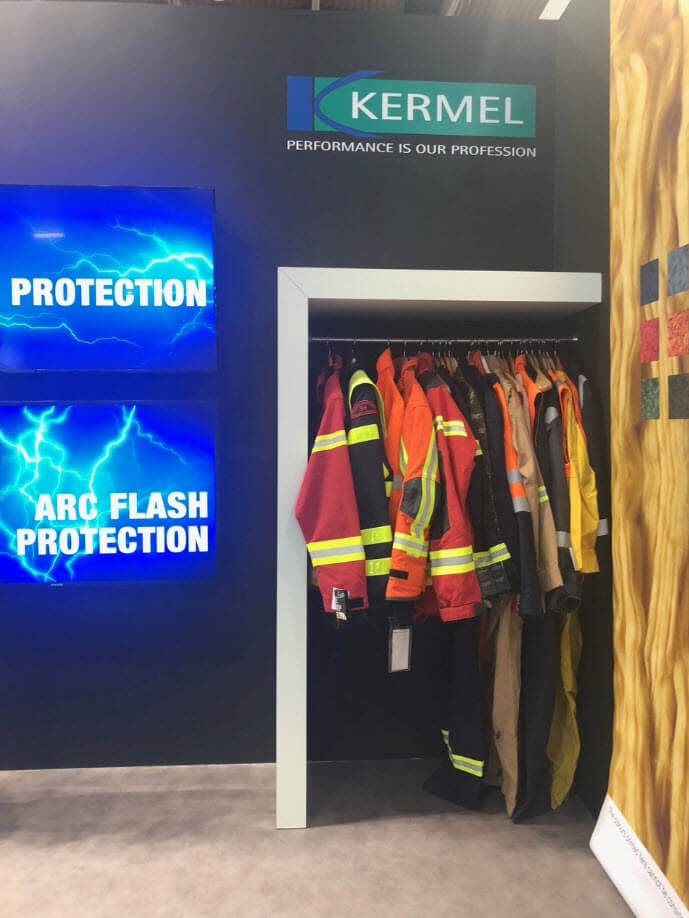
Kermel's exhibit at Expoprotection 2018
Recently, Kermel presented its latest products at the Expoprotection exhibition in Paris, France, which was held on 6-8 November.
Laetitia Lajoie, product manager for the firefighter and army sector, and Ranya El Haoui, product manager for industry, at Kermel, explain more about its latest developments and challenges to WTiN.
“Kermel produces aramid fibres, so we are based at the very beginning of the textile chain,” says Lajoie. “My team and I work with weavers, spinners and garment makers and we aim to provide end users with the best solution to their problems.”
Kermel’s main end users include firefighters, military personnel and law enforcement professionals, with the industry and firefighter markets being the company’s biggest opportunity.
The high performance of the aramid fibre means that it does not melt, shrink or burn under heat and flame exposure, making it ideal for heat and flame-resistant textiles. Additionally, the fibre can be made to make lightweight and comfortable fabrics which still provide some of the highest levels of protection.
“This year at Expoprotection, we are also showing our new textile concept designed not only for protection against heat and flame but against electric arc. It is very lightweight compared to others on the market and our design only requires one layer of protection, when usually a double layer is needed,” explains El Haoui.
The Kermel LCI Arc C2 is a single layer which weighs 380 g/m² and reaches Class 2 with the Box Test method (which defines a protection class linked to the intensity of the electric installation). This solution results in light and durable clothing, protecting against the risk of burn from an electric arc.
The R&D team is also working on key issues in the industrial market, such as high visibility and multi-risk solutions.
“We are facing competition not only from other aramid companies, but from those who produce cotton too. Cotton FR-treated fibres are not as protective as aramid fibres because their fire-retardant treatment will not last/vanish away after washing,” says El Haoui.
Another issue for Kermel is decontamination. Decontamination of a firefighter’s suit is an important and complex process, which is necessary to ensure the firefighter is safe from toxic substances.
Lajoie adds: “Decontamination is a huge subject, and we are working on solutions to this even though we are not garment makers or spinners or weavers, so for now this is an ongoing project for Kermel.”