The term ‘biodegradable’ refers to the ability of a material to decompose naturally via living organisms. Not all fabrics are safely biodegradable as they are made with additional artificial and chemical components, which make them difficult to decompose. Some fabrics are technically able to biodegrade; however, this may take potentially hundreds of years.
The textile industry is under a lot of pressure at the moment due to the amount of waste it generates, however some companies are trying to lessen this impact by creating biodegradable textiles.
Mushrooms
Mushrooms are becoming quite a popular choice when it comes to making biodegradable textiles.
Earlier this year, two University of Delaware students put their best foot forward at this year's National Sustainable Design Expo, Washington DC, US, showing off a biodegradable shoe they fashioned using mushrooms, chicken feathers and textile waste.
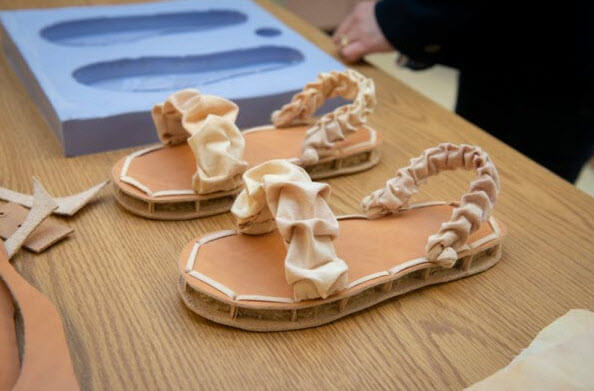
Two students at the University of Delaware, US, have developed a shoe from mushrooms, chicken feathers and textile waste
"The fashion industry produces a lot of waste, so sustainability is an issue everyone is trying to address," says Jillian Silverman, master’s degree student who is one half of the research team. “It’s hard to believe that people are going to change their consumption habits, but with this shoe, when someone gets tired of it or it wears out, it can go into the compost pile and not the landfill."
The researchers experimented with growing different species of mushrooms and using different materials, known as substrates, in which the mycelium forms its network of roots. They grew numerous samples, dried them and tested them for potential use as the sole of a shoe.
The nutrients in which the samples grew included chicken feathers and a textile waste product that's most often used as a packing material. The team hopes to experiment in the future with discarded natural-fibre clothing, perhaps shredding it to create a fluffy addition to the feathers as a growth medium.
Researchers from the University of Utrecht, Netherlands, and Aniela Hoitink (NEFFA) have also developed a 100% biodegradable material based on mycelium, the root of mushrooms, called MycoTEX.
The team made a proof-of-concept with the material and the 3D modelling process and developed a catwalk-ready prototype for the Dutch Sustainable Fashion Week.
The MyoTEX material is sustainably grown in the lab – which means no expensive farmland is required. Additionally, less water and no chemicals or pesticides are used. And, once you have finished with the garment, it can simply be buried into the ground to decompose.
The company Bolt Threads has also developed a material using mycelium, which they have named Mylo.
Mylo is developed from mycelium cells by creating optimal growing conditions for it to self-assemble into a supple, sustainable material that looks and feels remarkably like animal leather. Mylo can be produced in days versus years, without the material waste of using animal hides.
Last year, a team called #GROWAPAIR from the Fashion Institute of Technology, New York, US, entered the Biodesign Challenge Summit with a pair of baby shoes made from microbial cellulose, mycelium and pineapple.
The baby shoes created by the team used natural dyes and a Native American brain-tanning process—a technique that uses an emulsified solution of animal brain and water to lend absorbency to animal hides—along with a smoking technique to soften the material, increase its flexibility, and add natural flame-retardant properties and water resistance. The shoes, developed with the goal of ‘translating a living material into a textile,’ were finished with an all-natural coating of beeswax, jojoba oil and pine resin, and are fully biodegradable.
“Their projects will be seen by thousands of people around the world,” says Daniel Grushkin, founder of the Biodesign Challenge and executive director of Genspace. “I firmly believe that they are leading us into a sustainable future with their visions.”
Algae
Algae is a renewable and aquatic organism. Algae has many types of life cycles, and they range in size from microscopic species to giant kelps that reach 60 metres in length. Lately, this organism is being used to make biodegradable textile materials.
AlgiKnit is a biomaterials company integrating science and design into textile production. The company is creating rapidly degradable, yet durable yarns derived from a seaweed called kelp.
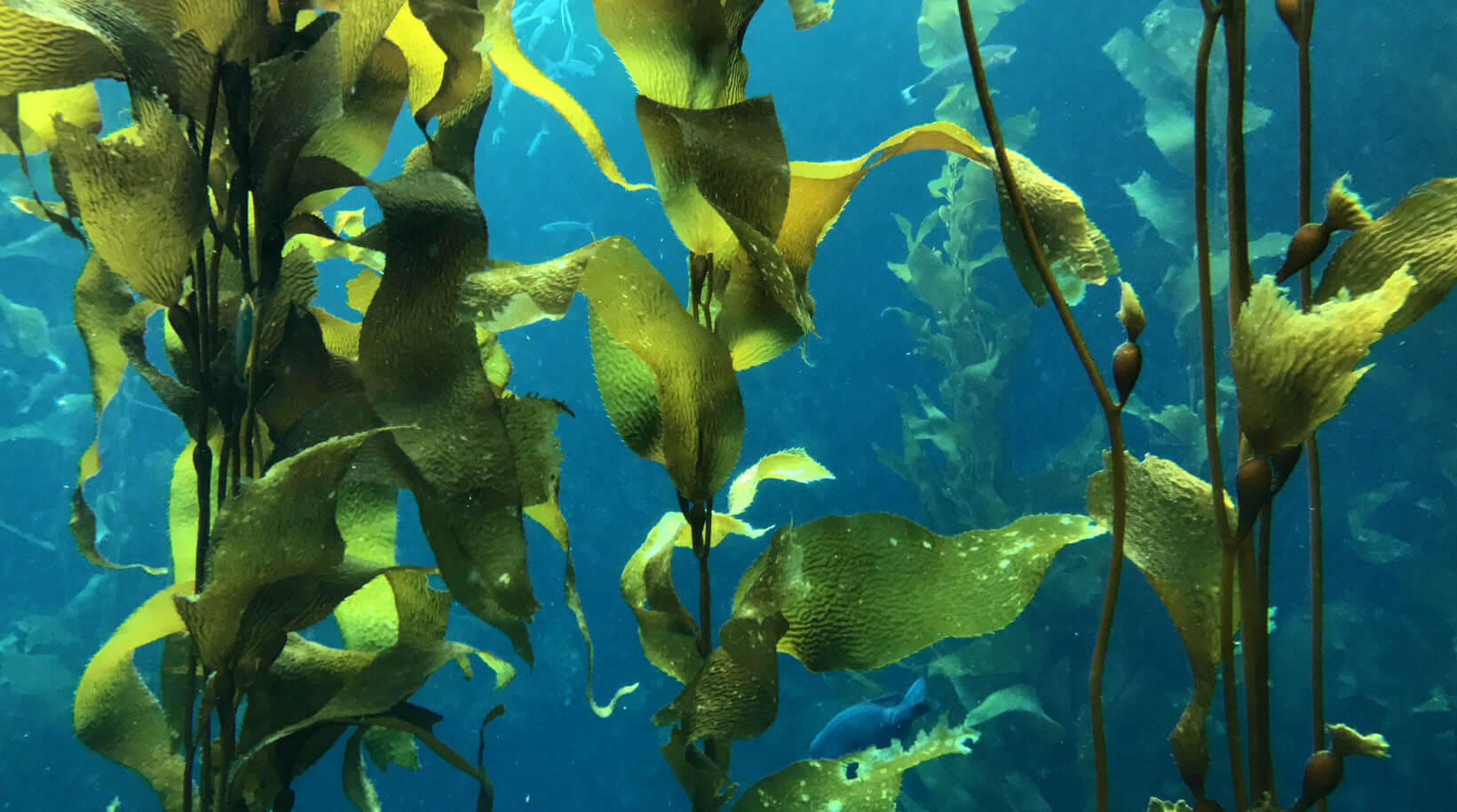
AlgiKnit is a biomaterials company integrating science and design into textile production
With a focus on marine health and fashion circularity, AlgiKnit strives to create better material alternatives for designers, consumers and the world. AlgiKnit’s yarns are both strong and hyper compostable. The yarns are made using biopolymers derived from seaweed and are 100% plant-based, negating the need for harmful chemical usage throughout production.
Recently, AlgiKnit won a €100,000 prize in the Dutch Postcode Lottery Green Challenge 2018.
“By transforming the natural polymers found in kelp with a novel combination of green chemistry and plant-based polymers, we have been able to create a yarn that is durable, easily dyed and fully compostable,” says Tess Callaghan, co-founder and director of Innovations, AlgiKnit, to the award jury.
One other company that has turned to algae for inspiration is Algalife.
Algalife explores a holistic and sustainable development of new materials which positively affects both the environment and the human skin.
Algae is a renewable and degradable aquatic organism, that can be turned into bio-fibre and environmentally friendly dye. A bonus effect of wearing clothes made from algae apparel is that the fabric releases antioxidants, vitamins and other nutrients to the skin.
Algalife recently won a €150,000 prize for the H&M Foundation’s Global Change Award 2018.
“Winning the Global Change Award is a game changer,” says Renana Kelbs, co-founder and CEO, Algalife. “It’s a very exciting moment for us. Our vision will be realised, our innovation will receive a huge support and a strong wind at our back.
“We will get a significant push and come closer to our mission of being the green engine for our fashion revolution. The grant will enable us to continue our research and scientific development, increase our personnel and our laboratory access, and support our experimental efforts with a variety of algae.”
Bacteria
One of the most polluting areas of the textile industry is the dyeing and finishing sector. To try and make these processes more sustainable and environmentally friendly, some companies are experimenting with dyes derived from bacteria.
Kukka is a textile and surface studio based in Rotterdam, the Netherlands. One of the company’s projects is called Living Colour, which is an ongoing biodesign research project exploring textile dyeing with live bacteria and cymatic frequencies.
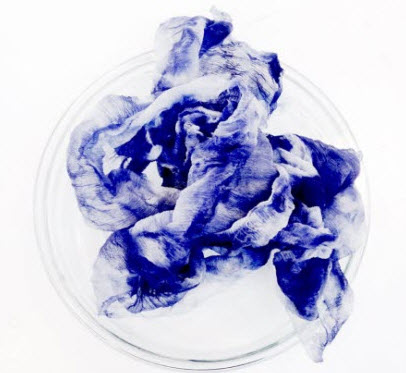
Kukka is a textile and surface studio based in Rotterdam, Netherlands
So far, the company has discovered three colour dyes – purple, derived from Janthinobacterium lividum, red from Athrobacter agilis, and yellow, derived from Micrococcus luteus. The colours are found from the pigments within bacteria such as carotenoids and violacein. All these pigments are biodegradable and friendly to humans, animals and the environment.
Faber Futures is another company working with bacteria to produce dyes for textiles.
The founder, Natsai Audrey Chieza, is a designer on a mission – to reduce pollution in the fashion industry while creating amazing new things to wear. In her lab, she noticed that the bacteria Streptomyces coelicolor makes a striking red-purple pigment, and now she is using it to develop bold, colour-fast fabric dye that cuts down on water waste and chemical runoff, compared with traditional dyes.
In a TedX talk Chieza gave in 2017, she says: “We have crafted a dependency on fossil fuels and we need to find new materials that are not petroleum-based. To dye one T-shirt, the bacteria survive on just 200ml of water. This process generates very little runoff and produces a colourfast pigment without the use of any chemicals.”
Chieza stresses that the issue now is how to achieve economies of scale with this process. She is currently looking at the tools she could use and digital fabrication techniques.
She adds: “This is a material future that we must be bold enough to shape.”