The global graphene market is expected to reach a value of US$552.3m by 2025, according to Grand View Research. Growing demand for smart consumer electronics is anticipated to fuel the market over this time.
One organisation that is contributing to innovation within this market is The Institute of Photonic Sciences (ICFO) based in Barcelona, Spain. Recently, researchers at the centre have developed a few different devices that can monitor a person’s health.
First of all, the ICFO has developed two light-based graphene technologies. These include the ‘world’s smallest’ single pixel spectrometer and a graphene-enabled hyperspectral image sensor, both with broadband capabilities, beyond to what was once perceived possible without the use of costly and bulky photodetection systems.
By enabling spectroscopy in such small dimensions, consumers could now be equipped with tools that previously were only available to highly specialised laboratories. Applications of these technologies could be used to detect counterfeit drugs or identify harmful substances within a product such as food.
“Built into a smart phone camera, the graphene-based camera sensor allows phones to see more than what’s visible to the human eye,” says Frank Koppens, group leader at Graphene Flagship partner ICFO, and chair of the Graphene Flagship MWC Committee.
“Made up of hundreds of thousands of photodetectors, this incredibly small sensor is highly sensitive to UV and infrared light.”
“This technology would allow users in the supermarket to hold the camera to fruit and infer which is the freshest piece,” he adds. “Or, in a more extreme example, the camera could be used for driving in dangerously dense fog by providing augmented outlines of surrounding vehicles on the windscreen.”
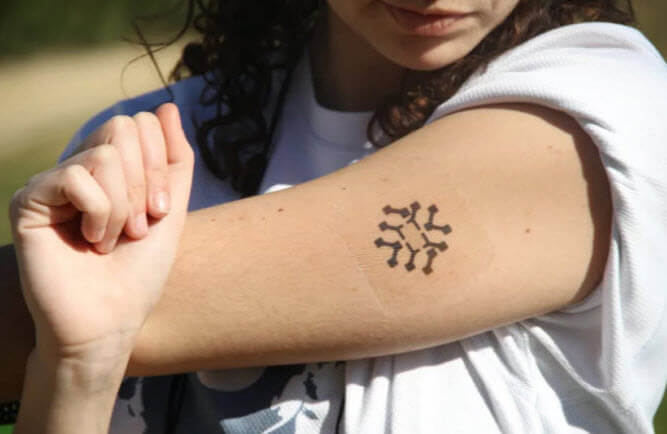
The ICFO has also developed a device that allows people to monitor their level of exposure to sunlight through a UV sensor. Designed as a flexible, transparent and disposable patch, it connects to a mobile device and alerts the user once he or she has reached a defined threshold of sun exposure.
What’s more, using the same core technology as the UV patch, ICFO’s other device is a fitness band that is being developed to measure heart rate, hydration, oxygen saturation, breathing rate and temperature, while monitoring the user when he or she is exercising, for example.
The fitness band does more than simply measure physical activity too, it can also emit warnings if the user needs help.
Consider the following scenario: A person is trekking in the remote Amazon jungle with limited access to water. By measuring the skin hydration of their body with ICFO’s fitness band, the user can optimise water intake, preventing any sort of dehydration. Similarly, an explorer hiking to the peak of Mount Everest could use the band to accurately monitor oxygen saturation in blood. The high altitude can severely effect oxygen saturation in the body. Using the band, the hiker could monitor these levels and emit a warning if oxygen saturation in the blood decreases drastically below a certain level.
The prototype devices will be on show in the Graphene Pavilion at MWC Barcelona, Spain, on 25-28 February 2019.