
Graphene is a relatively recent innovation and is thought of by many as a type of wonder material. It is the thinnest material currently known (just a single atom thick sheet of carbon atoms) and has notable properties such as thermal and electrical conductivity.
What's more, it has great potential to be used as a component in wearable technology, although integrating graphene into textiles is still a challenge.
But recently, two independent research studies have reported successful developments in using graphene to produce sensors and battery-like devices for wearable applications.
Sensor technology
First up, researchers at the University of British Colombia Okanagan's School of Engineering in Canada, have developed a low-cost sensor that can be interlaced into textiles and composite materials.
The embedded microscopic sensor is able to recognise local motion through the stretching of the woven yarns that are treated with graphene nanoplatelets that can read the body’s activity, explains Mina Hoorfar, engineering professor and lead researcher at the Advanced Thermo-Fluidic Lab at UBC’s Okanagan campus.

She continues: “Microscopic sensors are changing the way we monitor machines and humans. Combining the shrinking of technology along with improved accuracy, the future is very bright in this area.”
This ‘shrinking technology’ uses a phenomenon called piezo-resistivity - an electromechanical response of a material when it is under strain. These tiny sensors have shown a great promise in detecting human movements and can be used for heart rate monitoring or temperature control.
Her research, conducted in partnership with UBC Okanagan’s Materials and Manufacturing Research Institute, shows the potential of a low-cost, sensitive and stretchable yarn sensor.
The sensor can be woven into spandex material and then wrapped into a stretchable silicone sheath. This sheath protects the conductive layer against harsh conditions and allows for the creation of washable wearable sensors.
While the idea of smart clothing may change the athletics industry, UBC Professor Abbas Milani says the sensor has other uses. It can monitor deformations in fibre-reinforced composite fabrics currently used in advanced industries such as automotive, aerospace and marine manufacturing.
The low-cost stretchable composite sensor has also shown a high sensitivity and can detect small deformations such as yarn stretching as well as out-of-plane deformations at inaccessible places within composite laminates, says Milani.
The testing indicates that further improvements in its accuracy could be achieved by fine-tuning the sensor’s material blend and improving its electrical conductivity and sensitivity. This can eventually make it able to capture major flaws like 'fibre wrinkling' during the manufacturing of advanced composite structures such as those currently used in aeroplanes or car bodies.
“Advanced textile composite materials make the most of combining the strengths of different reinforcement materials and patterns with different resin options,” he says.
“Integrating sensor technologies like piezo-resistive sensors made of flexible materials compatible with the host textile reinforcement is becoming a real game-changer in the emerging era of smart manufacturing and current automated industry trends.”
Battery-like devices
And on the other side of the Atlantic, a team from the University of Cambridge, UK, has developed a washable and wearable battery-like device that could be woven directly into textiles.
Working in collaboration with colleagues at Jiangnan University in China, the researchers have shown how graphene and other related materials can be directly incorporated into fabrics to produce charge storage elements such as capacitors.
The research, published in the journal Nanoscale, demonstrates that graphene inks can be used in textiles able to store electrical charge and release it when required. The new textile electronic devices are based on low-cost, sustainable and scalable dyeing of polyester fabric. The inks are produced by standard solution processing techniques.
Building on previous work by the same team, the researchers designed inks which can be directly coated onto a polyester fabric in a simple dyeing process. The versatility of the process allows various types of electronic components to be incorporated into the fabric.
Most other wearable electronics rely on rigid electronic components mounted on plastic or textiles. These offer limited compatibility with the skin in many circumstances, are damaged when washed and are uncomfortable to wear because they are not breathable.
“Other techniques to incorporate electronic components directly into textiles are expensive to produce and usually require toxic solvents, which makes them unsuitable to be worn,” says Dr Felice Torrisi from the Cambridge Graphene Centre, and the paper’s corresponding author.
“Our inks are cheap, safe and environmentally-friendly, and can be combined to create electronic circuits by simply overlaying different fabrics made of two-dimensional materials on the fabric.”
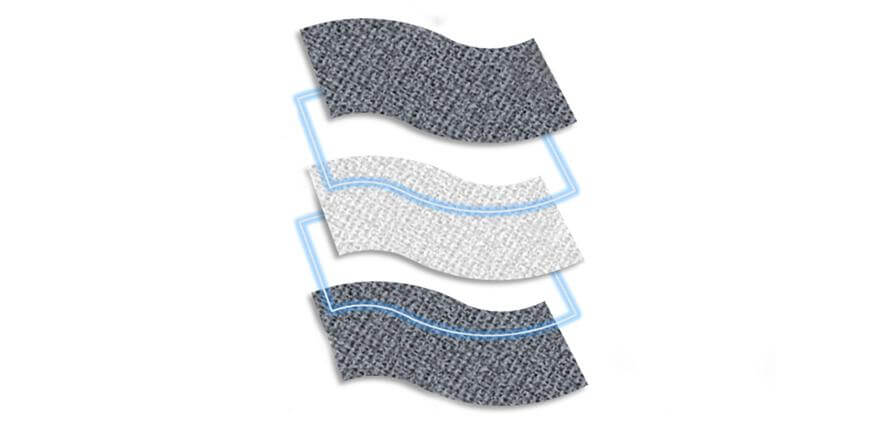
The researchers suspended individual graphene sheets in a low boiling point solvent, which is easily removed after deposition on the fabric, resulting in a thin and uniform conducting network made up of multiple graphene sheets. The subsequent overlay of several graphene and hexagonal boron nitride (h-BN) fabrics creates an active region, which enables charge storage. This sort of ‘battery’ on fabric is bendable and can withstand washing cycles in a normal washing machine.
“Textile dyeing has been around for centuries using simple pigments, but our result demonstrates for the first time that inks based on graphene and related materials can be used to produce textiles that could store and release energy,” says co-author Professor Chaoxia Wang from Jiangnan University in China.
“Our process is scalable and there are no fundamental obstacles to the technological development of wearable electronic devices both in terms of their complexity and performance.”
The work done by the Cambridge researchers opens a number of commercial opportunities for ink based on two-dimensional materials, ranging from personal health and well-being technology, to wearable energy and data storage, military garments, wearable computing and fashion.
“Turning textiles into functional energy storage elements can open up an entirely new set of applications, from body-energy harvesting and storage to the Internet of Things,” adds Torrisi.
“In the future our clothes could incorporate these textile-based charge storage elements and power wearable textile devices.”