
Atlantic Leather’s Steinunn Gunnsteindóttir speaks to Jessica Owen about the company’s journey from ‘fish soup to luxury leather’.
Leather making is an ancient art that has been practised for more than 7,000 years. Many people look to sheep and cows when they think of leather, but few are aware that fish skins can also be made into this durable material.
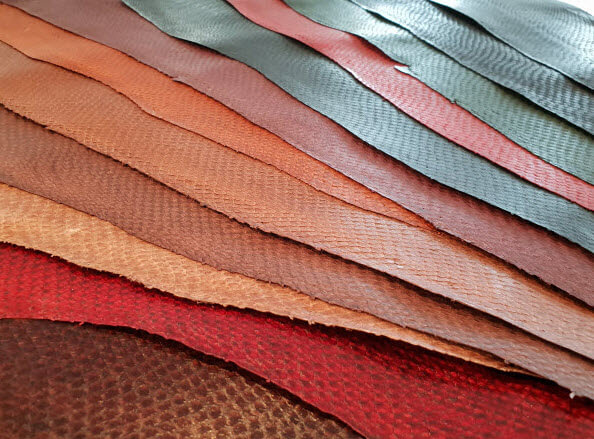
Atlantic Leather focus on four types of fish leather – salmon, perch, wolffish and cod
Stationed in Sauðárkrókur, in the heart of Skagafjörður, Iceland, Atlantic Leather – a family run tannery – specialises in the production of exotic fish leather from four different varieties of fish, each with its own individual characteristics.
“When we first started, we only worked with long wool sheepskin, but around 1990 the market for sheepskin just collapsed completely, so we had to think of what else we could do, and we ended up with fish leather,” says Steinunn Gunnsteindóttir, sales manager, Atlantic Leather.
“It took a while to learn how to get the technique right because it’s a very different thing to tan an animal with cold blood compared to an animal with warm blood. The first 200 times we tried it we just ended up with fish soup, but eventually we got it right.”
The four types of fish leather
Atlantic Leather focuses on four types of fish leather – salmon, perch, wolffish and cod.
“You can work with any type of fish you want really, but we focus on just four as it is always best to focus on less and do it better,” she adds.
“The salmon is always the most popular leather because the scales are really even and straight and the leather can be used in most things. Perch scales are really big and wild, and this does not suit as many products as salmon does.”
The salmon leather is thin, flexible and very strong. The texture of the salmon leather is also smooth and refined and takes colour well. Perch leather is quite large in size and thick and the scales can be left open to create natural, raw and wild textures, or they can be smoothed down and closed up using varnish. Atlantic Leather is the only company in the world that makes wolffish leather. The leather has two distinct qualities – its dark spotted pattern and scaleless surface. Lastly, cod leather is thin and supple and surprisingly strong. The leather has a highly unusual surface and the triangular shape of the hides make it ideal for triangle panels.
Atlantic Leather also has a line of washable salmon leather, and according to the company, it is the first and only company in the world to have found a way to make fish leather that can be washed in a washing machine.
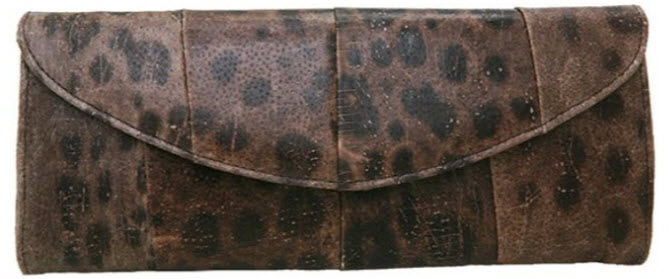
Atlantic Leather is the only company in the world that makes wolffish leather
From scraps to leather
The company only works with fish skins that are bi-products of the food processing industry, so no animal is killed with the sole purpose of taking its skin.
The salmon skins are sourced from salmon farms in the Nordic countries, while cod and wolffish hides are obtained from Icelandic fisheries. Perch skins are sourced from fish-processing companies in Africa as the Nile perch is fished for human consumption from Lake Victoria.
The skins are frozen and delivered to Atlantic Leather and then the tanning process begins.
“Once the skins are tanned, we can add colour and add a finish to them. We have lots of colours and the finishes just depend on what our clients would like. We can add a full shine or a half shine, but it just depends on the orders,” says Gunnsteindóttir.
And if you were thinking ‘well, what about the fishy smell?’ Don’t worry – the smell is removed during the tanning process.
After the fish skins have been prepared, they can be used to make all sorts of things.
“Fish leather is very strong,” adds Gunnsteindóttir. “It is about seven to eight times stronger than cow leather, for example. This is because the fibres in the skin criss-cross instead of just going up and down, so it is very durable and great for things like belts, bags and shoes.”
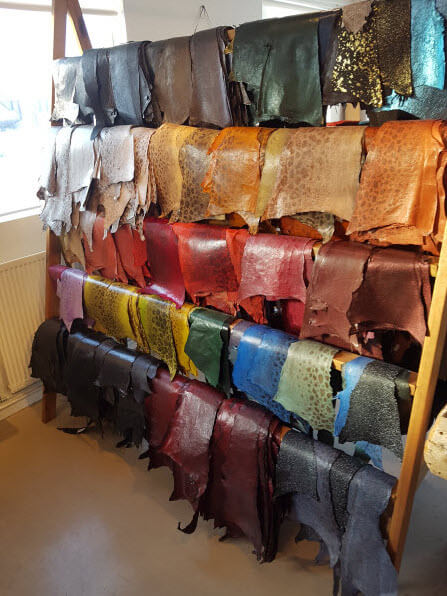
The company only works with fish skins that are bi-products of the food processing industry
Sustainability
Atlantic Leather has the goal to keep the natural characteristic of the skins in place as well as making all the skins in an environmentally-friendly way. The company uses chrome-free tanning and takes advantage of the natural sources of hot spring water and hydroelectric power for its production.
“Here in Iceland we are lucky to have a lot of hot water, so we don’t have to use coal etc to heat it – we can just use what we have,” says Gunnsteindóttir.
When it comes to dyeing the skins, Atlantic Leather always uses AZO-free dyes. For the finishing, water-based acrylic and urethane-based compounds are used.
All tests have shown that the company is well under the chemical regulation of the European Union, and additionally, the company treats its wastewater before it goes out from the factory.
Luxury leather
“In 2013, Atlantic Leather was voted best luxury leather in the world at the APLF Hong Kong leather exhibition,” says Gunnsteindóttir.
“There were more than 800 companies competing – so, we have come from fish soup to the best luxury leather in the world.”
Not only is Atlantic Leather an award-winning company, but it has worked with several high-profile companies. Gunnsteindóttir says that in the past clients have included Dior, Nike, Prada and Estee Lauder.
“We usually go to textile shows like Première Vision in Paris, Lineapelle in Milan, and there’s a fair in Hong Kong, too,” she says. “We meet our clients mostly at these and then usually they come over to us and put in orders.”
The company has recently premiered a new colour line at Lineapelle, Milan, last month (September). This line will mostly be applied to tanning salmon.
“We are always striving to do better – we have a really high-quality product and we just have to be the best at what we do,” adds Gunnsteindóttir.


