Carbon nanotube technology is a hot topic at the moment. Researchers have been exploring the medical and composite coating applications of these cylindrical structures, and now military functions are being investigated, too.
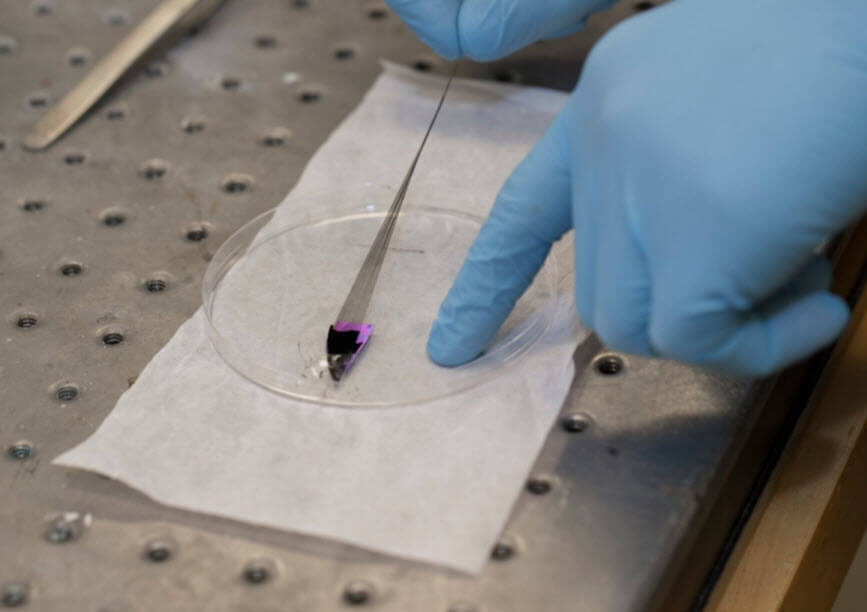
The carbon fibres can be spooled into strong, conductive thread
The University of Cincinnati’s College of Engineering and Applied Science has a five-year agreement with the Air Force Research Laboratory to conduct research that can enhance military technology applications.
“The major challenge is translating these beautiful properties to take advantage of their strength, conductivity and heat resistance,” says professor Vesselin Shanov, co-director of the university’s Nanoworld Laboratories.
Shanov’s research partner, professor Mark Schulz, says manufacturing is at the cusp of a carbon renaissance. “Carbon nanotubes could replace copper wire in cars and planes to reduce weight and improve fuel efficiency. Carbon could filter our water and tell us more about our lives and bodies through new biometric sensors,” he adds.
Schulz continues to explain how carbon will eventually replace polyester and other synthetic fibres.
“Since carbon nanotubes are the blackest objects found on Earth, absorbing 99.9% of all visible light, you might say carbon is the new black,” he adds.
Growing carbon nanotubes
The university researchers ‘grow’ nanotubes on a 10p coin-sized silicon wafer under heat in a vacuum chamber through a process called chemical vapour deposition.
“Each particle has a nucleation point – we can call it a ‘seed’,” says graduate student Mark Haase, who has spent the past year exploring carbon nanotube applications and the Air Force Research Lab of Wright-Patterson.
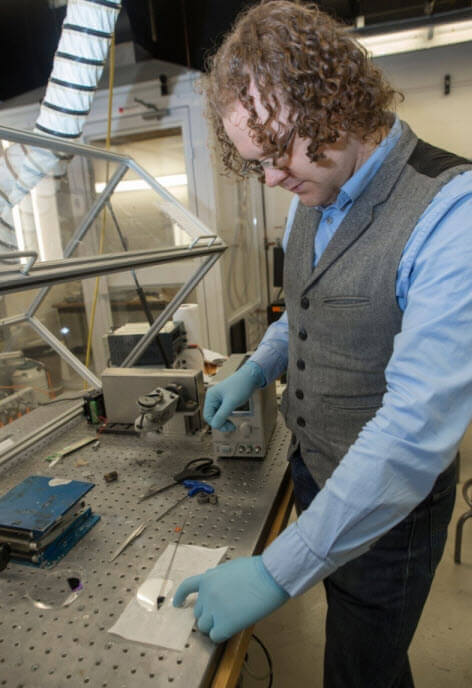
Graduate student Mark Haase stretches a carbon nanotube fibre
“Our carbon-containing gas is introduced into the reactor,” he adds. “When the carbon gas interacts with our ‘seed’, it breaks down and re-forms on the surface. We let it grow until it reaches the size we want.”
Researchers can use almost any carbon, from alcohol to methane.
“I remember one group showed off by using Girl Scout cookies,” says Haase. “If it contains carbon, you can turn it into a nanotube.”
UC researchers stretch the little fibrous square over an industrial spool in the lab. This tiny sheet of carbon then becomes a spun thread that resembles spider silk that can be woven into textiles.
“It’s exactly like a textile,” says Shanov. “We can assemble them like a machine thread and use them in applications ranging from sensors to track heavy metals in water or energy storage devices, including super capacitors and batteries.”
Military applications
For the military, this could mean replacing heavy batteries that charge the growing number of electronics that make up a soldier’s loadout: lights; night-vision; and communications gear.
“As much as one-third of the weight they carry is just batteries to power all of their equipment,” says Haase. “So, even if we can shave a little off that, it’s a big advantage for them in the field.”
The preliminary results have been promising, however, the costs are too excessive currently.
“We’re working with clients who care more about performance than cost,” says Haase. “But once we perfect synthesis, scale goes up considerably and costs should drop accordingly. Then we’ll see carbon nanotubes spread to many, many more applications.”
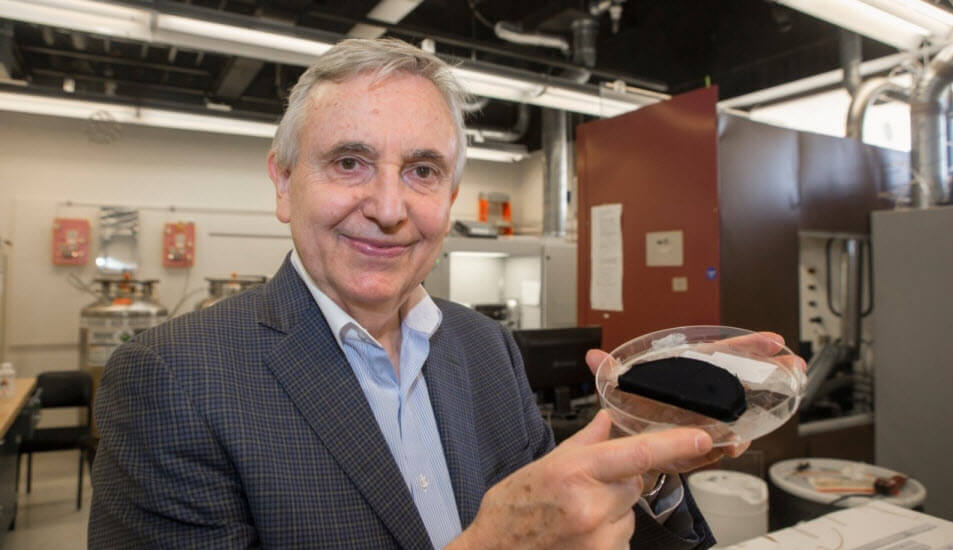
Professor Vesselin Shanov holds up a sample of a carbon nanotube fibre grown in the Nanoworld Laboratories
Constraints
For now, the University of Cincinnati’s lab can produce about 50 yards of carbon nanotube thread at a time for its research, whereas most large-scale textile machines need miles of thread, but the team is working on this.
“Until then, mass production remains one of the bigger unresolved problems for carbon nanotube technology,” says Benji Maruyama, who leads the Materials and Manufacturing Directorate at the Air Force Research Laboratory.
“There is still a lot of work to be done in scaling up the process,” he adds. “Pulling a carbon nanotube fibre off a silicon disk is good for lab-scale research but not for making an airplane wing or flight suit.”
Maruyama is trying to solve that problem with a series of experiments he is conducting using an autonomous research robot called ARES. The robot designs and conducts experiments with carbon nanotubes, analyses the results and then uses that data and artificial intelligence to redefine parameters for the next experiment. In this way, it can conduct 100 times as many experiments in the same time as human researchers.
“The big advantage of using carbon nanotubes is that there’s no shortage of materials,” says Maruyama. “It just requires a metal catalyst – we use iron and nickel – and carbon. It’s not scarce.”
The goal is to convert the University of Cincinnati’s academic research into solutions to real problems.
“We have the luxury in academia to explore different applications,” adds Shanov. “Not all of them may see the market, but even if 10% do, it would be a great success.”