This week the Australian wool market recovered some of the previous week’s losses and was assisted by a further weakening in local currency.
The Australian Wool Exchange (AWEX) Eastern Market Indicator (EMI) rose by 22 cents (1.1%) for the week to close on 2,090 cents per kilo clean on Friday 31 August. However, in US dollar terms, the EMI declined by 3 cents (0.2%) to 1,516 US cents.
The Australian dollar against the US dollar fell by 0.76 cents (1%), finishing at 72.80 cents on Friday.
Sales were held at all three selling centres on Wednesday 30 August, at Sydney and Fremantle on Thursday 30 August, and at Melbourne on Friday 31 August.
Thursday’s Melbourne sale was delayed until Friday due to authorities issuing an evacuation order for the Melbourne wool auction centre on Thursday following a nearby warehouse fire. It was one of only three Friday sales in the history of AWEX (since 1995) and the first postponement of a sale since the 9/11 New York terrorist attacks in 2001.
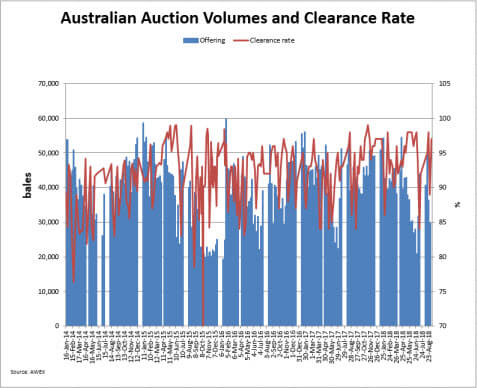
This week’s total national offering was 36,000 bales, compared with 29,691 bales last week, resulting in a clearance rate of 97%.
On Wednesday the EMI rose by 8 cents to 2,076 cents and in US dollar terms climbed by 6 cents to 1,525 US cents. On Thursday the EMI lifted by 5 cents to 2,081 cents but in US dollar terms declined by 9 cents to 1,516 US cents. On Friday the EMI increased by a further 9 cents to 2,090 cents and in US dollar terms stayed firm on 1,516 US cents.
The market increased progressively during the week, resulting in rises of 10 to 50 cents for Merino types on the East coast. The movements for Fremantle showed losses approaching one dollar for the 20/21 micron range. However, this was compared to its previous sale held a fortnight earlier.
AWEX said that a designated Australian Superfine sale in Sydney this week was timely given a focus on the finer microns, where significant premiums were paid for Spinners styles and higher strength types in the ultrafine range.
In Melbourne on Friday all micron ranges and most types moved up. Among the national AWEX average Micron Price Guides (MPGs) for the Merino types, 16.5 microns lifted by 26 cents (0.8%); 17 microns was up by 30 cents (1%); 17.5 microns climbed by 36 cents (1.3%); 18 microns increased by 42 cents (1.6%); 18.5 microns lifted by 46 cents (1.9%); 19 microns was up by 28 cents (1.2%); 19.5 microns gained 4 cents (0.2%); 20 microns increased by 2 cents (0.1%); 21 microns rose by 40 cents (1.8%); 22 microns climbed by 10 cents (0.4%); and 24 microns was up by 4 cents (0.2%). No MPG was quoted for 23 microns.
AWEX reported that Merino skirtings were similarly in high demand, particularly the well-classed better types exhibiting low vegetable matter (VM) and good length.
The smallest crossbred catalogue for the season saw prices firm by around 10 cents over the three days. Among the national AWEX average MPGs for the crossbred types, 25 microns was unchanged; 26 microns gained 5 cents (0.3%); 28 microns was up by 23 cents (2.4%); 30 microns increased by 27 cents (3.9%); and 32 microns was unchanged.
Merino carding types added to recent gains with further rises this week. Improvements of 40 to 60 cents pushed all three Merino Carding Indicators into record territory, beating the previous benchmark reached in January. The average Merino Cardings Price Guide was up by 3.1% for the week to close at 1,584 cents.
AWEX reported that the total value of the wool sold this week was AU$87.3m (AU$2,493 per bale), taking the season total to AU$502.7m. Buyers for China were dominant, with support from buyers for Europe and India.
Next week (Week 10) there is a national total of 39,293 bales expected in the three selling centres. The forecast for Week 11 is 34,023 bales, and Week 12 38,165 bales. The offerings for the next three sales are forecast to be 10.4% less than in the same period last year.