The Australian wool market had a relatively stable week as the Australian Wool Exchange (AWEX) Eastern Market Indicator (EMI) recorded an increase for the first time in over a month.

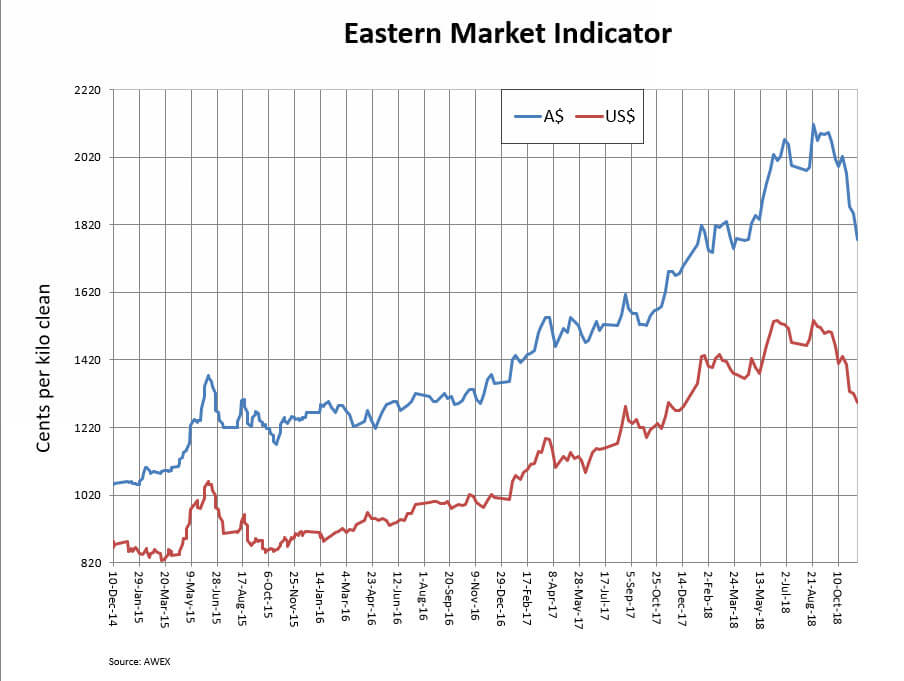
The EMI rose by 5 cents (0.3%) for the week to close on 1,781 cents per kilo clean on Thursday 15 November. In US dollar terms, the EMI gained 2 cents (0.2%) to finish on 1,295 US cents.
The Australian dollar against the US dollar finished 0.35 cents (0.5%) higher to close at 72.79 US cents on Thursday.
This week’s national offering was 35,334 bales, compared with 32,189 bales last week. The clearance rate was 89.1%. Analysts noted that the lift in the market did not improve the clearance rate on Thursday, when it was 88.7%, after being 89.5% on Wednesday, suggesting that growers are looking for prices nearer to those of a few weeks ago.
Sales were held at all three selling centres on Wednesday 14 November and Thursday 15 November. The market moved up in both currencies at all three centres on Thursday, after showing signs of settling on Wednesday. On Wednesday the EMI fell by 8 cents to 1,768 cents and in US dollar terms declined by 16 cents to 1,277 US cents. However, on Thursday the EMI lifted by 13 cents to 1,781 cents and in US dollar terms rose by 18 cents to 1,295 US cents.
Trade reports indicated that there was good widespread competition that made it difficult for any one firm to dominate.
AWEX reported that this week’s increase in the EMI was mainly a result of solid gains in the carding and crossbred sectors. The Merino fleece market performed with mixed results, with all three centres recording varied outcomes for similar wools. A large selection of fine tender wools struggled to attract strong buyer demand, and this contributed to the average AWEX Micron Price Guides (MPGs) for 19 microns and finer generally falling by 30 to 50 cents. The MPGs for 19.5-20.5 microns attracted excellent competition and managed modest increases for the week, while a limited selection of 21 microns and coarser were generally unchanged when compared to the previous sale.
Among the average MPGs for the Merino types,
16.5 microns fell by 15 cents (0.6%); 17 microns was down by 17 cents (0.7%); 17.5 microns declined by 8 cents (0.3%); 18 microns stayed firm; 18.5 microns fell by 26 cents (1.2%); 19 microns stayed firm; 19.5 microns gained 9 cents (0.4%); 20 microns increased by 9 cents (0.4%); 21 microns declined by 1 cent; 22 microns fell by 12 cents (0.6%); and 23 microns was down by 25 cents (1.2%).
AWEX noted that as a result of the finer microns suffering larger losses over the previous few months, the price differentials between microns has shrunk considerably. This is best highlighted when looking at the difference between the MPGs for 19 and 21 microns. Currently, this difference is averaging only 47 cents, compared to over 110 cents when the MPGs peaked in August.
Skirtings had an up and down week, with losses felt on the first selling day, then gains on the second, resulting in prices being generally unchanged.
The crossbred sector recorded gains for the week. Prices generally increased by 5 to 25 cents, with the largest gains for the better prepared lines. Among the national AWEX average MPGs for the crossbred types, 25 microns fell by 25 cents (1.8%); 26 microns gained 2 cents (0.2%); 28 microns rose by 15 cents (2%); 30 microns increased by 21 cents (3.2%); and 32 microns climbed by 5 cents (1%).
The oddments saw the biggest movements for the week, finally recording price increases after two months of continual large losses. Locks, stains and crutchings generally rose by 50 to 120 cents. These rises helped to push the AWEX Merino Carding Indicator up by 89 cents. This cancelled out last week’s 61 cent fall, but still left it 469 cents behind the season peak.
AWEX reported that the total value of the wool sold this week was AU$62.1m (AU$1,972 per bale), taking the season total to AU$1.274bn (AU$2,322 per bale). Buyers for China were dominant, with support from buyers for India, Korea and Europe.
The national quantity is forecast to remain very similar next week (Week 21), with 35,334 bales currently on offer. The projection for Week 22 is 37,540 bales, and Week 23 36,778 bales.
The combined offerings for the next three weeks are expected to be 24.4% less than in the same period last year. This would mean that the total for the season up to Week 23 would be 17.7% lower than up to the corresponding week last season.