EFI Reggiani will launch three new digital textile printers in the first half of 2021. Here, the company’s senior vice president and general manager, Adele Genoni, outlines the motivating factors. Joseph Link reports.
As part of its 75th anniversary celebrations, EFI Reggiani has revealed the imminent launch of three new digital textile printers. Adele Genoni, senior vice president and general manager at the company, revealed the news during a press briefing at EFI’s first virtual user conference, EFI Engage 2021.
Following a tumultuous year for the textile printing industry, the scale of the announcement is surprising. But in the increasingly competitive and rapidly evolving world of inkjet textile printing, Genoni explains the new machines will enable EFI Reggiani to further expand its share of the high-growth market beyond the current pandemic.
The inkjet textile printing industry has enjoyed a decade of technological innovation, but the market remains quite small in comparison to the rotary screen-printing sector. According to WTiN Intelligence: Digital Textiles, inkjet technology accounts for around 10% of all printed textiles.
But in spite of the versatility and resourcefulness of digital textile solutions, the industrial high-volume segment of the market struggled in 2020. Orders for fashion and apparel fell away when western economies went into lockdown and many high-volume print service providers were left in a precarious position. Their plight resulted in a decline in new machinery installations – which also caused a serious headache for OEMs such as EFI Reggiani.
Increasing productivity
Genoni believes productivity is a key driver in increasing that percentage and one of EFI Reggiani’s new launches will specifically target a noticeable gap in the market.
“We want to help support our customers in their digital transformation,” she says. “One of [EFI Reggiani’s] three new printers is going to target the industrial high-speed segment of the multi-pass textile printing sector. The printer will not only be the fastest multi-pass printer that EFI Reggiani has ever developed, but we are expecting it to be the fastest of its kind in the market.”
EFI Reggiani technicians are currently working behind the scenes to carry out the few remaining tests to officially verify that claim, but the overriding aim of the solution is to further close the productivity gap between single-pass printers and scanning machines.
“We have listened to our customers and we have understood that there is a need [for even more productive digital textile scanning printers], and we are trying to fulfil those requirements with one of the upcoming solutions,” Genoni adds.
However, due to the growth in ecommerce last year – particularly the online trading of fashion and apparel – the exciting and more sustainable on-demand Web2Print business model reached new heights. And with the world still struggling to contain the Covid-19 virus and large economies enduring ongoing social restrictions (which includes the closure of non-essential brands and retailers) the business model is forecast to become even more prominent in 2021.
Nevertheless, EFI Reggiani believes it will answer to these shifts with other two impending scanning machines, which will help facilitate a customer’s need to manufacture closer to the end consumer.
“Breaking into the industrial low-end segment of the digital textile printing market is another driver for [EFI Reggiani],” explains Genoni. “Industrial is our field but we are listening and adapting to the current market trends, which includes nearshoring and reshoring. We are expecting new customers to enter into the industrial area and into new geographies.
“In the growing low-volume segment of the market we are going to strengthen our multi-pass offering by introducing novelties to our industrial range. We will be presenting two new industrial entry level scanning printers to the market that will be equipped with EFI Reggiani state-of-the-art technology. They will enable new customers to move their first steps in industrial textile digital printing with easy-to-use and reliable solutions, independently the productivity level they are looking for. Through the machines, customers will also access the best technology in terms of EFI Reggiani quality and reliability.”
Bespoke designs
Moreover, Genoni points to a growing misconception that personalisation – a trend often linked to low-volume on-demand printing online – is not achievable for high-volume print service providers. Following a rise in ecommerce last year (2020) for textile goods, the personalisation trend is accelerating.
“It is important to understand that high-productivity printing can be matched with personalisation and customisation,” she says. “We have customers who are leveraging our top scanning printers, like the EFI Reggiani POWER, with its 32 print heads, to print thousands of personalised designs every day.
“These customers have ecommerce linked to their production planning and they are also printing in large widths, up to 3.4 metres. They are printing personalised pillows, for example, with photos provided directly from the customer.
“The productivity is a requirement of the print house based on their order size or the output that they want to achieve. Obviously, if a print house is entering into the inkjet industrial level it may want to start with a low-speed printer and then increase output depending on their demand and its customers’ needs. But crucially, with digital personalisation is possible no matter what the productivity of the printer is.”
Sustainability
Besides drivers behind the three EFI Reggiani’s new machines, Genoni has announced plans to expand EFI Reggiani’s digital inks offering in 2021. Issues around sustainability were a critical motivating factor.
The OEM knows, as does its customers, that consumer buying habits are changing based on a growing understanding that their purchases are potentially nurturing environmentally damaging manufacturing processes, and a lack of supply chain transparency is culpable.
In the digital textile printing market, pigment inks are key to lowering a print service provider’s environmental impact.
“EFI Reggiani is the only OEM on the market that is offering a full range of digital pigment printing solutions,” explains Genoni. “We don’t just have one printer model, so we can answer to the request of our customers on an individual basis taking into consideration their productivity level. We have developed a pigment printer offering that replicates the full range of the other ink classes, and thanks to EFI Reggiani TERRA pigment with binder and the special polymerisation unit, it allows for a short process with inline fixation directly on the printer itself. The benefits of digital pigment printing are that less water and energy are consumed, no post-treatment after printing is needed, and waste is kept to a minimum.
And even though the cost of digital pigment inks remains stubbornly high despite a decline in recent years, there are other cost benefits to take into consideration.
“The print service provider would not have to spend on auxiliary equipment for pre- and post-treatments if they adopted a pigment process,” Genoni says. “And by printing with water-based pigments, users can provide a more environmentally friendly solution for consumers. This is especially important to younger generations as they are driving the agenda of style and trends with sustainability in mind.”
Single-pass printing
Genoni is also keen to dispel the myths around the need for single-pass printing. The technology has evolved quickly into a solution that now competes, in terms of productivity, with rotary screen-printing technology – the latter accounts for 80% of the market. Genoni does not believe that new low-volume textile printers will account for such high volumes.
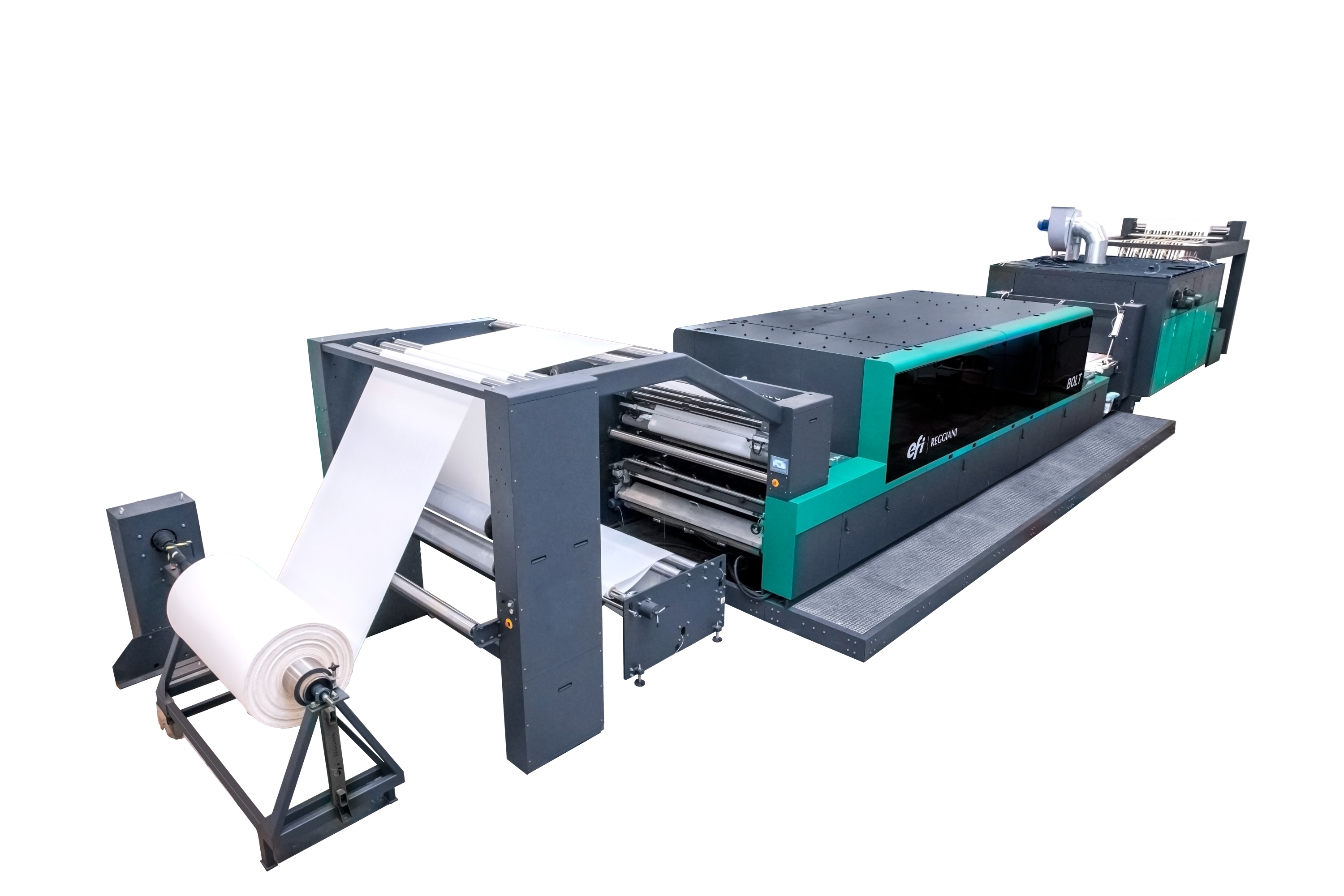
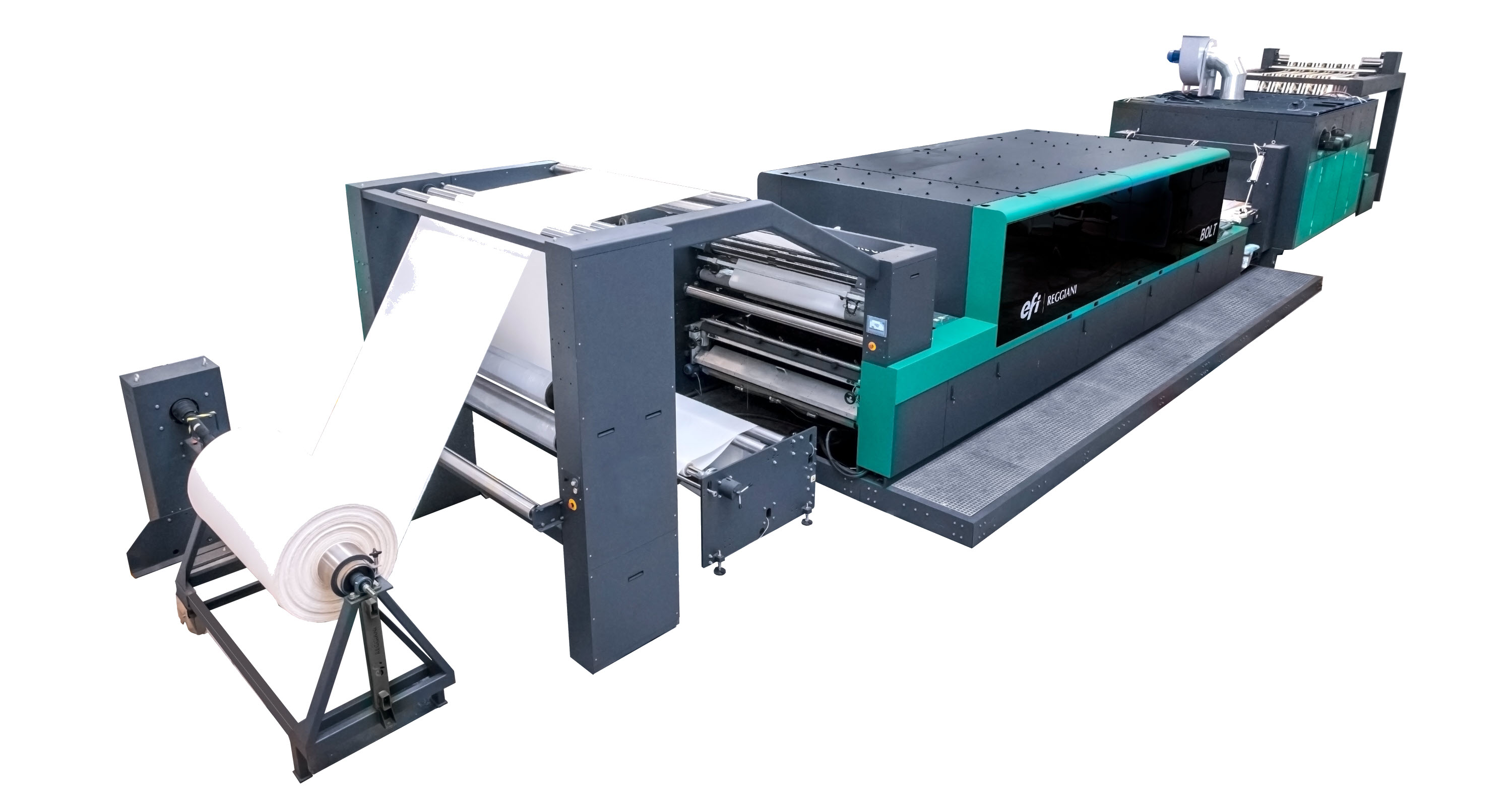
“In just one year, an EFI Reggiani customer based in Pakistan printed 15 million metres of fabric with the BOLT,” she claims, adding that it will be difficult to offset that demand through low-volume print ecommerce. Genoni adds: “We firmly believe that single-pass technology has a strong future in the market.”
The BOLT, launched in 2018, is EFI Reggiani’s only single-pass textile printer to date but is the most productive of its kind in the market. According to Genoni, the printer epitomises the technology’s innovation throughout the last 10 years.
“The adoption rate of single-pass technology when it first came to market was limited due to availability and reliability issues, thus it did not meet the expectations of print service providers,” Genoni says.
“The BOLT, however, is very reliable and in the first year following its launch [in 2018] we [EFI Reggiani] sold four units, which accounted for one third of single-pass printer sales in 2019. Unfortunately, last year was the start of the pandemic and we cannot consider 2020 from a high-productivity standpoint because it is inconceivable that a print house would invest in a high-speed printer when demand was so uncertain. But we do believe fully in the BOLT machine and its future impact on the textile printing market.”
The fashion & apparel sector accounts for two thirds of the textile printing market, home décor applications form the remainder. Genoni points out that the BOLT is increasingly used to print fashion and apparel where high-quality, fine detail prints are required.
And she is quietly optimistic that demand for high-volume printing is returning.
“[EFI Reggiani] had a satisfactory Q4 last year and we are seeing signs that the first quarter of 2021 will also be positive,” she says. “We have agreements that are already in place with customers for Q2 2021 as well. So yes, the market is definitely showing signs of a recovery.”
EFI Reggiani’s new solutions, the development of which began pre-Covid-19, will be launched virtually in the first half of the year (2021).
It will be exciting to see EFI Reggiani’s new range of equipment on exhibition stands around the world, but the company says it will only return to physical exhibitions once it is safe and able to do so.
In the meantime, Genoni says the company will be working to continue to improve its offering to customers by further expanding its product range in due course.
“Our product development roadmap is an ongoing process so we are always considering what EFI Reggiani’s next steps will be,” she continues. “We have a passion for the textile world, so we want to be able to provide our customers with the latest in cutting-edge technology.”