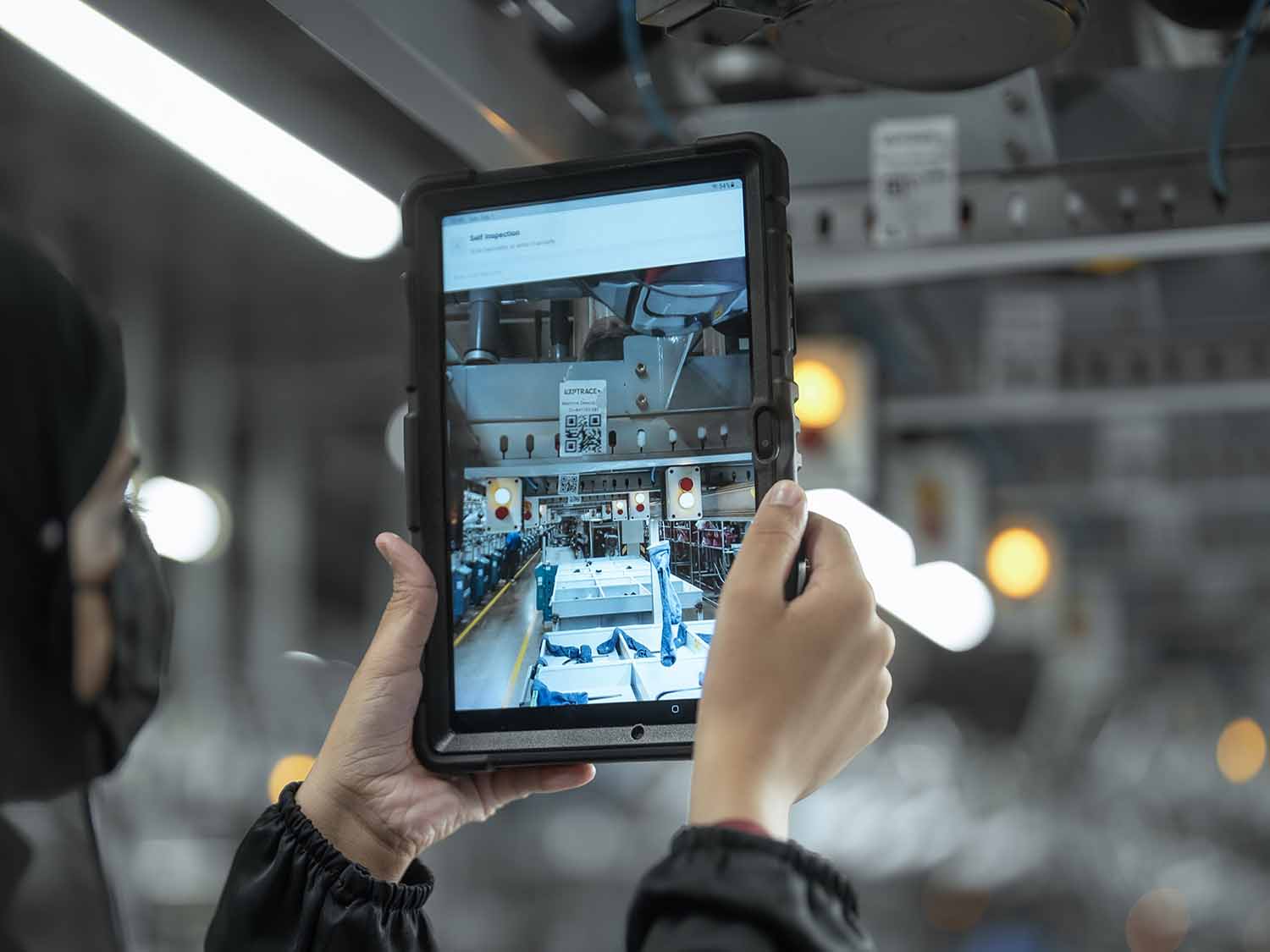
Guido Jaeger, managing director of PFAFF Industrial, talks to Madelaine Cornforth about the importance of automation in the sewing sector and providing added value through connecting the supply chain.
PFAFF Industriesysteme und Maschinen GmbH (with the brands PFAFF Industrial and KSL) develops, produces and sells industrial sewing and welding machines, 2D/3D sewing robots and fully automatic production units. Together with its parent company Dürkopp Adler AG, PFAFF is part of the Shanggong Group Co and as a corporation is one of the biggest manufacturers of industrial sewing machines in the world. PFAFF Industrial and KSL have a unique competence in joining technical and non-technical textiles, leathers and composites, according to Guido Jaeger, managing director of the PFAFF Industrial. In the coming years, Jaeger says, the company will focus on and promote the areas of CNC (computer numerical control) and robotics. “We will expand our technological lead in automation.”
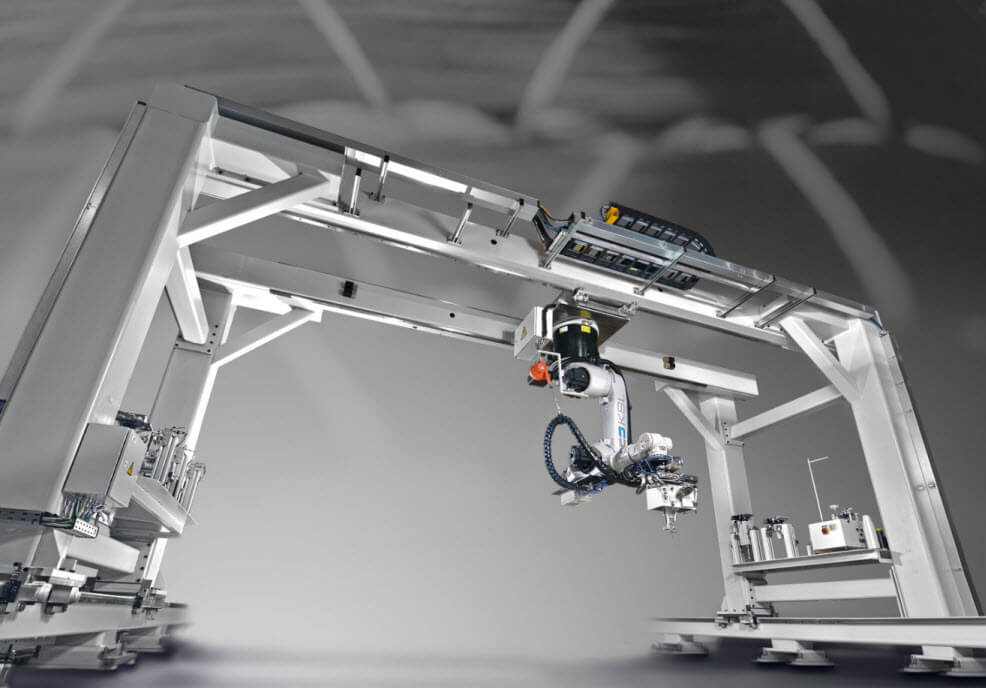
3D-Robot unit (Portal) for the aerospace industry
With KSL (Keilmann Sondermaschinenbau), the company serves the high-end market and provides solutions for automated processing in the automotive, filter, mattresses, home textiles, fashion, belts and aerospace sectors. In late 2015, the KSL-LABORATORY was established in Lorsch/Germany as a center of excellence that is unique in the industry. Jaeger says: “The KSL-LABORATORY serves as the interface between complex customer enquiries and sophisticated robot and CNC-technologies. Based on many years of experience and expertise, customer-oriented solutions and concepts are developed at the facility. Feasibility studies are carried out, prototypes and small batches are realised and special sewing heads for systems are designed and assembled. Ideas and product studies often result in high-end series machines, for example our market performer KL 110 Headbag, a CNC-large-area computer stitcher featuring a turning head for sophisticated operations in airbag production.”
Digitising the sewing sector is difficult, mainly because of the intricacies in the fabric handling aspect of the process that part of the industry requires. However, Jaeger says that digitising this segment of the industry is an opportunity not to be missed and that the apparel industry should follow the lead of the automotive industry.
“Digitisation is a huge opportunity for companies in the West. Without a doubt, the pacemaker for our industry is the automotive industry. We specifically receive demands from the manufacturers of car seats, side panels, dashboards, airbags, convertible tops etc, who utilise sewing machines, sewing automats and sewing robots. However, global players from the sports and garments industries, such as Adidas and its SpeedFactory, also want to be ready for the digitised future. As PFAFF Industrial, KSL and Dürkopp Adler, we will together accompany these customers into the era of digital processing of textiles and leather.”
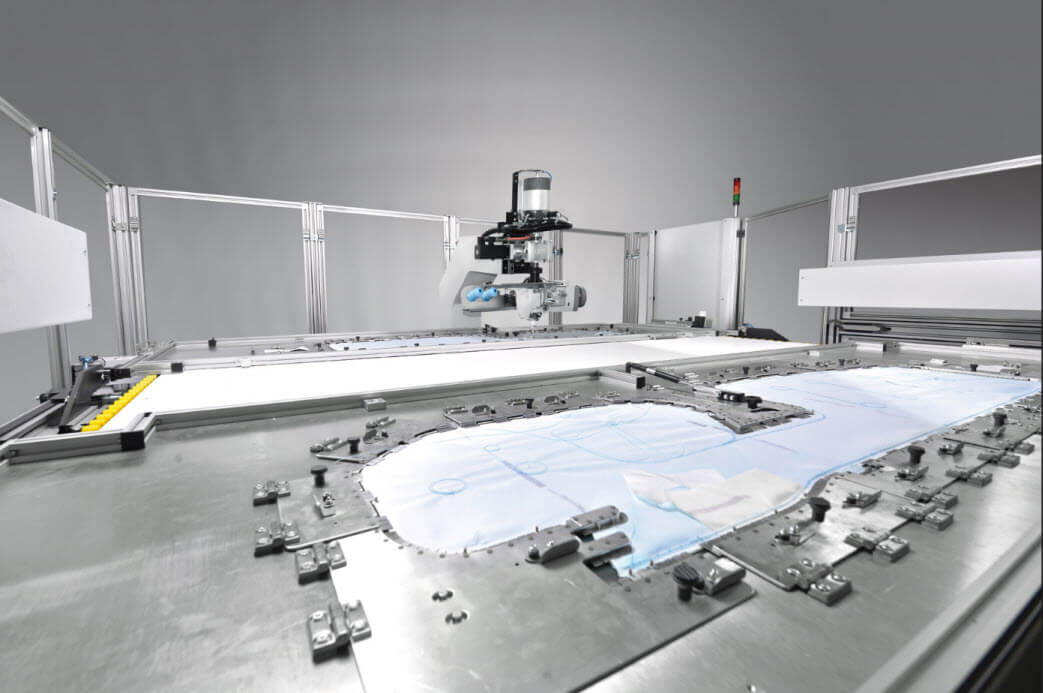
CNC-Sewing unit with turning head for processing airbags
Bringing sewing into the digital era will provide numerous benefits to manufacturers and their supply chains, especially as labour costs continue to rise and more regulations are being put in place, which is making manufacturing more expensive, particularly in China and India. Jaeger comments: “Increasing labour costs in the emerging economies, and limited human resources, are still accompanied by a high percentage of manual labour in industrial textile and leather processing. Unlike in almost any other industry, manual workplaces are still the norm when it comes to sewing and joining. In the future, automated production solutions will help customers processing textiles and leather increase the degree of automation in their production.”
He continues: “Automation and digitisation will increase productivity and process reliability, making the industries more independent of ‘human resources’. Industry 4.0 solutions and IoT platforms connect entire factories – even across borders. Using the real-time analysis of the acquired machine data can significantly improve the availability of the machines and systems, the productivity and the quality of the finished product.”
However, Jaeger notes that digitisation and the implementation of IoT-platforms must provide the customer with real added-value and rather than just being an isolated and automated process, sewing must digitally link directly to processes further up and downstream – such as cutting and packaging – to become a fully-connected system in a smart factory. Jaeger says: “With our QONDAC solution (which is developed and advanced by Dürkopp Adler) we are leading the industry. QONDAC is a high-performance networking system for the optimisation of manufacturing and maintenance processes, remote control and predictive maintenance. The system analyses huge amounts of data in seconds and provides key figures which may be used to immediately detect bottlenecks and potentials for improvement in real time. This enables double digit increases in productivity. Up to 1,500 sewing machines may be connected.”
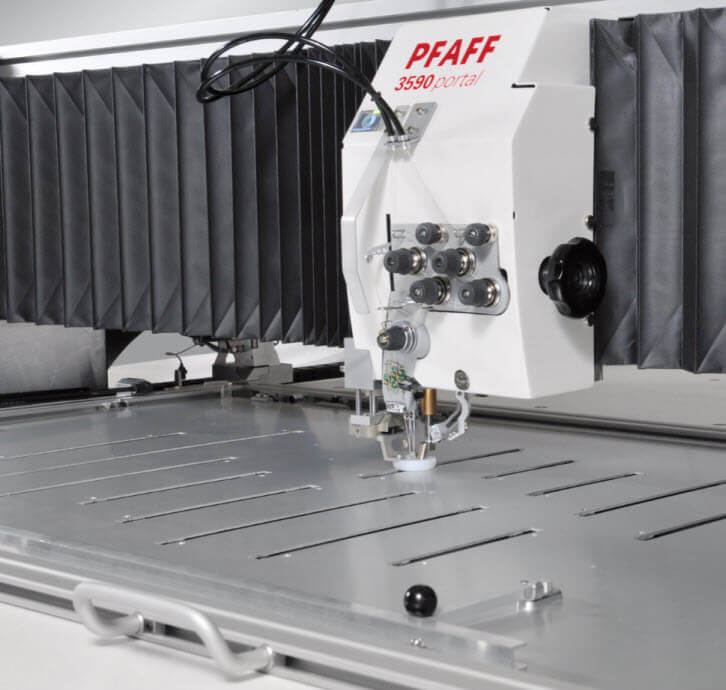
Large-area sewing unit for complex sewing operations
He adds: “Indeed the challenge is connecting the entire production; both up and downstream processes such as printing, cutting, pressing, ironing. But, as a first step, all sewing machines within a production line (as well as the machines of other brands) must be connected. Here QONDAC relies on sensor technology and open interfaces.”
Latest technology
One of the latest technologies from PFAFF is the PFAFF 3587 CNC large-area computer stitcher with a sewing area of 500 x 300mm. It is designed for manufacturers who require process reliability and production output. At the core of the stitching automat is the intermitting material feed system featuring a patented drive, says the company. Because of the intermittent feed (the feed stops when the needle enters the material) a positional change of the cuts in the clamp are avoided. This way, the PFAFF 3587 ensures high stitching accuracy and very high sewing performance and a unique 3,200 SPM (stitches per minute) with intermittent feed, continues PFAFF.
The sewing technology, based on a seam-optimisation system (needle-turning device and bobbin thread slide), ensures good seam quality and stitch pattern in multi-directional sewing operations, according to the OEM. The needle-turning device, in combination with the bobbin thread slide and the vertical hook, prevents slip stitches in highly-decorative seam patterns with a circular seam contour.
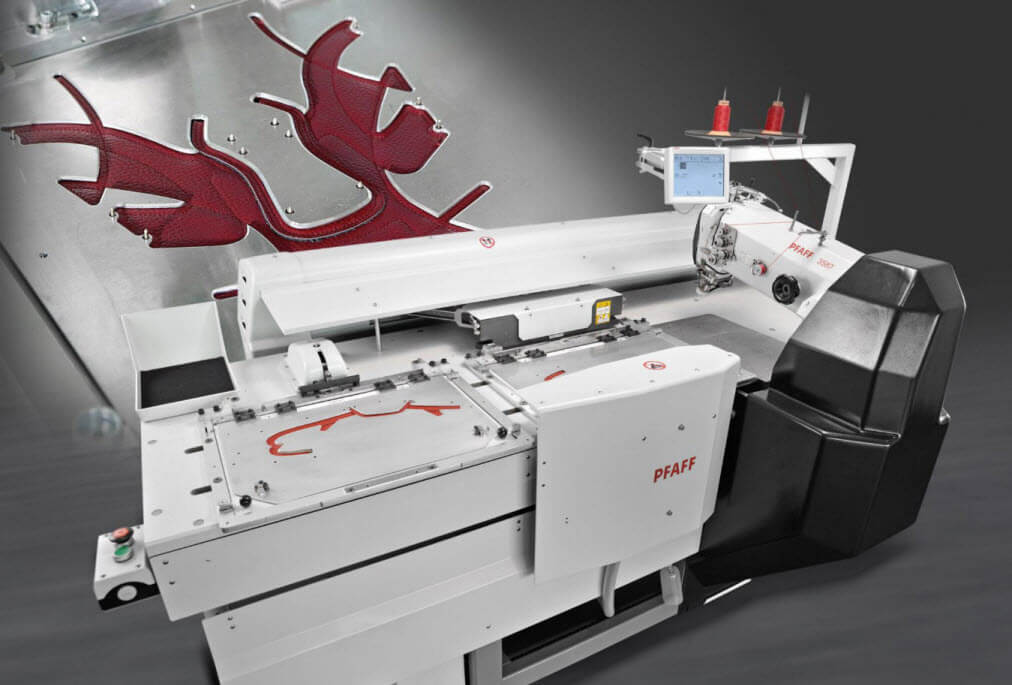
The PFAFF 3587 CNC-large-area computer stitcher
The unique automatic clamp-changing system permits a completely overlapping fully-automated operation with the exception of the material, which still has to be inserted manually.
Additionally, the company adds that the PFAFF 3587 has all the technical requirements to tackle sophisticated and challenging sewing operations. For example, in shoe production, small leather good production or automotive interiors.