Otis Robinson speaks with Paolo Crespi, DTF sales and marketing director at Epson Group, about the company’s virtual booth at Innovate Textile & Apparel and ongoing industry trends.
Hello Paolo – welcome to Innovate Textile & Apparel!
“Thank you! It’s a real pleasure to be part of the Innovate Textile & Apparel virtual trade show this year. This is the first virtual fair we have taken part in and we have joined it with great enthusiasm.”
How will exhibiting at the virtual trade show benefit Epson?
“At a time when physical events with professionals in the sector have been suspended, our presence is important to reaffirm what is essential for us: that technological innovation in this sector never stops. This is certainly a great challenge for speaking about products and technologies, which were traditionally seen and observed by people directly. On the other hand, however, the virtual fair has no limits with respect to space and time. It is active 24 hours a day, so it can be viewed by anyone around the world, and we believe it is a great opportunity to continue to interact with our clients at this time. With our technicians, sales agents, and experts, we are ready to answer and virtually meet all those who want to visit us.”

What is the company showcasing at the event?
“Epson is participating in Innovate Textile & Apparel with its complete range of solutions for the textile sector, from sublimation with the Epson SureColor F series, to DTF (direct-to-fabric) printing with the Monna Lisa series.
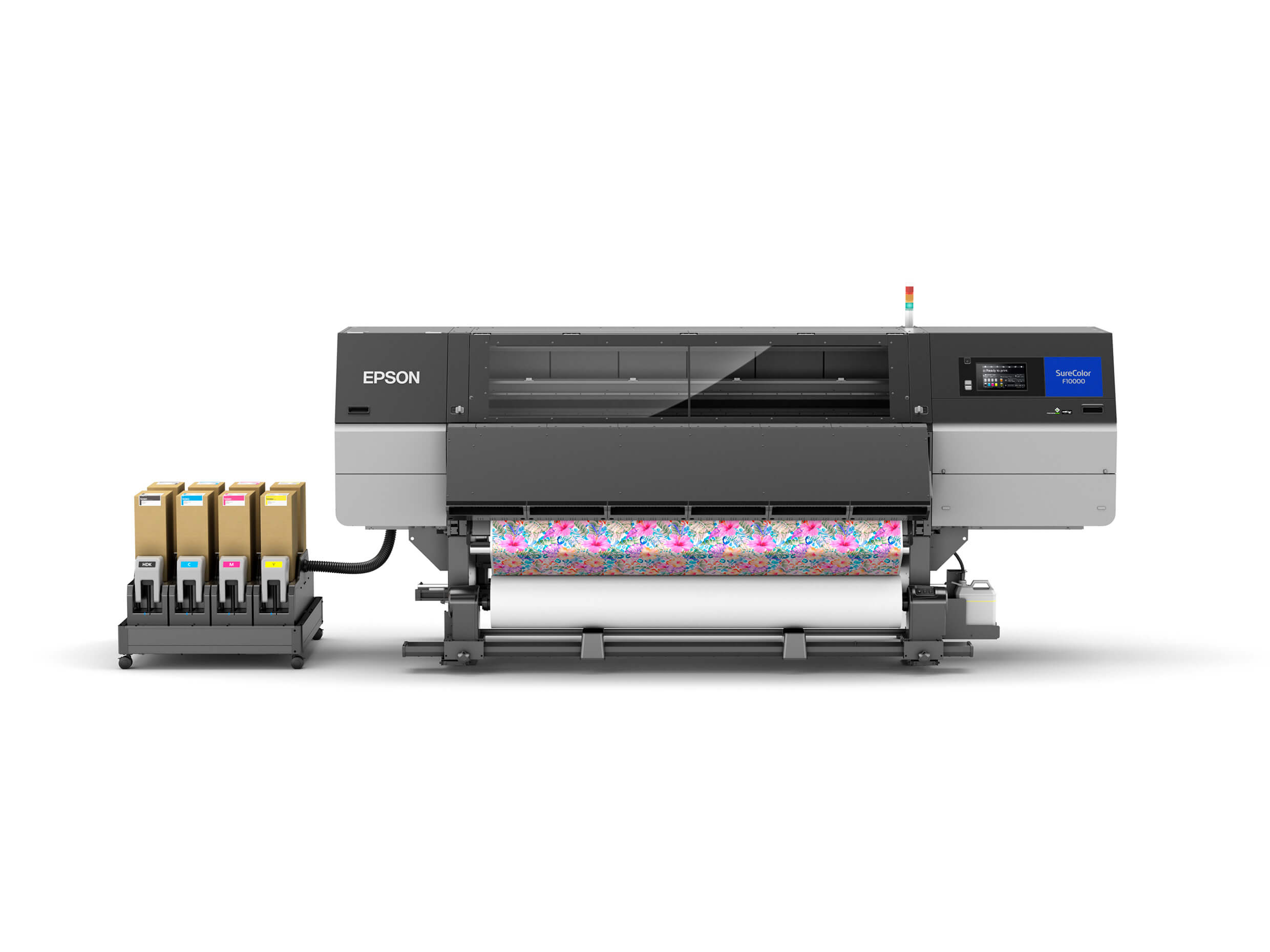
“In more detail, we are showcasing: our Monna Lisa ML-8000, the latest evolution of the Monna Lisa series that combines performance and usability to meet the needs of the digital textile market for flexibility and sustainability; the Monna Lisa ML-64000, which with its 64 PrecisionCore printheads is built for high productivity; our Monna Lisa Evo Tre 32, a flexible solution with selectable channels configuration and available in standard 8 colours or 16 channel configuration; the Monna Lisa Evo Tre 16; and finally the Epson SureColor SC-F10000, our first 76-inch large-format printer, a dye-sublimation printer specifically developed for several applications, including fashion, sportswear, home furnishings, promotional goods and soft signage.”
Throughout 2020, what have been your key textile-related activities?
“Of course, the spread of Covid-19 has represented a great challenge for us and for the whole business world. As you can imagine, our commercial activities have been limited by the impossibility to travel and attend exhibitions in the world. However, in the meantime we had the possibility to continue other crucial activities, such as promotion, sales, support service and new printers’ installations, especially thanks to the capillary presence of Epson’s offices located in every country and in every textile district. We have done all we could to go ahead regardless of the Covid-19 pandemic.”
What developments have you recently made in the European market?
“At the moment, we are very focused on promoting our Monna Lisa series in European countries, including our latest recently announced model, the Monna Lisa ML-8000, equipped with pigment inks. Thanks to the shorter printing process, we wish to spread digital technology even outside the conventional textile printing mills. With our systems, new opportunities are offered to medium and small sized companies who are interested in starting a business without big investments in heavy equipment.”
What role does your company play in the European textile machinery market?
“Epson, with its Monna Lisa project, was the first company to approach the digital textile market with an industrial vision and set the quality reference for digital print. Today, after 20 years, Monna Lisa is still recognised as a leader in quality. Our commitment to keep renewing and extending the Monna Lisa Evo Tre range is one of our most significant strengths.
“Then, there is Epson’s particular value in offering what we call the Total Solution, which is an integrated system for the textile printing world. Total Solution helps operators seize digital textile market opportunities. The all-inclusive textile digital printing system features textile printing technology, Epson PrecisionCore printheads and Genesta inks, which offer maximum results based upon Epson technology and fabric treatment expertise. This system finds its highest expression in the Monna Lisa Evo Tre series.
“Overall, Epson firmly wants to maintain its strong leadership and is thus promoting digital print technology all over the world.”
What technological trends are thriving in the industry?
“Digitalisation never stops. This trend is extremely clear. Our goal is to develop technologies to let our customers not only produce more, but especially produce better. Today it’s important to reduce the environmental impact as much as possible. Digital printing is the key to reducing water and energy consumption, as well as to limit chemical consumption. Modern day consumers have a raised awareness about the sustainability of their purchases and about their role in promoting sustainable behaviours.
“Today, quality over quantity is the hallmark of the new buying habits of the responsible consumer, for whom every action can make a difference. Epson takes a leading role in addressing and meeting the need to reduce environmental impact, and takes the challenge by offering fashion brands quality, durability and environmental sustainability.
“The Monna Lisa project is the result of Epson’s commitment to producing sustainable fashion, being perfectly in line with an idea of sustainability aimed at achieving three specific objectives: reduced consumption and use of raw materials, shortened production processes, and production versatility.”
What are your customers increasingly requesting in terms of textiles and machinery?
“Customers already understand, accept, and invest in digital printing machines. However, to go further they must keep themselves up to date and have access to the latest technologies available on the market. So, at this stage, after 20 years, customers are investing again and renewing their old machines.
“The new and latest Monna Lisa Evo Tre printer range assures them the best quality and productivity, thanks to Epson’s latest heads generation equipped with the innovative proprietary PrecisionCore Technology. In a few words, what they are looking for is better production because producing better (and faster) is mandatory to stay competitive.”
It’s been a tumultuous year for industries worldwide. How has Epson stayed resilient during this period?
“Covid-19’s impact is still a big issue for all industries. The textile market has suffered a lot from this difficult situation, and generally speaking most shops have been in serious trouble and were forced to close their doors for a while. However, apart from a couple of months of total lockdown, our customers are doing their best not to stop their activities. From July onwards, they started again to invest in new technologies in order to be ready when consumers are ready again. We wish not to be forced to a second stop.”
How has Epson adapted to a changing demand during the Covid-19 pandemic?
“It’s clear that the Covid-19 had a big impact on the textile market. At the same time, a new kind of social commerce jumped up. Thanks to digital technology we can offer many different business models together with a fast and easy local on-demand production. Epson printer models are so many in number and so different in range that they can respond to any market request and need, including the changed demand emerging in a pandemic period.”
The demand on digital printing machinery is growing globally, therefore what developments are required to inkjet print heads to ensure they can reliably meet such a demand in the future post-Covid-19?
“Digitalisation keeps growing. Epson is ready to respond to any demand with its wide range of printer models: from desk to industry; from limited productivity and limited costs up to high-speed production.”
What are your plans for the next couple of years?
“We have several projects in our agenda for next year, including the release of new upgraded printing machines, plans to increase the number of colours and inks available in order to enhance colour performances and fastness, and last but not least, the implementation of our green vision. Going forward with our green vision is crucial for us, by reducing chemical, water and energy consumption for textile production as much as we can.”
To speak with Epson about its machinery, sustainable vision, digitalisation and more, visit its booth here.