With the demand for digital textile printing growing in Pakistan, print houses are investing in more technologies and working to increase their lead times and capabilities to meet new consumer demands, such as customisation and shorter production times, all while attempting to increase sustainability efforts.
Masel Fab, based in Lahore, Pakistan, is attempting to do just this. The company provides womenswear brands with printed fabrics, print designs, fabrics, stitching and packing for both its domestic and international markets. It has MS Printing Solutions, Italy, now owned by Dover and EFI Reggiani high-speed digital textile printing machines, each with 32 print heads and uses inks from Sensient Xennia, Huntsman and SPGPrints (formerly Stork inks).
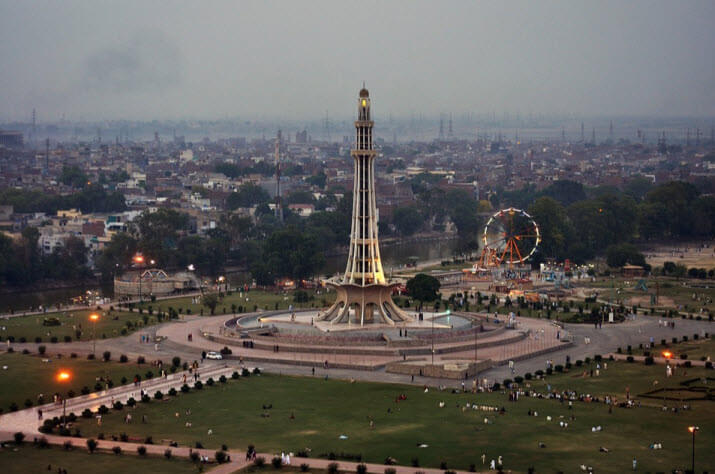
Masel Fab is based in Lahore, Pakistan
Pakistan
Digital textile printing first started in Pakistan for sampling purposes in 2005. From 2013, according to Akmal Rana, senior managing consultant at Masel Fab, some Italian and Chinese manufacturers in the country introduced high-speed digital textile printing machines.
Today, key digital textile printing machinery manufacturers such as EFI Reggiani, MS Printing Solutions, SPGPrints, Mimaki, Arioli and Atexco are actively selling their high-end machines in Pakistan for high-speed cotton textile printing, says Rana. “Digital machines for sublimation printing are also gaining share in polyester fabrics and garments with brands such as Mimaki, Mutoh and Roland popular in this area,” he adds.
The digital printing sector in Pakistan is new but is the “most exciting subsector in the Pakistan textile industry,” says Rana. Although it accounts for “less than 5% of total textile printing in Pakistan, the growth in digital printing is indeed remarkable,” continues Rana, as the amount of fabric been printed digitally in the country has doubled in the last year. The digital textile printing market in Pakistan “is increasing as it offers better and high definition textile print design possibilities, lower water, effluent, emissions and energy use with an economical production of ‘short to mass run’ prints to the market,” Rana explains. Despite this, the majority of textile printing is done using traditional analogue methods but there is a growing interest for digital printing on textiles, shown by the increase in digitally printed fabric and digital textile machines in the Pakistan market.
One of the reasons for the growth of digital textile printing in Pakistan is the country’s fast-growing apparel sector, which accounts for 5% of its exports and is highly concentrated on cotton products and according to Rana, firms are competitive with global exporters in terms of prices. “In this context, Pakistan’s domestic apparel market has experienced rapid growth, driven by an increase in average household income and an increasing younger population,” says Rans. “Falling textile exports, because of the high cost of doing business, has also compelled several major textile manufacturers to launch their own fabric and apparel brands in the local market, many of them adding digital printing machines to their production lines to meet the demand for new, creative designs, speed and quality apparel.”
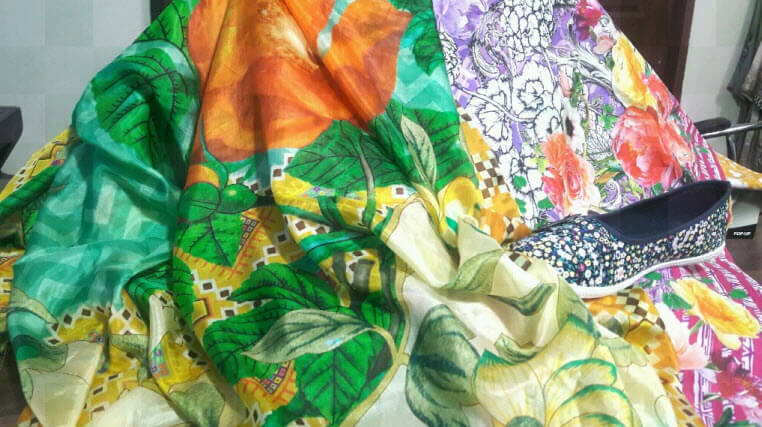
Fabric printed by Masel Fab
In particular, Pakistan-based fashion designers and factory owners are collaborating with each other to produce designer lawn fabrics. “In most cases, the brands hire top fashion designers to design their range of lawn,” says Rana.
“Lawn fabric is in huge demand in the domestic market and abroad. Several brands like Gul Ahmed and Khaadi and designers have already opened their outlets in the Middle East, the UK and the US to cater to the demand of affluent Pakistanis and other South Asians and Indians, living there,” he continues. “In other cases, designers get their stocks produced by mills and sell in the market under their own brands and in certain cases, both the mill owners and designers partner to share profits.”
As well as this, the entry of qualified, young fashion designers in to the market has also helped transform the lawn market by catering to the demand of brand quality conscious urban middle-class consumers and with the younger generation savvier to new, digital technologies, this has led to an increase in digital textile printer investment.
As a result of this growth in the fabric industry and the changing consumer landscape, retailers in Pakistan are increasingly aware of the shorter production lead times, proximity sourcing and quick stock replenishment strategies in the local fashion market which will lead to more applications in digitally printed fabrics. Rana comments: “Therefore, digitally produced fabrics have allowed for individuality of designs and production of smaller runs for a higher value price-point. The garment industry has emerged as one of the important small-scale industries in Pakistan. Its products have large demand both at home and abroad.”
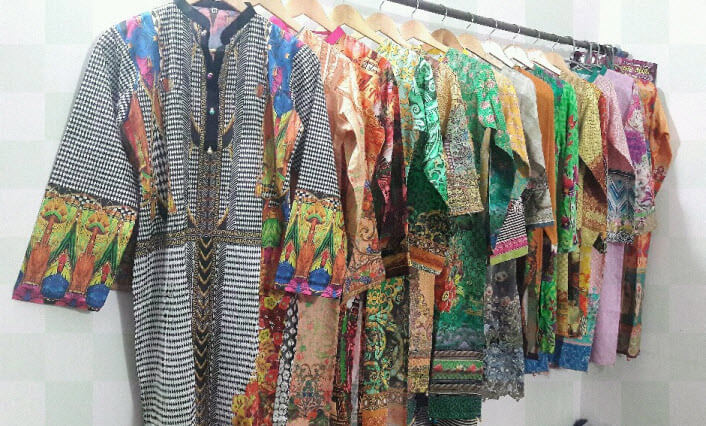
Garments made with fabric printed in Pakistan by Masel Fab
Benefits
As well as allowing for exclusivity, customisation and short runs, with short lead times, Rana notes that there are other benefits of digital textile printing that have lead to its acceleration in the Pakistan textile market. For example, Rana says: “There is no restriction on the number of colours or size of repeat and photo realistic images are easily achievable.” What’s more, because of the ability to sample and do batch size one test runs, the risk of getting products to market is much reduced and the technology itself, on the whole, is a much smaller investment than traditional printing technology, with its generally lower initial investment and low set-up costs, Rana continues. Also, from an aesthetic point of view, he says, “digital can achieve many prints that are not possible with the conventional method and using the proper ink-fabric combination with finishing provides excellent light/colour fastness.” As well as this the dyes used, Rana finds are very compatible with conventional dying processes.
Challenges
However, there are some aspects to digital textile printing that still need to be improved, for it to continue its growth in the market and take a larger share of the remaining 95% of the market that is still printed using traditional methods. First of all, Rana says that comparatively, the speed of printing is still slow: “Efficiency is money, the speed of printing is to a large extent the benefit of the enterprise. At present, the speed of the fastest digital ink jet printing machine can reach 150sqm/h, but it is still far behind the traditional printing machine, and it needs to be further improved.” One of the fastest machines installed in Pakistan at the moment is the MS LaRio from MS Printing Solutions (Dover Digital). The first model of its kind in the industry, the machine is installed at Sargodha Textile located in Faisalabad, Pakistan. Rana continues: “Digital printing technology continues to improve, the speed of printing is also accelerating, but to catch up with the speed of traditional printing machines, digital still has a long way to go. Therefore, the use of time-saving digital printing machines for proofing/samples or small quantity production, combined with traditional printing machine for mass production, will be a basic combination mode for the textile printing industry for a period of time.” However, combining both traditional and digital methods can also have its integration issues.
Other challenges with digital textile printing that Rana has come across is the cost of digital textile printing inks, which is still high, despite prices falling in recent years. Rana says that although digital inkjet printing has a smaller initial production cost than traditional printing, due to not needing to create screens or storage for screens, the ink dye and pigment ink cost is much higher so after a certain amount of ink is used, the “digital printing ink prices will boost the cost of printing. The price of the ink in the future needs to be adjusted reasonably to promote the development of digital textile inkjet printing.”
Additionally, although colour accuracy, due to sophisticated software, has been greatly improved with the use of digital textile printing, Rana says the Pakistan market has had some problems with this. He says: “Compared with traditional spot colour printing where each set of colours is individually adjusted through the colour paste and we can achieve high colour accuracy – even if a colour paste deviates, it only affects one colour. However, through the software colour matching system, digital printing is CMYK mixed colour printing, where all colours are mixed by four ink colours. With a little bit of external influence, such as ink difference, print head difference and tiny changes in the printing process, the accuracy of a series of colours after blending can be affected. Therefore, the colour accuracy of digital printing can be worse than that of traditional printing.”
Also, relating to Pakistan directly, Rana notes that there is a lack of available engineers and equipment in the area to properly maintain digital machines, as a result, investors in the technology can feel they have been left on their own, with a new, expensive technology. Also, some smaller industries “don’t have pre- and post- processing technology, so they can’t make sure fabric quality for their requirements,” adds Rana.
Despite these challenges, OEMs are working hard to advance digital textile printing technology and in all, the technology has progressed very quickly in its short lifespan. And in countries such as Pakistan, where the technology is even newer, its prospects for growth remain optimistic. Rana concludes: “From the end-user side, the quality and creative advantages are well-known. And from the technology manufacturers’ point of view, we have seen developments in new hardware, software, inks and chemicals every year. All these improvements mean that the future is positive for the industry.”