With their carpet companies Infloor and Girloon, Stefanie Ritterbach and Ulrich Dresing have successfully established digital carpet printing production. They expect that the many advantages of digital technology will boost the sales of textile floor coverings, according to Zimmer Austria.
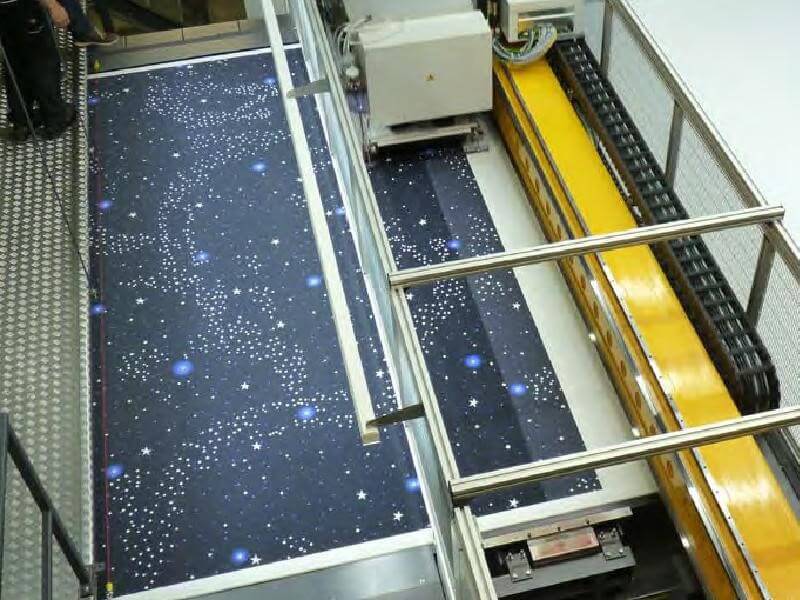
Since the last ITMA in Milan in 2015, the companies have been engaged in converting their carpet print shop from the Zimmer Chromojet to digital printing. After a favourable experience with the laboratory system, acquired in 2016, and many new findings, Ritterbach and Dresing ordered the first 400cm-wide Colaris digital printing system from Zimmer Austria, based in in Kufstein, Austria, in mid-2017. “We were confident that we would be able to cope with the risks associated with a new technology through the high level of in-house competence and the support of manufacturer Zimmer Austria,” they say.
Within five weeks, between December 2017 and January 2018, the Colaris was configured at the company’s joint production site in Herzebrock-Clarholz, North Rhine-Westphalia, Germany. “It then took just three more weeks until we had printed and delivered the first orders,” they say. “Thanks to the great commitment of all employees from our technology and design departments, but also thanks to the support and the trustful cooperation with Zimmer Austria, we were able to start regular production at the end of February 2018,” continue Ritterbach and Dresing.
“Our Colaris digital printing process provides a number of major advantages: sensational print results; simplified production; flexibility; environmental protection; resource conservation; and cost savings,” they add.
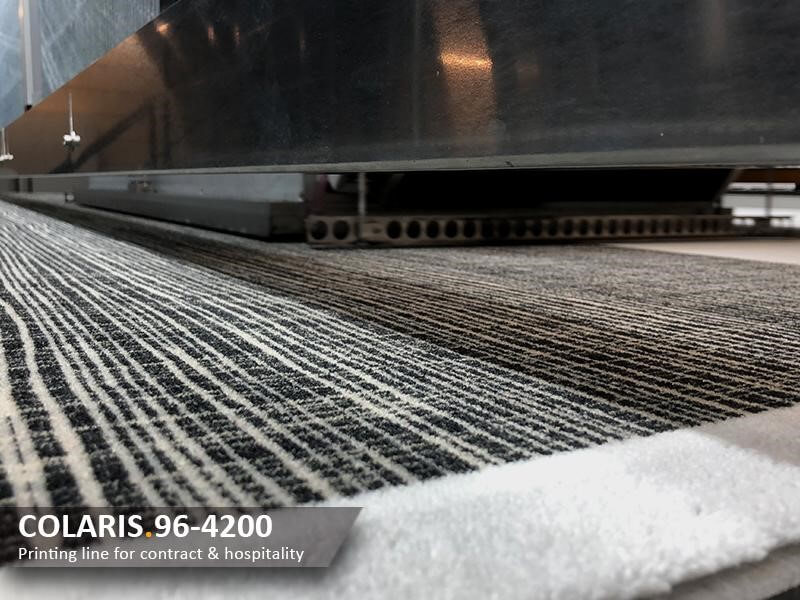
Due to a high resolution of up to one billion pixels/sqm the company’s prints now have a perfect outline sharpness as they could previously achieve just one million pixels/sqm, according to Ritterbach and Dresing. “The Colaris system enables us to produce designs that were simply impossible on the conventional printing systems,” they say. “For example, we can now print the finest woven patterns or tufted designs – a quality level that was previously unimaginable for us. All our own fabric types such as loop, smooth velour, frisé and Saxony can be printed on our digital printing machine without any problems.”
The new machinery has also simplified the production process for the companies. In the past, they had to prepare every single colour in the required quantity in a separate colour tank. After production end, all the tanks and the entire piping system had to be rinsed and afterwards refilled with the new dye preparations for the next production run. This set-up time always required two to three hours, according to the company owners. “Digital printing requires almost no set-up time as colour preparation in colour tanks is not necessary,” say Ritterbach and Dresing. “Any colour required for a design will be generated from the four primary colours red, yellow, blue and black. As described above, this happens directly in the print jet during printing.”
Ritterbach and Dresing have also found that the simple production process provided by the Colaris results in a high degree of flexibility. “Our former system required individual colour preparation in colour tanks, and thus a production of less than 300sqm was not profitable,” they say. “The new digital printing system now enables us to print even the smallest orders.”
With the new digital printing system, the company also saves up to 30% on water and energy compared to traditional carpet printing, and consume around 80% less dyes and additives, according to Ritterbach and Dresing. They add: “All these mentioned facts show the infinite advantages of digital printing. We are convinced that nobody in our company would prefer to go back to the old printing technology. In fact, everyone is happy that we have taken the plunge into digital printing and that we are able to enjoy all the listed benefits in our marketplaces.
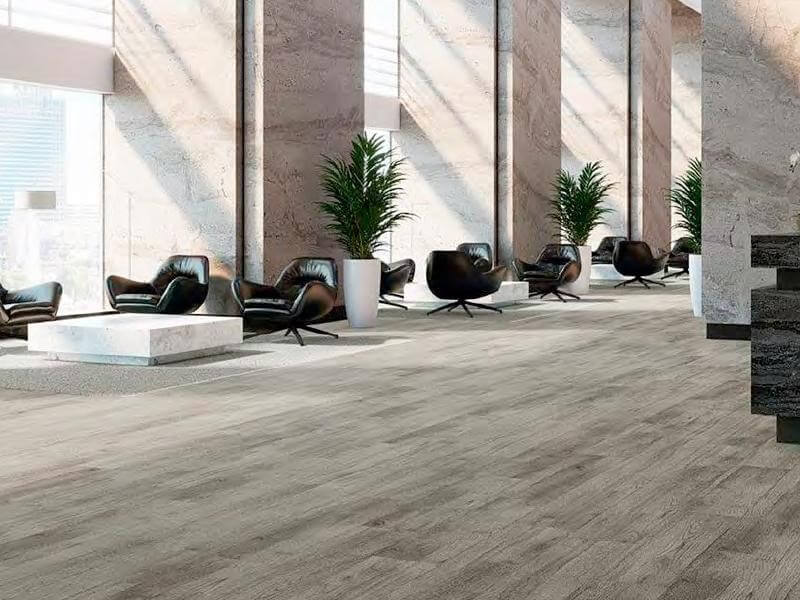
“In combination with our self-adhesive carpet modules we have the possibility to create wood, stone and other optics that look incredibly realistic,” say Ritterbach and Dresing. “This opens up completely new possibilities for us to make carpeting attractive on the market again.”
OEM Zimmer Austria recently presented Digital Pile Fabrics and Carpet Printing – Possibilites and Limitations during the AATCC/SGIA Digital Textile Printing Conference 3.0 in Durham, NC, US. Speakers Thomas Kloebl and Roland Zimmer offered insights into the evolvement of carpet printing technology, how to choose the right inkjet printing system, printer mechanics, print heads, inks, printing process and costs.