Cinte 2018 showed how China’s technical textile and nonwovens sector is growing in importance. Jens Kastner, in Shanghai, reports.
The latest edition of the biannual China International Trade Fair for Technical Textiles and Nonwovens (Cinte Techtextil China), held 4-6 September, in Shanghai, showed how Chinese manufacturers are more than holding their own in these technically demanding markets.
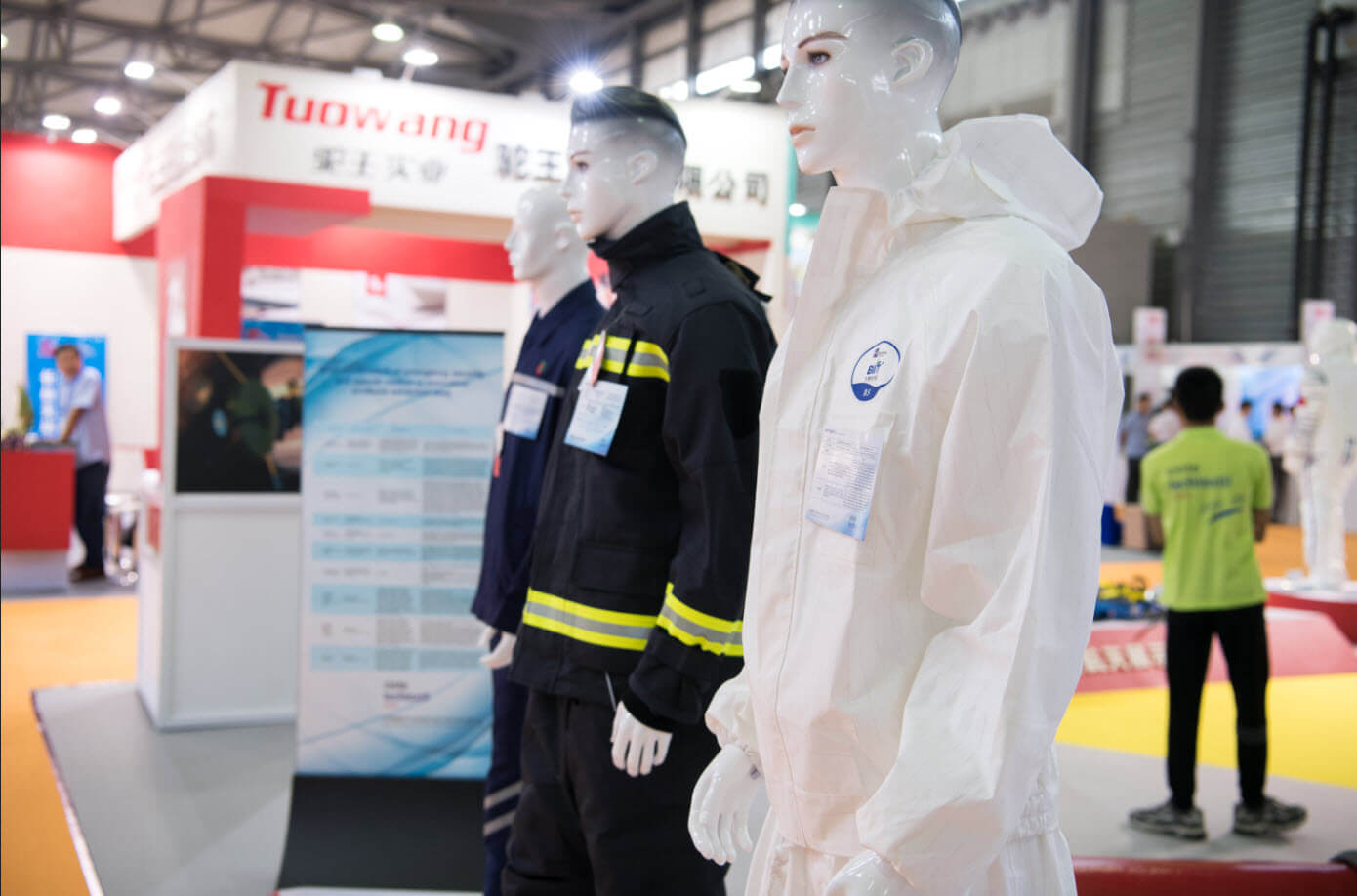
Protech is expected to receive a boost from new Chinese government workplace standards
The fair, a spin-off from the Techtextil show in Germany, attracted a diverse range of some 500 exhibitors from around 20 countries, covering 12 different application areas, with Protech, Mobiltech and Geotech – spanning wovens, knits and nonwovens – arguably being the most prominent.
While Belgium, Germany, the Czech Republic and Taiwan had their own pavilions within one exhibition hall, Chinese exhibitors had two entire halls, with their focus having notably shifted to technical nonwovens, compared with Cinte 2016.
The 2018 show was opened by a recorded video message of French astronaut Thomas Pesquet aboard the International Space Station (ISS); Pesquet waved into the camera against a backdrop of technical textiles used for various applications on the ISS.
A thriving market
“Technical textiles are today everywhere, including in space, and are thus forecast to grow at a compound annual growth rate (CAGR) of 4.6% until 2027, with all application areas serving as contributors to growth,” said Michael Jänecke, director, brand management technical textiles and textile processing at Messe Frankfurt, the fair organiser, in his opening speech.
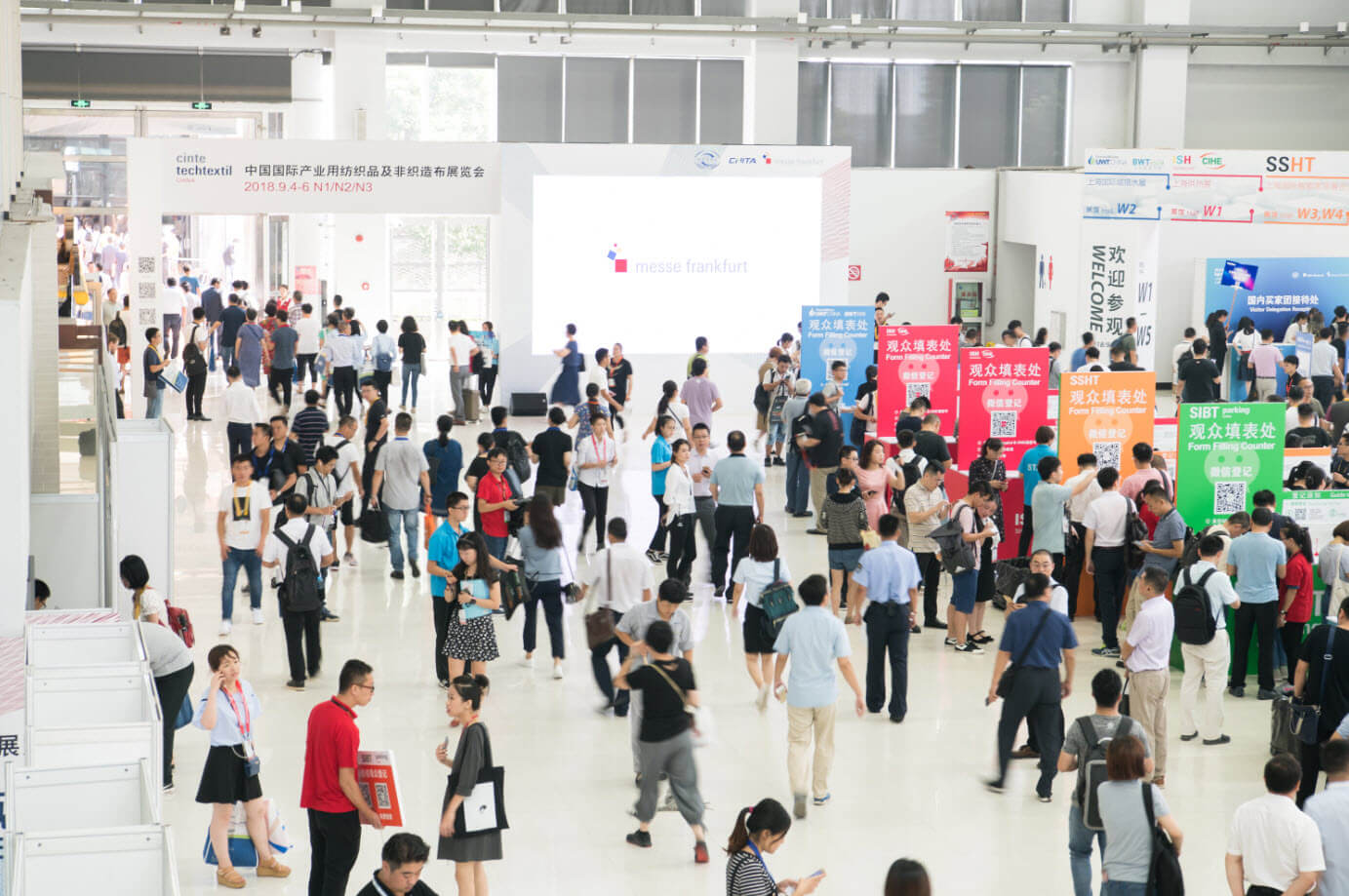 The fair attracted a diverse range of some 500 exhibitors from around 20 countries
Stressing that Mobiltech remained the technical textile and nonwovens main growth driver, with the modern passenger car containing between 25kg and 40kg of textiles, he presented a regional breakdown, according to which China is currently the most dynamic market.
The country’s total output of technical textiles and nonwoven products is estimated to exceed 22 million tonnes by 2020, accounting for 30% of global production, and double its 2013 output.
Growth is also strong in India, where the technical textiles industry is expected to expand at a CAGR of 13.11% during 2018 to 2023, to US$32bn.
Meanwhile, in the US, two of the largest consumers of technical textiles – military and infrastructure – are about to receive huge new financial infusions from the government, Jänecke predicts. This is because of the policies of the Trump administration, which has stressed military muscle and renewing transport infrastructure.
Protech
Back in China, however, Protech is expected to receive a boost from new Chinese government workplace standards. This notion was often repeated at the side lines of Cinte 2018 and benefits could be reaped by companies outside China.
An example is Germany-based Norafin Industries, which produces speciality and technical nonwovens in plants in the EU and the US and notes rapidly growing demand in China. With an annual capacity of 6,000 tonnes spunlace and 2,000 needlepunch, Norafin processes PET (polyethylene terephthalate), PA (polyamide), aramids, among other fibres.
“The main trend in Protech is a combination of woven fabric and nonwovens in order to achieve lighter weight while ensuring good protection,” says Jos van Hattum, a certified consultant with Norafin.
“Our flame-retardant, arc-protection and anti-abrasion properties are embedded in the fibre, as opposed to being applied in a coating, meaning the products can endure 50 or 100 wash cycles without letting go of the protective qualities,” he adds.
Van Hattum adds that as ‘human lives become more valued in China’, much stricter national standards on worker protection, including for the highly protected firefighter sector, are being implemented and enforced everywhere in China.
And, this trend is being solidified, he says, by more foreign companies continuing to shift their manufacturing lines to China and Southeast Asia.
“These companies have to equip their workers in the region with modern Protech because otherwise they would be losing insurance coverage,” says van Hattum.
Similarly, Ping Chen, general manager of German-invested Ibena Shanghai Technical Textiles, notes rapidly growing demand for Protech for China’s welders, metal workers, riot police and the military.
As for Ibena’s most recent R&D breakthrough, Chen singles out the reduction of thermal barrier layers in the outshell of firefighter coats from four to three, which increases comfort through lighter weight.
“The double-layer woven fabric makes an air space to increase the thickness of the combination due to the two materials’ different thermal shrinkage properties under heat exposure,” says Chen.
“Another recent breakthrough is a fabric with aluminium coatings, which improved the stability of aluminium coating to an extent that layers do not separate under heat exposure, which would otherwise mean protection is lost,” she adds.
Her company needs to keep innovating, though, as Chinese competitors are fighting for business. Among the handful of local Protech manufacturers present at Cinte 2018 was Shanghai 3H Safety Technology Co, which had a range of industrial protection fabric arc protection fabric, firefighter coats and firefighter underwear in its portfolio.
“We started three years ago, and sales have been constantly growing since, but meeting the different standards of the EU [European Union] and the US takes many expensive and time-consuming composition trials,” says Xu Ruisong, deputy general manager, Shanghai 3H Safety.
Mobiltech
Meanwhile, Mobiltech is being boosted in China by tightening Chinese train standards, electric car range lighting requirements and declining leather quality.
At the Belgian pavilion, Pennel & Flipo showcased its ORCA brand, with its double-ply airtight fabric – a layer of rubber that is calendared onto a textile backing.
ORCA’s traditional focus has been inflatable boats, but it has in recent years shifted more to train gangways, mainly owing to Chinese demand.
Mouscron, Belgium-based Pennel & Flipo says it is the only company in the world whose train gangway rubber-coated fabrics comply with all Chinese, Russian, US and EU standards at the same time; train gangway standards mainly deal with anti-fire properties and fume toxicity.
Other eye-catching ORCA products on display were pressure bags to gently lift aircraft for maintenance or after having slipped off a runway, as well as lightweight, ultra-strong inflatable boats for special military personnel, who may need to carry the boats in backpacks for long distances or drop them from aircraft.
“The EU is still our main market, but China and Asia have been grabbing a larger share over the least five years because of China building up its train network,” says Romain Launay, sales manager with Pennel & Flipo.
“Our coated fabric solution covers all different national standards, so Chinese train manufacturers looking to export are happy to work with us,” he adds.
Launay adds that although Chinese competitors are starting to fight on price, “we fight back with R&D, meaning every year we come out with a new fabric to answer very specific technical requests from different industries we serve and bring added value to our customers”.
Meanwhile, Germany’s Kufner presented a fabric that is heat-glued onto the backside of leather for automotive seats where it prevents crinkles and bumps through tension.
According to Martin Dinter, Kufner’s global sales director technical textiles, this feature is becoming more sought-after, given that the quality of leather available in the world market has been constantly declining.
This, Dinter says, is mainly brought about by Chinese consumers’ growing appetite for leather shoes translating into higher prices.
“In the past, leather used in automotive seats had been much thicker than it is nowadays, so crinkles and bumps haven’t been an issue even if the passenger got on and off several thousand times,” says Dinter.
“But today we are down to 1.5 mm or 1.2 mm thickness, and therefore the leather becomes unstable,” he adds.
Kufner’s textile heating system (THS) caters to the evolving needs of the automotive industry, too, as the heated fabric is thin and smooth enough to be put directly under leather.
By contrast, conventional heated fabric has to be cushioned by a foam layer owing to the thickness of the embedded electric wires.
“Foam contains a lot of air, and air is a major energy brake, so by omitting the foam layer, our system becomes much more energy-efficient,” says Dinter.
“Think of modern SUVs that already need two dynamos for all their board electronics and heating systems and think of electric cars where any reduced electricity consumption translates into the strongest possible selling point of extended range,” he adds.
Indeed, according to Dinter, German car brand Audi has tested Kufner’s THS and found that it needs 50% less energy than conventional solutions.
Dinter also notes that Hugo Boss’s forthcoming autumn collection features THS as kidney heating features for its coats.
Geotech
Another client is the wind turbine industry, as turbine wings need to prevent icicles from becoming potentially fatal projectiles, flung fast through their centrifugal power.
Raw material price rises can also be a problem for the technical textile and nonwovens sectors however, and Cinte exhibitors in the nonwovens realm complained about rapidly climbing prices of polypropylene.
Xu Tian, marketing manager of Chinese-maker of geotextile nonwovens Tian Ding Feng Trading, notes that while geotextile nonwoven demand in China has greatly been boosted by road, airport and subway tube construction across the country, raw material prices including of polypropylene and polyester have risen at dramatic paces in the past three months.
While Xu saw this as a secondary effect of rising international oil prices, other Cinte participants spoke of a concerted effort of speculative hoarding of nonwoven raw materials in China.
By contrast, the US-China trade war was a fringe topic at best at the sidelines of Cinte. Cinte participants remarked that foreign exchange rates have been relatively stable despite the drama and pointed out that the main raw material makers such as DuPont produce in the US, EU and Asia, so that there are enough alternative sourcing options to circumvent either the US’ or China’s new tariffs.
Ruisong, Shanghai 3H Safety, says: “Our main concern is rising raw material prices this year, as it will be difficult for us to keep up by rising sales prices.”