Otis Robinson interviews Satria Ngetis, co-owner and director of Palm Printing, a garment print house situated in Bali, Indonesia, about the company’s experiences tackling local market demands and the technology enabling its success.
Indonesia, the fourth most populous country on Earth, has a rapidly growing apparel market. Commonly, garment producers battle for international sales among relentless overseas competition – worldwide customers seeking low costs often turn to Bangladesh or China, countries infamous for their cheap labour, leaving other countries scrambling for sales – but business and capital is rising in Indonesia as it modernises its technologies, improves its labour skills and offers an improved infrastructure. In fact, the sector is thought to be achieving an annual growth rate of over 5% (CAGR 2019-2023) and with its large population, domestic trade may be just as important to the textile industry as its international footprint.
In 2018, 28.6 million sqm of fabric was produced by the country, according to WTiN Intelligence: Digital Textiles, and it seems the increased presence of digital print technology is impacting the way these textiles are utilised by Indonesian businesses and designers, specifically with regards to domestic trade.
Companies such as Palm Printing, a digital textile printing company situated in Kuta, a tourist town in Bali, Indonesia, are becoming a popular choice for local customers seeking fast, green, high-quality textile and apparel printing in the face of slower, more common, traditional methods. The customers, Palm Printing says, increasingly demand faster production speeds, and digital printing offers this.
“Us Indonesians have a phrase which literally translates to ‘instant noodle generation’,” says Satria Ngetis, co-owner and director of Palm Printing. “This perfectly sums up our Indonesian customer base: they want [their products] now. This fits perfectly for digital printing.”
Tackling pollution
Since the formation of the company – both Ngetis and his business partner and wife Tashana Marjanac launched the print house three years ago – Palm Printing has operated with this rapid customer demand in mind, investing in digital printing technologies from the get-go. But it wasn’t just high-production volumes and domestic customer trends that Palm Printing hoped to tackle: Ngetis says the couple was concerned over the rising environmental damage the local Indonesian textile industry had caused over the past few decades.
“We were so disheartened seeing all the screen printing companies (that service Bali’s sprawling boutique clothing manufacturing industry) just dumping all their unfiltered effluent directly into the ground water or rivers.
“My wife, Tash, and I live a couple of streets away from our factory in a quiet residential neighbourhood. It’s only a short walk from the beach, so using large amounts of groundwater or creating effluent was not an option under any circumstance.”
Ngetis elaborates that, throughout the 1980s and 1990s, his parents’ generation had created substantial pollution with analogue printing methods, prompting his mission to generate change: “Being environmentally aware and sustainable was one of the main reasons we created Palm Printing.”
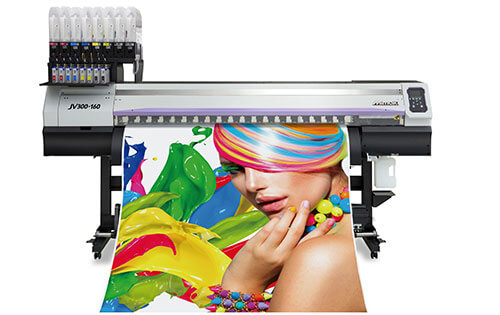
Thus, after discussions with Mimaki’s distributor about their needs, Palm Printing’s first offering was established as sublimation printing. The Mimaki JV300 dye-sublimation printer was the company’s first installation, which was seemingly such a reliable investment that Ngetis even purchased another as operations began to prove fruitful.
Though the company now offers direct-to-garment (DTG) printing with pigment inks – with DGI and Epson machines in operation – sublimation, as a first step, allowed Palm Printing to consider the environment. “There’s no water involved there [and] all the spent transfer paper goes directly to a recycling company that conveniently happens to be a street away.”
Overall, the couple's efforts forged a sustainable process that did not use or produce “any wastewater, effluent, or large amounts of energy”. Later, when the company eventually forayed into pigment printing, the couple even found ‘high-end, biodegradable eco-inks’ to keep its processes sustainable. This environmentalism proved unique in Indonesia, and Palm Printing apparently became – as the company boasts on its website – “the first of its kind on a commercial scale in Indonesia”.
More investments
Although aware of the quality, efficiency and environmentally friendly nature offered by sublimation printers, Palm Printing did eventually welcome a direct-to-fabric printer from DGI and an Epson DTG printer to its armoury. Still in its early years at the time, Palm Printing utilised improving digital technologies to grow its printing capabilities.
“The DGI solution for direct printing ran on Kyocera print heads, which in my opinion can handle all the bumps, ink blocks and head strikes that a learner is going to make,” Ngetis confesses, citing Kyocera print heads, which are the most preferred print heads in the country, according to WTiN Intelligence: Digital Textiles.
This room for learning allowed Palm Printing to grow from strength to strength while remaining in reliable and rapid operation – because, not only does Ngetis handle demand placed upon Palm Printing, but also its sister company Yogi&Boo, an apparel manufacturer that wields 70% of Palm Printing’s printing output. Therefore, most of its sales are domestic, since the rest goes to local clothing factories, fashion designers and sewing hobbyists, Ngetis says.
And more success is on the horizon, Ngetis suggests, because very recently, the print house stumbled upon a German ink company that has offered Palm Printing a unique pigment ink for use on natural fibres. According to Ngetis, the ink requires no pre-treatment – putting out ‘extremely clear and saturated’ colours – and offers a printing quality akin to reactive inks. “These inks have a great hand feel, too, so we don’t need to run any softener or post-treatment,” Ngetis says. “We are [also] eyeing off another larger pigment printer with a minimum of 8-16 heads (they have to be Kyocera). We’re also considering adding a laser cutting system to complement our digital printers.”
Analogue vs digital
Despite the clear and present success in using digital technologies to push environmentalism and rapid production, Palm Printing still faces a hurdle like many other print houses around the globe: convincing those rooted in tradition to place their trust in new industry techniques.
“Pricing and marketing are definitely big parts of getting buyers on board,” Ngetis comments.
But, even though more Indonesian customers opt for digital textile printing, Ngetis advises that the market is still ‘conservative and outdated’: the availability of quality digital print services was so scarce in Indonesia that it had acted as a big push for Palm Printing to invest in digital machinery in the first place, he says.
But Ngetis adds that, slowly, in the last six months, many clothing brands in Indonesia have begun to realise the value-added factors associated with digital printing – factors that are often difficult to quantify – which suggests that more print houses might adapt to this changing demand, adopting quality technology. He credits this increasing preference of digital print technology among textile and fashion designers as a reason to expect a move away from analogue printing methods in Indonesia’s future. This may be encouraging for customers and fashion brands looking to source here, who primarily navigate towards the ‘boutique’ clothing associated with Bali and are often ‘happy to pay a premium’ for high-quality digital printing, Ngetis suggests.
“Most Indonesian print houses are stuck in their ways and are dubious to new technology,” Ngetis says. “[But] there is definitely a large shift of interest. It’s yet to fully convert into sales but a lot of designers are pushing the demand.”