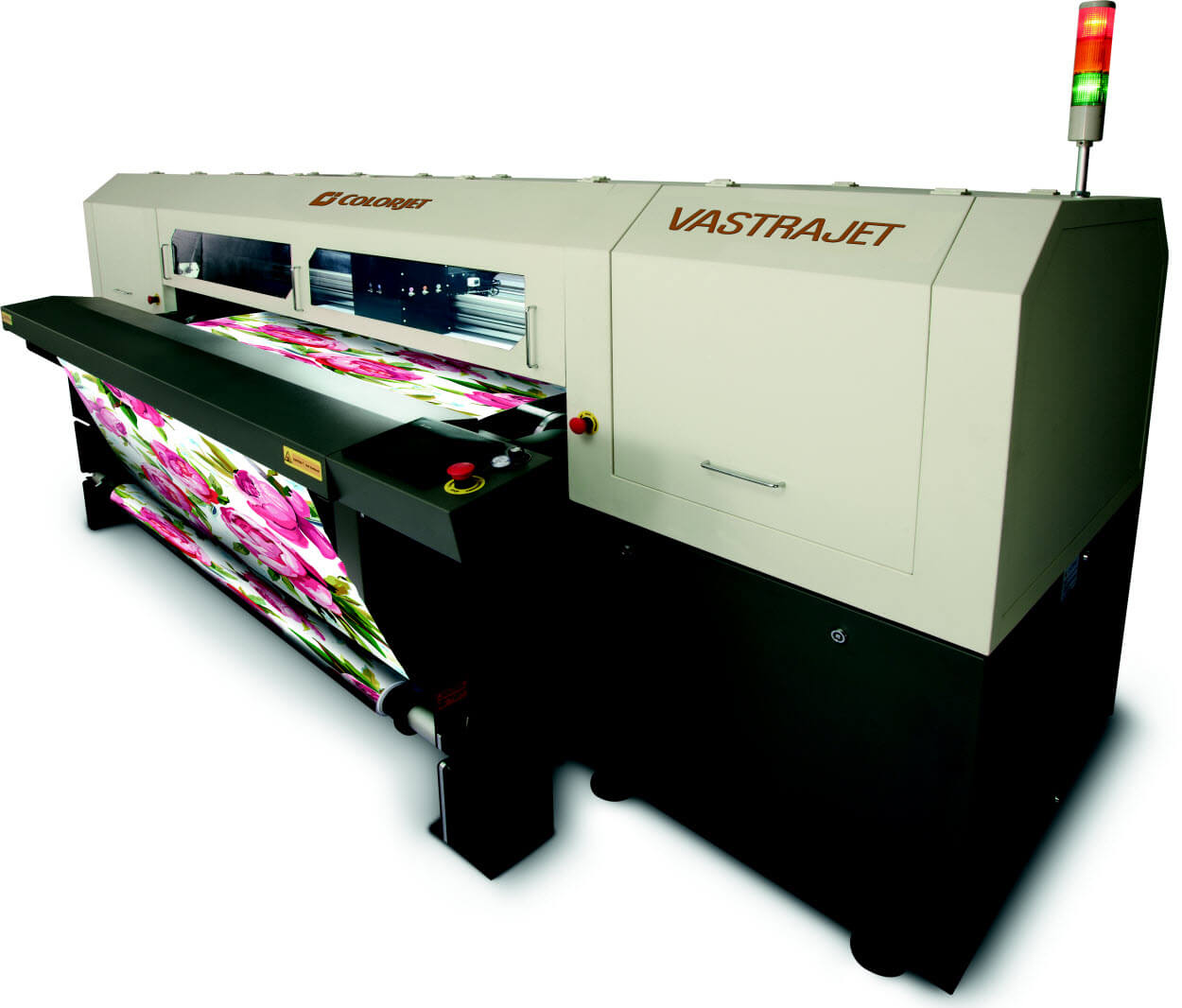
The Greek digital textile printing market isn’t an obvious choice for digital textile printing OEMs. However, Indian OEM Colorjet has set up a demonstration machine at the home of its Greek partner, Atlas Digital, in Athens. This is mainly due to the growth of SMEs in the country, who require machines for smaller runs with an increase in demand for personalised textile goods.
Kamal Kulshreshtha, head – international BD and sales at Colorjet, says: “Even though Greece might not be a big market like Italy, it is a market where we would be well supported by our partner, Atlas Digital. In our business it is not enough to sell but also to provide support to buyers.”
The Colorjet Vastrajet digital inkjet printer for direct-to-fabric printing has been well received in Greece, with the machine been set up in February. It is currently printing using pigment ink on polyester fabric. Atlas Digital displayed the machine at Graphica Expo 2019 in Greece on 22-24 February. The machine was then moved to Atlas Digital’s demonstration room in Athens and is now available for demos and sample making for potential customers.
“Judging from the warm reception it received during the show, I believe it won’t be long until it finds its way to a production environment,” says Papadopoulos Vassilis, dye sublimation and textile product manager at Atlas Digital.
Atlas Digital’s first goal working with Colorjet is to promote the brand name. “The presence of Colorjet in trade shows such as ITMA and FESPA are a big step in the right direction,” adds Vassilis. “The next step is to make our first installation, which I believe will prove to be critical in spreading the word about the advantages and quality of Colorjet machines.”
However, Colorjet and Atlas Digital have been working together for some time. Atlas Digital has previously introduced Colorjet solvent printers to the Greek market and, as a result, has “had the chance to witness first hand, over a period of time, the build quality, reliability and fast printing speeds,” of Colorjet engineering, says Vassilis. “Those factors, along with the competitive cost of the machines, were the decisive points [in wanting to work with Colorjet in the textile market as well],” he continues.
Kulshreshtha says: “[As] Atlas Digital was already promoting our digital inkjet printers for other applications, we knew the company had the technical strength and technological understanding of digital printing to not just sell but also to support buyers in Greece and neighbouring countries, where it also has operations.”
Greece
Greece’s textile industry dates back a long time and, even though the market has shrunk throughout recent decades, “the spark is still there,” says Vassilis. And although the Greek digital textile printing market remains small compared to that of some of its neighbours, the country now has stable growth rates, with the total number of machines operating in the area increasing by 13% in 2018, according to WTiN Intelligence: Digital Textiles.
“The production knowledge from past generations, combined with the passion, vision and creativity of the younger generation will be the foundation of rebuilding our textile industry,” adds Vassilis.
The global growth of digital textile printing is affecting the Greek textile market. As its textile production and export capabilities grow, the Greece knows it cannot stay competitive without digital machinery to meet the needs of a growing, on-demand market. And with the ever-growing need for small-scale production, the time is right for Greece’s textile-focused print houses to go digital, or for new businesses to emerge.
Vassilis comments: “The market trend that demands small-to-medium runs, as well as personalised designs, has reached Greece. Businesses also realise that in order to grow they have to expand into foreign markets and offer top-quality products at a fast pace. Digital textile printing enables companies to meet these demands and offers them the tools to be more creative, flexible and competitive in the global market.”
Kulshreshtha continues: “There is potential for Colorjet in Greece because there is a market segment that is not looking for high-speed machines but for reliable machines on which they can print 20,000-50,000 m/month. The machine we have in Greece will demonstrate to anybody interested that you can print good quality textiles that are commercially acceptable, reasonably priced, and manufactured on a relatively simple machine.
“We also make machines that can print faster for those who might be looking for speed.”
Dye-sublimation is currently the most popular digital textile printing method in Greece. The majority of the printed textiles are used for sportswear with the fashion segment of the market following this. Direct-to-textile printing, according to Vassilis, is more common in the soft-signage segment. Flag production accounts for a significant proportion of this, with fashion applications again the second largest market for direct-to-textile printing solutions.
However, although market demands motivate businesses to invest in digital printing, the “lack of local technical support and training is a deterrent,” says Vassilis. “At Atlas Digital we believe that our ability to offer technical support and colour management services, combined with a reliable and good-quality printer, will help the market’s growth in the coming years,” he adds.
Kulshreshtha concludes: “With our current installation and with Atlas Digital, we are a step closer to meeting expectations of small print houses in and around Greece who want quality prints and a robust machine.”