Kirsty Kirk from Carrington Textiles speaks to WTiN about the company’s fast-growing defence fabric collection and market challenges at this year’s Expoprotection exhibition.
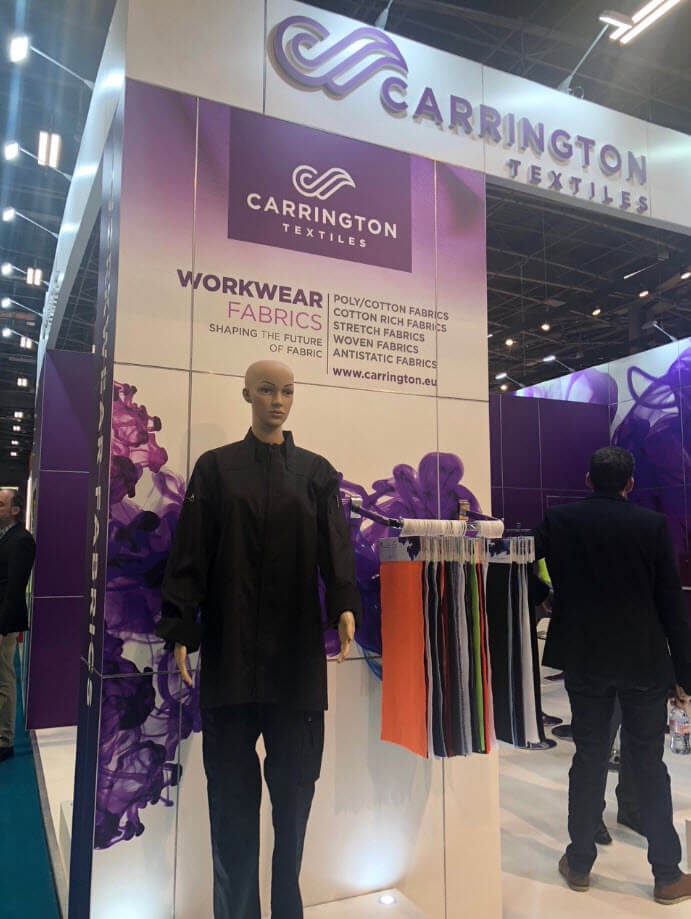 Carrington Textiles' exhibit at Expoprotection 2018
With over 125 years in the industry, Carrington Textiles is the largest producer of workwear fabrics in the UK, producing over 55 million metres of fabric annually, and exporting to 80 countries worldwide.
The company is based in Lancashire, UK, and is home to one of Europe’s largest fully integrated textile processing and finishing operations.
“Carrington produces workwear and fire-retardant fabrics. We also have a waterproof and breathable collection and a printed line, where we mainly specialise in defence fabrics,” says Kirsty Kirk, research and development manager, Carrington Textiles.
Carrington is most well known for its workwear range, which is consequently the company’s best-selling line. The second most popular range for Carrington is its fire-retardant collection, which sells particularly well across Europe.
“The biggest growing range is our defence collection because we have just been given the licence to print MultiCam, making us the only European licence holder for this,” says Kirk.
In June earlier this year, Pincroft, a dyeing and finishing company that merged with Carrington in 1999, was chosen to be the official printer of MultiCam camouflage fabrics in the European market by 1947 LLP.
Described as an “uncompromising concealment option for those who demand the best,” the MultiCam camouflage pattern was developed to effectively limit the visual and near-IR signature of a person operating across a wide range of physical environments and seasons. The company has four main camouflage patterns – Arid, Tropic, Alpine and Black.
“There are only three licences in the world for printing MultiCam, one in America, one in the Far East, and now we have the European licence. This is a huge opportunity for us,” adds Kirk.
From success to challenges, one of Carrington’s key issues is balancing protectiveness with developing lightweight fabrics.
“It’s a constant battle between finding the right protection and developing lightweight materials,” adds Kirk.
“We sell a lot of products to the Middle East where it is extremely hot, and many workers struggle with heat stress due to the flame-retardant finish. They’re working in a very hot and dry environment, so a challenge is trying to find the right protection that is lightweight and also breathable.”
Another task for Carrington Textiles is addressing the need for sustainability. Similar to finding the balance between lightweight materials and protection, balancing sustainability and protection is equally difficult.
“This market is all geared around protection, and what you lose with recycled products is the strength,” says Kirk. “For example, recycled polyester is not as strong as the virgin option and with recycled cotton the staple fibres aren’t as long and strong as the virgin product.”
Not only is strength hindered when using recycled materials, but the colours are not as perfect either. For example, the whites of recycled materials are not as white as the virgin version.
“This is an issue when it comes to the hospitality environment, when the whites of a chef’s uniform needs to be clean and professional looking, for example.”
The research and development departments and production engineers at Carrington Textiles are constantly working towards the development of sustainable fabrics, however. The company is actively working out how to minimise waste and toxic substances by introducing greener alternatives in raw materials and using renewable energy sources more, for example.