
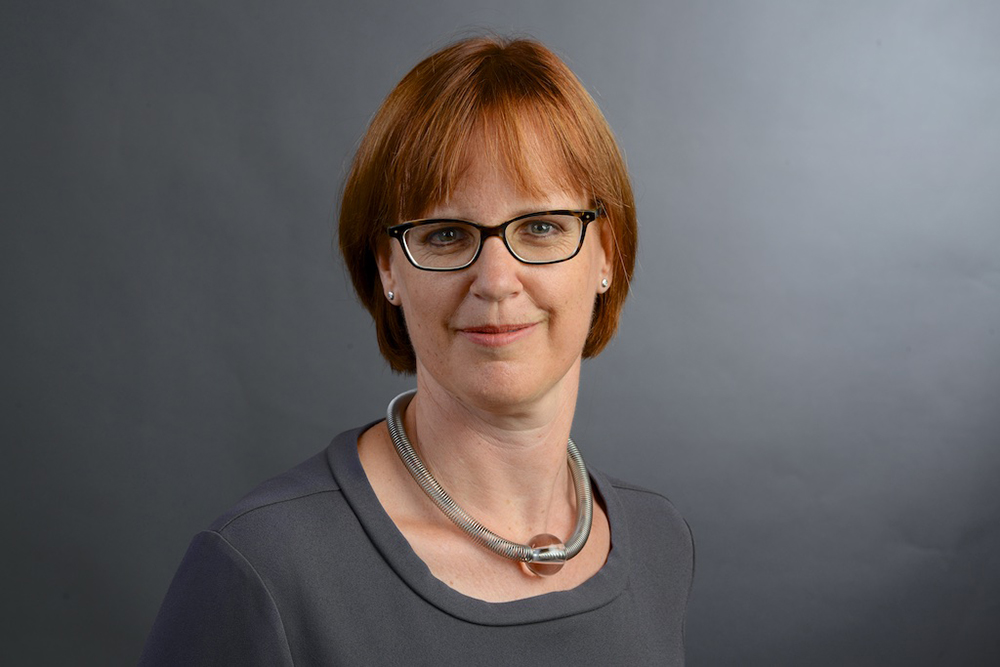
Cornelia Buchwalder, secretary general Textile Machinery at Swissmem discusses the road to zero carbon for Swiss textile machinery companies. Madelaine Thomas reports. As seen in WTiN’s Zero Carbon Report.
For textile machinery manufacturers around the globe, reducing carbon emissions (both their own and the ability of their customers to do so with their technology) is now of critical importance. Switzerland is no different. The country’s long-term climate strategy is to reduce its greenhouse gas emissions to around 90% of 1990 levels by 2050, according to the Swiss Federal Office for the Environment (BAFU). Remaining emissions must then be balanced with CO2 capture, removal and storage, the BAFU continues.
As such, textile machinery manufacturers in the country are working towards improving their carbon footprint – and Swissmem (Switzerland’s association for mechanical and electrical engineering industries and related technology-oriented sectors) is supporting them in their journey.
Cornelia Buchwalder, secretary general Textile Machinery at Swissmem, notes that zero carbon is a mid-term goal for Swissmem member companies. Companies are each at different stages of their zero carbon journey and although there is growing understanding, Buchwalder says: “There's still a way to go, because there's also still a lot of awareness in all the areas of our field that has to be done.” She adds that we must take time to ensure companies really are zero carbon and not to make it “just a claim, but really following and being able to reach that goal, which is a tough one.”
Developing a universal ideology
The challenge for Swiss textile machinery manufacturers, as well as increased awareness, is having a holistic view of sustainability. Buchwalder explains that sustainability gains have been made in recent years across the industry but not necessarily in the name of sustainability, rather in having better yields, higher output, using less energy and water etc for increased efficiency and margins.
She adds: “This whole holistic view of sustainability I think is something that we just see really happening now. But navigating the challenges around sustainability really comes down to seeing the whole scope: where does sustainability start and where does it end?”
Buchwalder continues: “Although a lot has been done, we are still building that holistic view in our industry.” In doing this Swissmem is measuring industry with a set of scopes to see where members stand and to help develop projects internally to reach the zero carbon goals. In doing so, the association is also building awareness of the whole sustainability framework.
Once framework is completed however, the challenge then becomes manpower, implementation and financials and these factors – especially in the current climate – can be limiting.
In helping its members, Swissmem has developed individual programmes for companies with external experts, where they individually can get training or develop something together and find the business opportunity.
Macroenvironment
The current wider economic and political landscape, particularly in Europe with the ongoing energy crisis, increasing inflation, conflict, developed EU strategy and the hottest summer on record has spurred the industry into making real change. For Buchwalder, sustainability gains and financial gains come hand in hand. She comments this progress is a “must do over the years to come for everyone in the textile ecosystem. It's clear to everyone that due to many of these reasons, sustainability just needs to be pursued.”
In the current climate, the need for change has become much clearer, says Buchwalder. “We now see companies thinking differently or going further than they have been before in terms of sustainability.”
A problem shared
For Buchwalder and the Swissmem team, collaboration and learning through these partnerships is paramount. She says that internally companies have their own best practices but in sustainability more so than in other areas, the challenges of each part of the textile value chain are different, “but there are certain aspects that can be shared.” She adds: “I think within our Swiss membership we have quite an open exchange within the members. This is one thing that we were starting to build: this best practice and learning from each other.”
Buchwalder has seen companies try to find solutions to sustainability issues themselves, but within sustainability there is the need to come together to find answers collectively and make environmentally positive gains. For example, she notes textile machinery companies, universities and associations are coming together to build projects for real. “With so much development going on it is clearer [in sustainability] than in any other subject that no one can do it alone.” Through this, Buchwalder has seen a transformation in what used to be a notoriously siloed industry. She says: “I really see change in our industry: there is so much more cooperation than before.”
She continues: “And that's of course, where we as an association can also support in creating these kind of networks, not only within Swiss textile machinery but also with other players in the field, be it in Switzerland or universities in neighbouring countries. It is important to us that we help to build those bones to get our members and the industry further on this sustainability journey.”